
Vermiculate angelfish (Chaetodontoplus mesoleucus)
Source-cited species reference: taxonomy from WoRMS, biology from FishBase, occurrence map from GBIF, conservation from IUCN Red List, description from Wikipedia.

Rickard Zerpe · CC BY 2.0
Chaetodontoplus mesoleucus, the vermiculated angelfish, is a species of marine ray-finned fish, a marine angelfish belonging to the family Pomacanthidae. It is found in the Indo-West Pacific region.
- Scientific name
- Chaetodontoplus mesoleucus
- Authority
- (Bloch, 1787)
- Family
- Pomacanthidae
- Order
- Acanthuriformes
- Maximum length
- 18 cm
- Depth range
- 1–20 m
- Habitat zone
- reef-associated
- Iucn red list
- Least Concern
- Gbif occurrence records
- 774
Visual Identity & Morphology
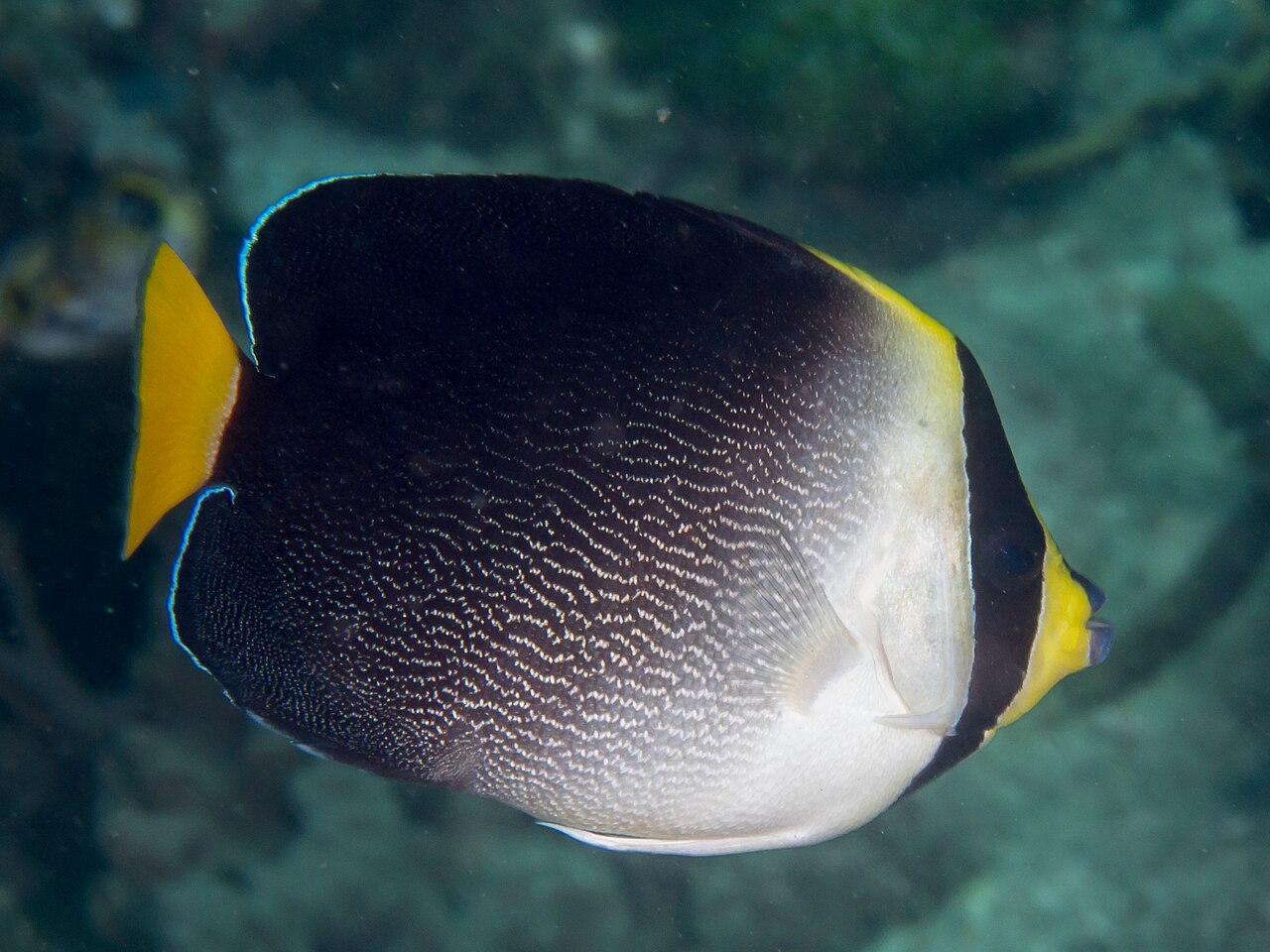
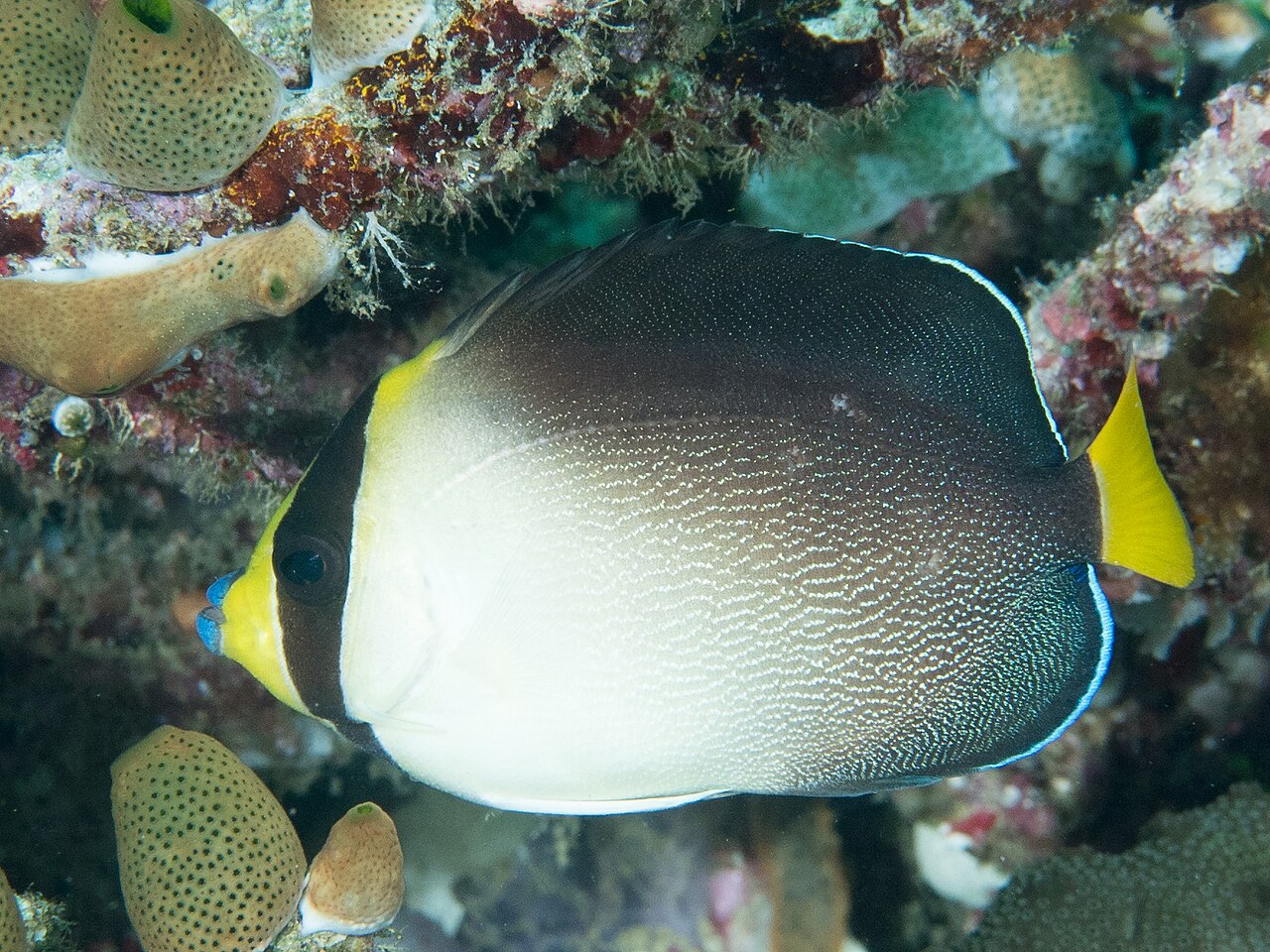
The vermiculated angelfish presents a striking palette that immediately sets it apart among its reef-dwelling relatives. Its face is a vivid yellow, framed by contrasting blue lips, while a bold black vertical stripe cuts directly through the eye. Behind the head, a greyish-cinereous zone transitions smoothly into a much broader expanse of black, which is scattered throughout with a dense pattern of yellow speckles — the very feature that gives the species its common name. The tail fin glows yellow, the dorsal and anal fins are edged in vivid blue, and the pelvic fins stand out as clean white. Structurally, the dorsal fin carries twelve spines alongside seventeen or eighteen soft rays, while the anal fin bears three spines with a matching count of seventeen to eighteen soft rays. At its largest, an individual reaches a total length of eighteen centimetres, roughly seven inches, making it a modestly sized member of the Pomacanthidae family.
Geographic Range & Preferred Environment
The vermiculated angelfish occupies a broad swath of the western Indo-Pacific. Its range stretches from the southern waters of Japan in the north, sweeps southward through the Indonesian archipelago, extends west to the Mentawai Islands, reaches east to the Bird's Head Peninsula on New Guinea, and dips south into northern Australian waters. Within Australia, it is recorded from the Kimberley Region reefs of Western Australia down to Varanus Island, as well as the Ashmore Reef in the Timor Sea. In terms of depth, individuals are encountered anywhere from just one metre below the surface to as deep as thirty metres. The species favours continental-shelf reefs and is notably scarce around oceanic islands. Its preferred microhabitat is silty inner coastal reefs and lagoons where coral growth is particularly lush and dense, suggesting a close ecological tie to the structural complexity such environments provide.
Diet, Social Structure & Reproductive Biology
In the wild, the vermiculated angelfish is typically seen in small groups rather than as a solitary individual. When a threat looms, these groups respond by darting into the surrounding coral for cover, a behaviour that underscores their reliance on the structural complexity of their preferred reef habitats. Their feeding niche is fairly specialised, drawing on sponges, tunicates, and filamentous algae, indicating a role in regulating these particular organisms within the reef ecosystem. Perhaps the most remarkable biological trait shared with all angelfish is protogynous hermaphroditism. Every individual is born and initially lives as a female. Over time, the dominant members of a group undergo a sex change and become functional males. This means that the social hierarchy within a small group directly determines which individuals will transition, linking reproductive strategy to group dynamics in a way that is both elegant and ecologically significant.
Taxonomic History & the Aquarium Trade
The species received its formal scientific description in 1787 from the German naturalist Marcus Elieser Bloch, who designated Japan as the type locality. The specific epithet is a compound of the Greek words mesos, meaning "middle," and leucus, meaning "white." Bloch offered no explicit explanation for this pairing, though it is plausible that it alludes to the way the white front portion of the body blends into the dark rear section across the mid-flanks. For some time, Chaetodontoplus poliourus was lumped together with C. mesoleucus as a single species. That confusion was resolved once researchers noted that poliourus possesses a grey caudal fin with a yellow margin, yellow pelvic fins, and a paler yellow dorsal fin margin — features that clearly distinguish it. Today, the vermiculated angelfish is widely exported for the ornamental aquarium trade and stands as one of the most popular species kept in home aquaria, a testament to its bold colouration and manageable size.
Gallery
Frequently Asked Questions
What is the Vermiculate angelfish (Chaetodontoplus mesoleucus)?
It is a small marine angelfish native to the Indo-West Pacific, first described by Bloch back in 1787. The species sits within the family Pomacanthidae and is recognized by its distinctive vermiculated (worm-like) markings.
Where can I find a Vermiculate angelfish in the wild?
This species ranges across the Indo-West Pacific and typically inhabits shallow waters between 1 and 20 meters depth. It is most often encountered near reef structures in that tropical band.
How large does a Vermiculate angelfish grow?
Adults top out at roughly 18 cm (about 7 inches) in total length, making it one of the smaller members of the angelfish family. Its compact size is one reason it appeals to hobbyists with more modest reef tanks.
What is the taxonomic placement of Chaetodontoplus mesoleucus?
It belongs to the order Acanthuriformes and the family Pomacanthidae, sharing that family with the larger, more colorful reef angelfishes. The genus Chaetodontoplus groups it with a handful of close relatives in the Indo-Pacific.
Why do fans and aquarists care about the Vermiculate angelfish?
Its intricate vermiculate patterning and relatively small adult size make it a visually striking yet manageable addition to a well-established reef system. Because it was described over two centuries ago, it also carries a long history of interest among marine-enthusiast communities.
Spotted an error? Know more?
Reader corrections go straight into our review queue. Suggest an edit · How this site is sourced