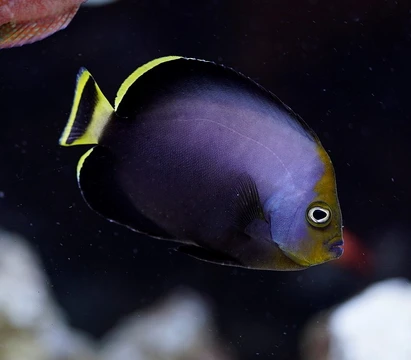
Black-velvet angelfish (Chaetodontoplus melanosoma)
Source-cited species reference: taxonomy from WoRMS, biology from FishBase, occurrence map from GBIF, conservation from IUCN Red List, description from Wikipedia.

Chaetodontoplus melanosoma, the black-velvet angelfish, brown angelfish, or phantom angelfish, is a species of marine ray-finned fish, a marine angelfish belonging to the family Pomacanthidae. It is found in the western Pacific Ocean.
- Scientific name
- Chaetodontoplus melanosoma
- Authority
- (Bleeker, 1853)
- Family
- Pomacanthidae
- Order
- Acanthuriformes
- Maximum length
- 20 cm
- Depth range
- 5–30 m
- Habitat zone
- reef-associated
- Iucn red list
- Least Concern
- Gbif occurrence records
- 57
A Study in Dark Elegance
The black-velvet angelfish earns its common name through a striking visual identity that sets it apart from many of its reef-dwelling relatives. Adults display a predominantly black or deep brown body, giving the impression of a shadow gliding over coral. Breaking that dark canvas, an ochre-toned face and a scattering of yellowish-orange spots across the forehead create an almost painterly contrast. The fins—dorsal, anal, and caudal—carry bright yellow margins that trace their edges like a thin frame. Structurally, the dorsal fin is built from thirteen spines backed by seventeen to nineteen soft rays, while the anal fin carries three spines and seventeen to eighteen soft rays. At its largest, this species reaches a total length of twenty centimetres, roughly eight inches, making it a mid-sized presence on the reef. Its alternative common names—brown angelfish and phantom angelfish—both nod to that same muted, ghostly darkness that defines its adult coloration.
Home in the Western Pacific
The black-velvet angelfish is a creature of the western Pacific, with a range that stretches across a remarkable arc of islands and waters. In central Indonesia, it has been recorded around western Java, Bali, Komodo, Flores, Sulawesi, and the northeastern reaches of Kalimantan. Beyond Indonesian waters, populations appear in Sabah on the Malaysian coast, and across the Philippine archipelago in the Sulu Archipelago, Cebu, and southern Luzon. Rather than lurking in sheltered lagoons, this species favours outer rocky or coastal reefs at depths between roughly five and thirty metres. It is often encountered in areas where strong currents sweep past or where cooler water upwells from below, pointing to a comfort with dynamic, well-flushed environments. Its diet centres on tunicates and sponges, and observers typically find it either in pairs or as a solitary individual. One of its most notable biological traits is hermaphroditism, a reproductive strategy shared by several members of the angelfish family.
A Name Written in 1855
The formal scientific record of this species traces back to 1855, when the Dutch naturalist Pieter Bleeker—a man whose expertise spanned ichthyology, herpetology, and medicine—described the fish under the name Holocanthus melanosoma. Bleeker, who lived from 1819 to 1878, designated the type locality as Lawajong on the island of Solor in Indonesia, anchoring the species to a specific point in the eastern Indonesian archipelago. The specific epithet is a straightforward Greek compound: melanos, meaning "black," paired with soma, meaning "body." Together they capture the most immediately visible feature of the adult fish, its plain, dark coloration. Today the species sits within the family Pomacanthidae, the marine angelfishes, and is classified as a ray-finned fish. Its current placement in the genus Chaetodontoplus reflects the modern taxonomic arrangement, distinct from the older Holocanthus grouping under which Bleeker originally filed it.
Life Behind Glass
For aquarists, the black-velvet angelfish represents both an attraction and a challenge. It is commonly exported for the marine aquarium trade, and its dark, elegant appearance makes it a natural focal point in a display tank. Maintaining it requires a fairly specific set of water parameters: a temperature range of twenty-two to twenty-six degrees Celsius, a pH between 8.1 and 8.4, a carbonate hardness of eight to twelve dKH, and a salinity of 1.020 to 1.025 specific gravity. As it matures to its full eight-inch length, the fish demands a tank commensurate with that size. Its omnivorous nature in captivity means it will readily consume a variety of foods, but keepers must remain vigilant, as the species has been known to pick off invertebrates such as coral from a living reef. Perhaps most frustrating for hobbyists is the species' reluctance to reproduce in captivity; breeding records are exceedingly rare, making captive propagation essentially a long shot rather than a reliable practice.
Spotted an error? Know more?
Reader corrections go straight into our review queue. Suggest an edit · How this site is sourced