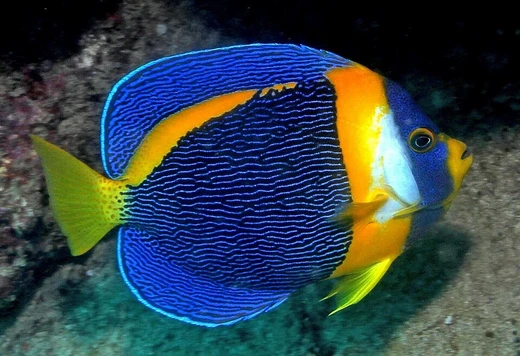
Where Scribbled angelfish has been recorded
GBIF occurrence records for Chaetodontoplus duboulayi, mapped and tabulated by country.

2,610 georeferenced occurrence records with coordinates are published for Chaetodontoplus duboulayi through GBIF, from 4 countries or marine areas. This page maps those records and lists where they come from. Occurrence records reflect where people have looked as well as where the species lives, so well-surveyed coastlines are over-represented.
- Georeferenced records
- 2,610
- Countries / areas
- 4
- Mapped locations
- 200
- Records sampled for the map
- 2,610
- Inland records omitted
- 19
- Gbif taxonkey
- 2396584
A Record-Breaking Debut and Enduring Popularity
In 1988, city planners set out to transform the Osaka Bay shoreline, drawing inspiration from the success of aquariums and commercial complexes abroad. The result was a facility that the general public itself named—the Osaka Aquarium Kaiyukan. When its doors opened in 1990, it held the title of the world's largest public aquarium. The crowds that arrived were staggering: one million visitors within just forty days, two million by the hundred-and-first day, and a full-year total of 5.6 million that shattered the national record previously held by Tokyo Sea Life Park, establishing the fastest-growing attendance in Japanese history. That momentum never waned. By February 2008, roughly eighteen years in, the aquarium welcomed its fiftieth millionth guest, the quickest such milestone among Japanese aquariums, with about sixty percent of those visitors being returning patrons. The sixty-five million mark fell in 2014, overtaking Toba Aquarium, and seventy-five million arrived by 2017, cementing its status as Japan's most-visited aquarium. In 2024, a special ceremony marked the eighty-five millionth visitor, a testament to three decades of sustained appeal.
The Pacific Ocean Tank and Its Legendary Residents
The crown jewel of the Kaiyukan is undeniably its Pacific Ocean tank, a vast enclosure stretching thirty-four metres in length and nine metres in depth, holding a staggering 5,400 cubic metres of seawater. Within those walls swim Indian mackerel, Pacific bluefin tuna, reef manta rays, scalloped hammerhead sharks, and two whale sharks—making the Kaiyukan only the second facility in the world, after Okinawa's Ocean Expo Aquarium, to house these gentle giants. The aquarium's pioneering work with large pelagic species continued in 1994 when it became the second institution globally to keep a manta ray in captivity, followed in 1995 by one of the very few places to maintain an ocean sunfish. Ironically, it is the sunfish rather than the whale sharks that draws the most attention from visitors; its comically oversized body and odd proportions make it a perennial favourite, reportedly outdrawing the much larger sharks in popularity. The tank's sheer scale and the diversity of its inhabitants have made it a defining image of the aquarium since its 1990 debut.
A Journey Around the Ring of Fire
Beyond its headline Pacific Ocean exhibit, the Kaiyukan presents a sweeping tour of marine and freshwater habitats across the Pacific's Ring of Fire. In total, sixteen main exhibits house twenty-seven tanks containing 10,941 tonnes of water. Visitors ascend an escalator to the eighth floor, passing through the Aqua Gate—a tunnel tank teeming with tropical fish species added in 1998—before entering the Japan Forest, a recreated woodland home to Asian small-clawed otters, Japanese giant salamanders, and black-crowned night herons. The walk-through displays then carry guests from the cold waters of the Aleutian Islands, where tufted puffins nest, to the kelp-rich Monterey Bay with its California sea lions, through the Gulf of Panama's coatis and porcupinefish, and into the Ecuador Rain Forest where arapaima share space with capybaras and green iguanas. Further stops include Antarctic penguin colonies, Tasman Sea dolphins, Great Barrier Reef surgeonfish, the Seto Inland Sea's octopuses and spiny lobsters, Chilean anchovies, Cook Strait sea turtles, and the abyssal Japan Deeps with its spider crabs and ghostsharks, capped by a dedicated jellyfish gallery.
Science, Conservation, and Hands-On Wonder
While the Kaiyukan dazzles tourists, its scientific programme is equally ambitious. The aquarium has concentrated its research on elasmobranchs—sharks and rays—and by 2016 had successfully maintained or bred forty-seven shark species, thirty-seven ray species, and one ghost shark, totalling eighty-five species in captivity. Its whale shark tagging programme, conducted across eight surveys, has revealed that these massive fish can travel as far as the Philippines and plunge to depths of 1,500 metres. The facility has also been breeding and studying giant devil rays since the early 2000s. For visitors, the 2013 opening of the New Interactive Area added a tactile dimension: in the Maldives Zone, guests can directly touch stingrays and small sharks such as brownbanded bamboo sharks and coral catsharks, while the Arctic Zone showcases ringed seals and the Falkland Islands Zone features southern rockhopper penguins. The museum shop was refreshed in February 2020 to coincide with the thirtieth anniversary, and the ambient soundtrack—drawn from the Acoustic Cafe Underwater Walk album—shifts with the time of day, adding a subtle sensory layer to the experience.
Frequently Asked Questions
How many georeferenced distribution records exist for the Scribbled angelfish?
The GBIF portal currently lists 2,610 coordinate-tagged occurrence records for Chaetodontoplus duboulayi. These points are drawn from four countries or marine areas and are visualized across 200 mapped locations.
In how many countries or marine areas has the Scribbled angelfish been documented?
Published occurrence data places this species in four distinct countries or marine areas. The full set of 2,610 records is tabulated by country on the distribution page.
Why do some coastlines show far more Scribbled angelfish records than others?
The map shows where observers have actually searched, not a complete picture of the species' true range, so heavily studied shorelines accumulate more points. Less-explored waters are therefore under-represented in the dataset.
Were any inland records found for the Scribbled angelfish in the database?
Nineteen inland points appeared in the raw GBIF data but were dropped from the distribution map, since this is a strictly marine reef species and those entries are almost certainly geolocation errors or misidentifications.
Where can I access the full Scribbled angelfish occurrence dataset?
All 2,610 georeferenced records are openly available through the GBIF portal under taxon key 2396584. The fan-encyclopedia page simply re-maps and tabulates those same records by country for a quicker visual reference.
Related in Scribbled angelfish
Links follow this subject's own source article.
Elsewhere in Scribbled angelfish
Spotted an error? Know more?
Reader corrections go straight into our review queue. Suggest an edit · How this site is sourced