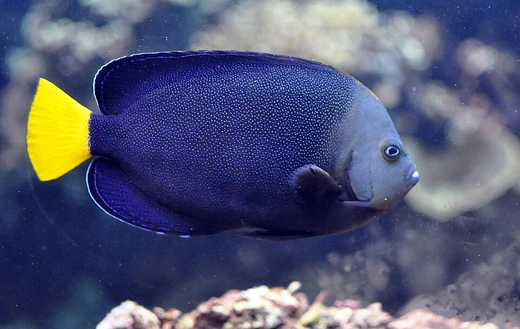
Bluespotted angelfish (Chaetodontoplus caeruleopunctatus)
Source-cited species reference: taxonomy from WoRMS, biology from FishBase, conservation from IUCN Red List, description from Wikipedia.

Chaetodontoplus caeruleopunctatus, the bluespotted angelfish, is a species of marine ray-finned fish, a marine angelfish belonging to the family Pomacanthidae. It is from the Western-Pacific Ocean.
- Scientific name
- Chaetodontoplus caeruleopunctatus
- Authority
- Yasuda & Tominaga, 1976
- Family
- Pomacanthidae
- Order
- Acanthuriformes
- Maximum length
- 20 cm
- Depth range
- 15–40 m
- Habitat zone
- reef-associated
- Iucn red list
- Data Deficient
Physical Appearance & Morphology
The bluespotted angelfish presents a striking visual contrast between its head and the rest of its body. The front portion, encompassing the head, carries a pale orange-brown tone, while the remainder shifts to a dusky brown or bluish-black canvas densely peppered with small blue spots. The dorsal and anal fins are dark brown edged in blue, and the caudal fin stands out in vivid yellow, giving the fish a bold, multi-toned silhouette. Juveniles look markedly different from adults: they are dark brown to pearl black, with a yellow stripe running along the forward part of the back, another on the head and around the dorsal fin, and a tail that blends yellow and white. In terms of fin architecture, the dorsal fin carries 13 spines and 17 soft rays, while the anal fin has 3 spines and 17 soft rays. The species reaches a maximum total length of 20 centimetres, roughly 7.9 inches, making it a modestly sized member of the angelfish family.
Taxonomic History & Systematic Position
The formal scientific description of this species dates to 1976, when Japanese ichthyologists Fujio Yasuda and Yoshiaki Tominaga named it, designating the Philippines as the type locality. Despite being recognised for nearly five decades, the species' exact position within the angelfish family remains unresolved. Its closest relatives have not yet been identified with confidence, leaving its systematic placement in a state of genuine uncertainty. At one point, researchers even proposed that the bluespotted angelfish might not be a true species at all but rather a hybrid between other angelfish. However, this hypothesis has been largely set aside because specimens collected over time show a consistent appearance, and the numbers of individuals gathered are sufficient to argue for a valid, distinct species. This ongoing taxonomic ambiguity makes the bluespotted angelfish a fascinating case study in how even well-documented marine organisms can resist neat classification.
Habitat, Diet & Reproductive Biology
In the wild, this angelfish inhabits depths ranging from 14 to 40 metres, favouring rocky areas where sponges and algae grow abundantly. Its diet reflects this environment directly, consisting of sponges and tunicates—organisms that are relatively difficult for other fish to process. The species is restricted to the Western Pacific and, more specifically, is endemic to the Philippines, where it is rarely encountered by divers or researchers. Like all members of the angelfish family, the bluespotted angelfish is a protogynous hermaphrodite. Every individual is born female, and the dominant fish in a group will later transition to male. This reproductive strategy means a single population contains both sexes at any given time, with social hierarchy determining which individuals undergo the sex change. The combination of a specialised diet, a narrow geographic range, and this complex reproductive biology makes the species ecologically distinctive.
Rarity in the Wild vs. Aquarium Presence
One of the most intriguing paradoxes surrounding the bluespotted angelfish is the gap between its scarcity in the ocean and its relative commonality in the aquarium trade. In the wild, it is rarely recorded, and its range is confined entirely to Philippine waters, making it a genuinely endemic and elusive species. Yet in the commercial aquarium market, it is quite frequently available to hobbyists. Furthermore, the species has been successfully bred in captivity, meaning that many specimens in home tanks are not wild-caught at all. This contrast raises interesting questions about the pressures the wild population faces, since a fish so seldom seen by marine biologists in its native habitat can still be a regular sight in glass tanks around the world. The ability to breed in captivity is particularly significant, as it offers a sustainable alternative to harvesting from the already limited wild populations in the Philippines.
Frequently Asked Questions
Who is Bluespotted angelfish (Chaetodontoplus caeruleopunctatus)?
It is a small marine angelfish in the family Pomacanthidae, first formally described by Yasuda and Tominaga in 1976. The species sits within the order Acanthuriformes and is native to the Western Pacific Ocean.
What are Bluespotted angelfish (Chaetodontoplus caeruleopunctatus)'s powers/role?
As a mid-depth reef dweller, it typically patrols the 15-to-40-meter zone, grazing on small invertebrates and algae to help regulate those populations. Its modest maximum size of roughly 20 cm places it as a mid-sized player in the angelfish community rather than a dominant predator.
Why is Bluespotted angelfish (Chaetodontoplus caeruleopunctatus) important?
It helps maintain mid-depth reef balance by keeping small invertebrate populations in check through its feeding habits. Its presence also acts as a useful indicator that the surrounding reef ecosystem is still functioning well.
Where does Bluespotted angelfish (Chaetodontoplus caeruleopunctatus) live?
This strictly marine, ray-finned species is found around coral reef structures in the Western Pacific Ocean, generally between 15 and 40 meters deep. There are no known freshwater or brackish-water populations of the species.
Spotted an error? Know more?
Reader corrections go straight into our review queue. Suggest an edit · How this site is sourced