
Needle spined urchin (Centrostephanus longispinus)
Source-cited species reference: taxonomy from WoRMS, biology from SeaLifeBase, occurrence map from GBIF, description from Wikipedia.
Centrostephanus longispinus, the hatpin urchin, is a species of sea urchin in the family Diadematidae. There are two subspecies, Centrostephanus l. longispinus, found in the eastern Atlantic and Mediterranean Sea and Centrostephanus l. rubricingulus, found in the western Atlantic.
- Scientific name
- Centrostephanus longispinus
- Authority
- (Philippi, 1845)
- Family
- Diadematidae
- Order
- Diadematoida
- Depth range
- 40–363 m
- Habitat zone
- benthic
- Gbif occurrence records
- 1,629
Classification (WoRMS)
Full classification as recorded by WoRMS: Kingdom: Animalia · Phylum: Echinodermata · Class: Echinoidea · Order: Diadematoida · Family: Diadematidae · Genus: Centrostephanus.
Accepted name: Centrostephanus longispinus · Authority: (Philippi, 1845) · Taxonomic status: accepted · AphiaID: 124331.
Synonyms and superseded combinations recorded for this taxon: Centroctephanus longispinus; Centrostephanus longispina (Philippi, 1845); Centrostephanus longispinosus; Cidaris (Diadema) longispina Philippi, 1845; Diadema europaeum L. Agassiz in L. Agassiz & Desor, 1846; Diadema longispina (Philippi, 1845).
Source: World Register of Marine Species (WoRMS) — https://www.marinespecies.org/aphia.php?p=taxdetails&id=124331 (CC BY 4.0). Accessed 2026-09-23.
Biology and life history (SeaLifeBase)
Measured values published by SeaLifeBase for Centrostephanus longispinus. Only fields the database actually holds for this species are shown; these are database values, not aquarium guidance.
Depth range: 40–363 m · Habitat zone: benthic.
Source: SeaLifeBase species summary (SpecCode 49967) — https://www.sealifebase.se/summary/Centrostephanus-longispinus.html (CC BY-NC 3.0 — non-commercial use only). Accessed 2026-09-23.
Distribution and occurrence records (GBIF)
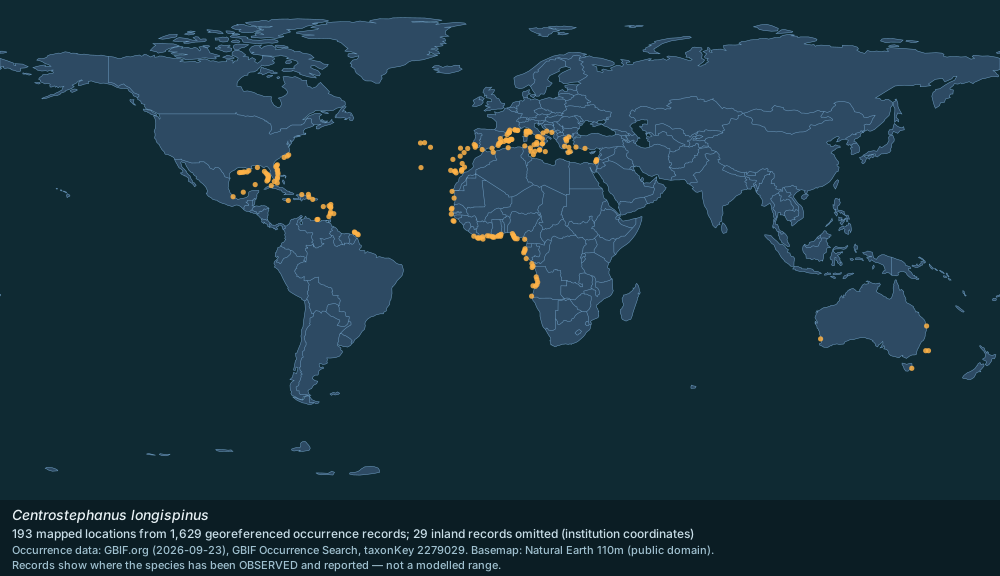
1,629 georeferenced occurrence records for Centrostephanus longispinus are published through GBIF from 44 countries or marine areas. The map above plots 193 distinct locations from a sample of 1,629 records, omitting 29 inland records that carry an institution's coordinates rather than a collection site; it shows where the species has been observed and reported, not a modelled range.
Most records by country or area: France (991); Australia (160); Spain (111); Italy (78); United States of America (62).
The full country table, WoRMS marine regions and the sampling notes are on this species' Distribution page.
Source: GBIF Occurrence Search (taxonKey 2279029) — https://www.gbif.org/occurrence/search?taxon_key=2279029&has_coordinate=true (records CC0 / CC BY); WoRMS distribution records (MarineRegions) — https://www.marinespecies.org/aphia.php?p=taxdetails&id=124331 (CC BY 4.0); Natural Earth 110m basemap — https://www.naturalearthdata.com/ (public domain). Accessed 2026-09-23.
Description and natural history (Wikipedia)
In 1940, Mortenson believed that C. longispinus and C. rubicingulus were closely related species but that they could be distinguished because C. longispinus has smaller and fewer secondary interambulacral tubercles. In 1975, Fell re-examined the genus but was unable to find sufficient differences to justify separating them into two species. He suggested that C. rubicingulus should be considered a sub-species of C. longispinus. Nor could he reliably distinguish the pair from C. besnardi except by the location from which they had been collected (C. besnardi is from the eastern Pacific). He was also unable to distinguish between juveniles of C. coronatus and juveniles of the other species.
Centrostephanus longispinus has a small central test and spines up to 30 cm in length. These are toxic and can cause a painful sting. The spines are of varying length and are mobile and used for locomotion. There are a number of club-shaped spines on the oral (lower) surface, a characteristic that this species shares with C. besnardi and C. coronatus but not other members of the genus. These spines are reddish brown and are tipped with purple or pink pigment. The subspecies C. l. longispinus has spines banded in purple on a pale green, buff or whitish background. Juvenile C. l. rubricingulus have reddish-brown spines on a pale background while adults have either spines banded in brown on pale brown or uniformly dark-colored spines. It has been shown that C. longispinus has chromatophores (pigment bearing structures in cells) which are sensitive to light. By changing their shape, these alter the color of the animal, which is changed from a night-time black to a daytime greyish brown.
Centrostephanus longispinus occurs on the continental shelf on either side of the Atlantic Ocean. Its range extends from the Mediterranean Sea and North African coast to the Caribbean Sea and the Gulf of Mexico. The depth range is between 40 and 210 m. Off Florida this urchin is usually found on algae or on broken coral substrates, particularly the rubble remains of dead ivory bush coral (Oculina varicosa). It forms part of a species-rich community which includes other sea urchins, mollusks, polychaete worms, crabs and encrusting organisms. These sea urchins are not usually found on living reefs, perhaps because there is seldom macro-algae growing there or because predatory fish hiding among the coral heads consume the juvenile sea urchins.
Examination of the contents of this urchin's stomach have shown that C. longispinus largely feeds on several species of red algae. At times of year when this is not available it probably eats small invertebrate prey. In the laboratory they will feed on the seagrass Thalassia testudinum and may attack the starfish Narcissia trigonaria if hungry enough.
Source: Wikipedia: Centrostephanus longispinus — https://en.wikipedia.org/wiki/Centrostephanus_longispinus (CC BY-SA 4.0). Accessed 2026-09-23.
Gallery
Related in Needle spined urchin
Links follow this subject's own source article.
Elsewhere in Needle spined urchin
Spotted an error? Know more?
Reader corrections go straight into our review queue. Suggest an edit · How this site is sourced