
Crowned sea urchin (Centrostephanus coronatus)
Source-cited species reference: taxonomy from WoRMS, biology from SeaLifeBase, occurrence map from GBIF, description from Wikipedia.
Centrostephanus coronatus, also known as crowned sea urchin, is a species of sea urchin in the family Diadematidae. It was first described to science by Yale zoology Professor Addison Emery Verrill in 1867.
- Scientific name
- Centrostephanus coronatus
- Authority
- (Verrill, 1867)
- Family
- Diadematidae
- Order
- Diadematoida
- Maximum length
- 17.5 cm
- Depth range
- 1–125 m
- Habitat zone
- benthic
- Gbif occurrence records
- 238,667
Classification (WoRMS)
Full classification as recorded by WoRMS: Kingdom: Animalia · Phylum: Echinodermata · Class: Echinoidea · Order: Diadematoida · Family: Diadematidae · Genus: Centrostephanus.
Accepted name: Centrostephanus coronatus · Authority: (Verrill, 1867) · Taxonomic status: accepted · AphiaID: 513165.
Synonyms and superseded combinations recorded for this taxon: Echinodiadema coronata Verrill, 1867.
Source: World Register of Marine Species (WoRMS) — https://www.marinespecies.org/aphia.php?p=taxdetails&id=513165 (CC BY 4.0). Accessed 2026-09-23.
Biology and life history (SeaLifeBase)
Measured values published by SeaLifeBase for Centrostephanus coronatus. Only fields the database actually holds for this species are shown; these are database values, not aquarium guidance.
Maximum length: 17.5 cm · Depth range: 1–125 m · Habitat zone: benthic · Vulnerability index: 10 of 100.
SeaLifeBase notes: This is an epibenthic species found on rocky bottoms in subtidal areas at depths of 1 to 125 m (Ref. 83942). It is known to forage at night (Ref. 865).
Source: SeaLifeBase species summary (SpecCode 49968) — https://www.sealifebase.se/summary/Centrostephanus-coronatus.html (CC BY-NC 3.0 — non-commercial use only). Accessed 2026-09-23.
Distribution and occurrence records (GBIF)
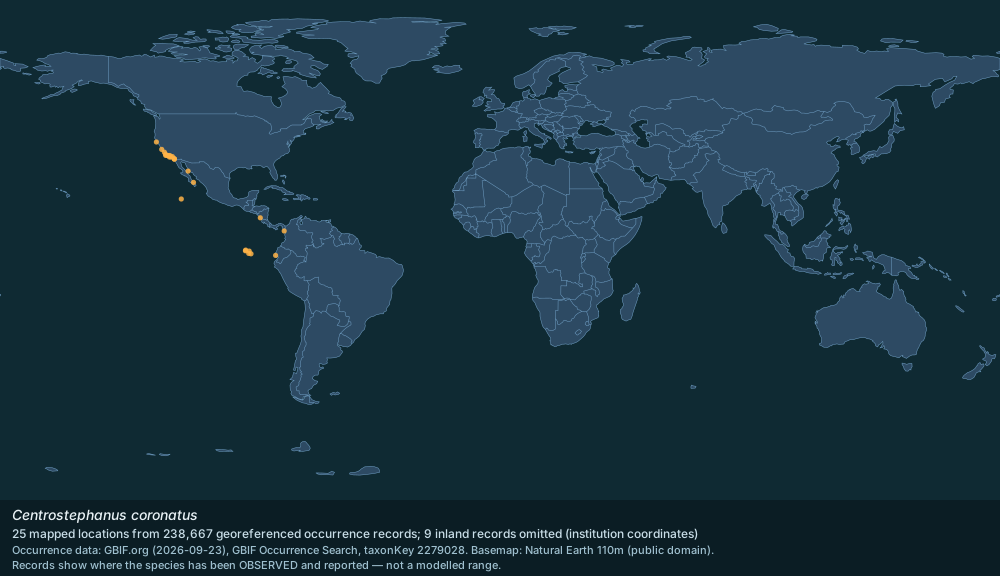
238,667 georeferenced occurrence records for Centrostephanus coronatus are published through GBIF from 10 countries or marine areas. The map above plots 25 distinct locations from a sample of 3,000 records, omitting 9 inland records that carry an institution's coordinates rather than a collection site; it shows where the species has been observed and reported, not a modelled range.
Most records by country or area: United States of America (237,025); Ecuador (972); Mexico (494); Colombia (165); Chile (3).
The full country table, WoRMS marine regions and the sampling notes are on this species' Distribution page.
Source: GBIF Occurrence Search (taxonKey 2279028) — https://www.gbif.org/occurrence/search?taxon_key=2279028&has_coordinate=true (records CC0 / CC BY); WoRMS distribution records (MarineRegions) — https://www.marinespecies.org/aphia.php?p=taxdetails&id=513165 (CC BY 4.0); Natural Earth 110m basemap — https://www.naturalearthdata.com/ (public domain). Accessed 2026-09-23.
Description and natural history (Wikipedia)
The adults are all black, with some blue at the base of the spines. Juveniles have gray bands on their spines. The test is 32 mm to 63 mm in diameter. The spines are thin, hollow, brittle, and very sharp. The longest spines can be 125 mm long. Five clusters of smaller spines surround the mouth on the underside of the test.
Crowned sea urchins are found in the eastern Pacific Ocean from Monterey Bay, California to Peru, including the Gulf of California. The species has expanded its range north in recent years. They are also found in the Galapagos Islands. They live from the low-tide line to 125 m deep. These are bottom dwellers, favoring rocky substrates and reefs.
This urchin seeks holes and crevices in the bottom when resting. The rock protects them from predators on all sides except the opening of the hole, and the spines guard that. When an individual finds an especially good fitting hole, it can brace its spines against the sides of the rock to resist being pulled out of its niche.
Crowned sea urchins are nocturnal, foraging within a few meters of their shelters, to which they return at dawn. They are mostly carnivorous, feeding on sponges, tunicates, bryozoans, and algae.
Crowned sea urchins are gonochoric, which is to say that there are two sexes, and each individual is either male or female. Spawning takes place on a monthly cycle that may be tied to tidal rhythms.
Source: Wikipedia: Centrostephanus coronatus — https://en.wikipedia.org/wiki/Centrostephanus_coronatus (CC BY-SA 4.0). Accessed 2026-09-23.
Gallery
Related in Crowned sea urchin
Links follow this subject's own source article.
Elsewhere in Crowned sea urchin
Spotted an error? Know more?
Reader corrections go straight into our review queue. Suggest an edit · How this site is sourced