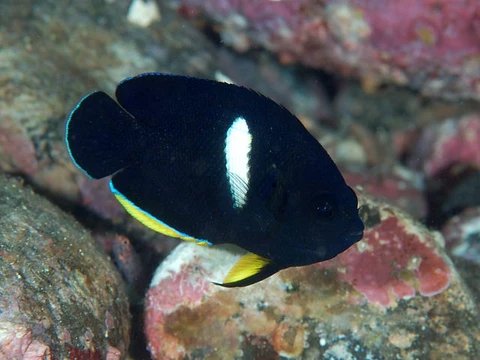
Where Keyhole angelfish has been recorded
GBIF occurrence records for Centropyge tibicen, mapped and tabulated by country.

1,878 georeferenced occurrence records with coordinates are published for Centropyge tibicen through GBIF, from 14 countries or marine areas. This page maps those records and lists where they come from. Occurrence records reflect where people have looked as well as where the species lives, so well-surveyed coastlines are over-represented.
- Georeferenced records
- 1,878
- Countries / areas
- 14
- Mapped locations
- 180
- Records sampled for the map
- 1,878
- Inland records omitted
- 29
- Gbif taxonkey
- 2396505
The Multilingual Tapestry of Capital Names
The etymologies of national capitals reveal an extraordinary spread of linguistic heritage. Kabul's name may trace back to the Kamboja tribe or to a Sanskrit word meaning "hump-backed" or "crooked." Algiers derives from an Arabic phrase referring to islands, specifically the islands of a tribe called Bani Mazghanna. Luanda's name comes from Bantu roots, where a plural prefix combined with a word meaning "value" or "traded" to describe a sandbank. Buenos Aires is Spanish for "Fair Winds," while Andorra La Vella simply means "Andorra the Old" in Catalan. Yerevan's origin, according to early Armenian chroniclers, connects to a word Noah supposedly exclaimed. Even within a single country like Albania, Tirana might derive from Greek, Latin, or local dialectal expressions, while Durrës carries Latin and Greek roots meaning "bad spine" or "difficult ridge." This diversity shows how capital cities accumulate names across empires, trade routes, and indigenous traditions over centuries.
Legends and Ancient Origins
Several capital city names carry mythological or legendary weight in their origins. According to early Christian Armenian chroniclers, Yerevan's name stems from an exclamation attributed to Noah himself—after the ark rested on Mount Ararat and floodwaters receded, he allegedly looked toward that direction and cried out a word meaning "it appeared!" In Afghanistan, Kandahar has been linked to Iskanderiya, the Pashto rendering of Alexandria, suggesting a connection to Alexander the Great's legacy. The ancient word Gandh, derived from Gandhar, meant a sweet or pleasant smell, and the city is noted as a source of fine grapes, pomegranates, apricots, and melons. In Albania, Tirana's name may connect to a fortress called Tirkan on the slopes of Dajti mountain, whose ruins date to the first century before Christ and whose tower was referenced by the Byzantine historian Prokop in the sixth century. These legendary and ancient threads give capital cities a depth that extends far beyond mere administrative function.
Geography and Commerce in Naming
Many capital city names encode practical geographic or economic realities. Algiers, from the Arabic al-ǧazāʼir meaning "the islands," refers to four islands that sat off the coast until they merged with the mainland in 1525. Luanda's etymology is even more specific: the Bantu prefix lu, a plural form common in coastal and wetland place names, combined with ndandu meaning "value" or "traded," alluding to small shells collected on the island that served as currency in the ancient Kingdom of Congo and across much of the West African coast. Buenos Aires was originally the much longer "City of the Most Holy Trinity and Port of Saint Mary of the Fair Winds," named after a church in Cagliari, Sardinia, before the shorter form became standard in the seventeenth century. Even the Guarani word behind Paraná, meaning "wide river," caused confusion with Tupi terminology for water bodies, leading some to mistakenly interpret it as "sea." These names preserve the physical and commercial landscapes that shaped settlement.
The Puzzle of Uncertain Etymologies
A striking feature of capital city etymologies is how often scholars remain divided. Kabul presents at least two competing theories: one linking it to the Kamboja tribe, another to a Sanskrit word for "hump-backed" or "crooked." Kandahar offers no fewer than four proposed origins, from a Pashto form of Alexandria to a combination of Proto-Indo-European words meaning "wall" and "mountain" or "stone," suggesting a stone-walled fortress. Tirana's name has been attributed to a Greek or Latin word, to a local fortress, to the Greek word for dairy, or to a dialectal expression for mountain-dwelling people who "fell" into the lowlands. Shkodër's origins remain what the source calls "shrouded in mystery," with scholars debating whether the root is Latin or Illyrian, while its name appears in Greek, Serbian, Croatian, Montenegrin, Macedonian, and Turkish variants. This persistent uncertainty reminds us that place names are living artifacts, layered with centuries of reinterpretation.
Frequently Asked Questions
What is Where Keyhole angelfish has been recorded?
It is a distribution page that maps and tabulates all publicly available georeferenced sightings of Centropyge tibicen, pulling from 14 countries or marine areas. The page currently displays 180 mapped locations drawn from 1,878 coordinate-tagged occurrence records.
How many records does Where Keyhole angelfish has been recorded include?
The page works with 1,878 georeferenced occurrence records, all sampled for the map. Twenty-nine inland records were excluded because they fall outside the species' marine habitat.
Why might Where Keyhole angelfish has been recorded over-represent certain coastlines?
Occurrence data reflects not just where the fish actually lives but also where researchers and divers have been most active. Heavily surveyed shorelines therefore show up more often in the map, skewing the visual distribution.
Where does Where Keyhole angelfish has been recorded source its data?
All coordinates and country-level breakdowns come from the GBIF biodiversity database under taxon key 2396505. The page simply reorganizes those published records into a browsable map and table.
Why is Where Keyhole angelfish has been recorded important for Keyhole angelfish fans?
It gives enthusiasts a concrete, citable picture of the species' known range across 14 marine regions, helping them understand geographic context before discussing care, behavior, or breeding in community forums. It also makes clear which parts of the Pacific remain under-sampled.
Related in Keyhole angelfish
Links follow this subject's own source article.
Elsewhere in Keyhole angelfish
Spotted an error? Know more?
Reader corrections go straight into our review queue. Suggest an edit · How this site is sourced