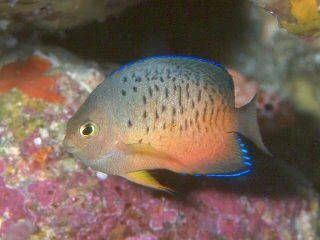
Rusty angelfish (Centropyge ferrugata)
Source-cited species reference: taxonomy from WoRMS, biology from FishBase, occurrence map from GBIF, conservation from IUCN Red List, description from Wikipedia.

Centropyge ferrugata, the rusty angelfish, is a species of marine ray-finned fish, a marine angelfish belonging to the family Pomacanthidae. The rusty angelfish comes from the Western Pacific Ocean and sometimes makes its way into the aquarium trade.
- Scientific name
- Centropyge ferrugata
- Authority
- Randall & Burgess, 1972
- Family
- Pomacanthidae
- Order
- Acanthuriformes
- Maximum length
- 10 cm
- Depth range
- 6–30 m
- Habitat zone
- reef-associated
- Iucn red list
- Least Concern
- Gbif occurrence records
- 72
A Tangled Taxonomic Tree
The Rusty angelfish belongs to Centropyge, a genus of small marine angelfish in the family Pomacanthidae that inhabits reef systems across the Atlantic, Indian, and Pacific Oceans. No member of this genus grows beyond fifteen centimetres in length. Despite a long history of study, the genus remains taxonomically messy. Centropyge is classified as paraphyletic because two other lineages—Genicanthus and the polyphyletic group Apolemichthys—are nested within it rather than branching off separately. The genus is divided into three subgenera and several species complexes. The subgenus Xiphypops contains the C. acanthops complex, which includes C. acanthops, C. argi, C. aurantonota, and C. resplendens. Paracentropyge groups C. boylei, C. multifasciata, and C. venusta. Both of these subgenera are monophyletic and have received support for elevation to full genus rank. Everything else, including C. ferrugata, falls under the nominate subgenus Centropyge, which is not monophyletic. Researchers continue to disagree on how to delineate species complexes within this group, as different studies apply different definitions of what constitutes a complex.
A Sex That Can Go Both Ways
Like all marine angelfish, members of Centropyge are protogynous hermaphrodites: every individual begins its adult life as a female, and the dominant member of a social group can transition to a male role within a matter of days. Distinguishing the sexes externally is notoriously difficult, though females tend to be slightly shorter and display more rounded fin shapes. What sets C. ferrugata apart from its relatives is a remarkable biological flexibility. In most protogynous species, once a female becomes a male, the change is essentially permanent. If social circumstances shift and the individual's rank drops, a reversal back to female is theoretically possible, but it demands a considerably longer period of physiological adjustment. For the Rusty angelfish specifically, however, this reversal is not merely theoretical—males of C. ferrugata are documented as being capable of changing back into females. This makes the species one of the few, if not the only, protogynous fish in which the sex-change pathway operates in both directions with relative ease, underscoring just how tightly linked reproductive role and social position are in this small reef dweller.
Harem Life on the Reef
In their natural habitat, Centropyge species organize themselves into haremic social groups, each centred on a single dominant male surrounded by multiple females. This structure is intimately tied to the protogynous hermaphroditism described above: the top-ranking individual assumes the male role, and should that individual be removed or lose its status, another female in the group can step up and undergo the sex change, again within days. The Rusty angelfish, like all its congeners, is a small reef fish not exceeding fifteen centimetres in total length. In the wild, these fish feed primarily on algae, sponges, and small benthic invertebrates found on and around the reef structure. Their range spans the Atlantic, Indian, and Pacific Oceans, a distribution that reflects the widespread presence of coral reef habitats. The combination of a compact body size, a flexible reproductive strategy, and a tightly structured social hierarchy allows these dwarf angelfish to occupy stable micro-territories within the complex three-dimensional architecture of living reefs, where they forage, defend, and reproduce in close-knit family units.
The Shy Newcomer in a Reef Tank
For aquarists, Centropyge species are best suited to matured reef tanks, where high water quality and abundant well-cured live rock replicate the conditions of a natural reef. In the wild these fish graze on algae, sponges, and small benthic invertebrates, and a generous supply of live rock in captivity helps supplement their diet in a way that mirrors their natural foraging. This is not merely a nutritional concern; underfed dwarf angelfish are known to nip at corals and sessile invertebrates, which can cause significant damage in a display tank. Behaviourally, newly introduced Centropyge are often quite shy, spending their first days or weeks hiding among corals, caves, and crevices. Over time, once they have established a territory and feel secure among appropriate tank mates in a sufficiently sized system, they become noticeably more outgoing and active. Patience and proper husbandry are therefore essential: the same fish that retreats into a crevice on day one may be confidently patrolling its patch of reef within a few weeks, provided its environmental and dietary needs are met.
Frequently Asked Questions
Who is Rusty angelfish (Centropyge ferrugata)?
The rusty angelfish is a small marine angelfish in the family Pomacanthidae, first described by Randall and Burgess back in 1972. It belongs to the order Acanthuriformes and is native to the Western Pacific Ocean.
What are Rusty angelfish (Centropyge ferrugata)'s powers/role?
As a reef-dwelling angelfish, it typically forages among coral structures between roughly 6 and 30 metres deep, helping to control algae and invertebrate populations on the reef. Its compact 10-cm body lets it slip into crevices that larger fish can't reach.
Why is Rusty angelfish (Centropyge ferrugata) important?
It adds a distinct rusty colouration to the already diverse Centropyge genus, giving reef ecologists and hobbyists another data point for studying small angelfish behaviour. Its limited aquarium-trade presence also makes each captive specimen a useful subject for husbandry research.
Where can you find Rusty angelfish (Centropyge ferrugata) in the wild?
You'll encounter it on coral reefs throughout the Western Pacific Ocean, generally hovering in the 6-to-30-metre depth band. Occurrence records are tracked through global biodiversity databases such as GBIF, confirming its range across that broad tropical region.
Spotted an error? Know more?
Reader corrections go straight into our review queue. Suggest an edit · How this site is sourced