
Carcharhinus tjutjot
Source-cited species reference: taxonomy from WoRMS, biology from FishBase, occurrence map from GBIF, conservation from IUCN Red List, description from Wikipedia.
The Indonesian whaler shark (Carcharhinus tjutjot) is a species of requiem shark belonging to the family Carcharhinidae. Until recently, it was thought to be a junior synonym of the whitecheek shark (C. dussumieri). The Indonesian whaler shark, along with the family Carcharhinidae, is a key economic group in global fisheries including commercial and small-scale fisheries within the Indo-Pacific region. Common spawning and nursery areas overlap with commercial fishing grounds and it is often caught as bycatch which has caused it to be listed as a vulnerable species.
- Scientific name
- Carcharhinus tjutjot
- Authority
- (Bleeker, 1852)
- Family
- Carcharhinidae
- Order
- Carcharhiniformes
- Maximum length
- 93.69999694824219 cm
- Habitat zone
- reef-associated
- Iucn red list
- Vulnerable
- Gbif occurrence records
- 22
Classification (WoRMS)
Full classification as recorded by WoRMS: Kingdom: Animalia · Phylum: Chordata · Class: Elasmobranchii · Order: Carcharhiniformes · Family: Carcharhinidae · Genus: Carcharhinus.
Accepted name: Carcharhinus tjutjot · Authority: (Bleeker, 1852) · Taxonomic status: accepted · AphiaID: 217348.
Synonyms and superseded combinations recorded for this taxon: Carcharias javanicus Bleeker, 1852; Carcharias tjutjot Bleeker, 1852.
Source: World Register of Marine Species (WoRMS) — https://www.marinespecies.org/aphia.php?p=taxdetails&id=217348 (CC BY 4.0). Accessed 2026-09-23.
Biology and life history (FishBase)
Measured values published by FishBase for Carcharhinus tjutjot. Only fields the database actually holds for this species are shown; these are database values, not aquarium guidance.
Maximum length: 93.69999694824219 cm · Habitat zone: reef-associated · Body shape: fusiform / normal · Vulnerability index: 57.5 of 100 · Aquarium trade: never/rarely.
FishBase notes: An inshore species, likely to be found in less than 100 m depth (Ref. 89954). One female specimen contained 2 late-term embryos measuring 27.8 and 28.5 cm TL. Probable size at birth is between 34.0-38.0 cm TL (Ref. 89954).
Source: FishBase species summary (SpecCode 67456) — https://www.fishbase.se/summary/Carcharhinus-tjutjot.html (CC BY-NC 3.0 — non-commercial use only). Accessed 2026-09-23.
Distribution and occurrence records (GBIF)
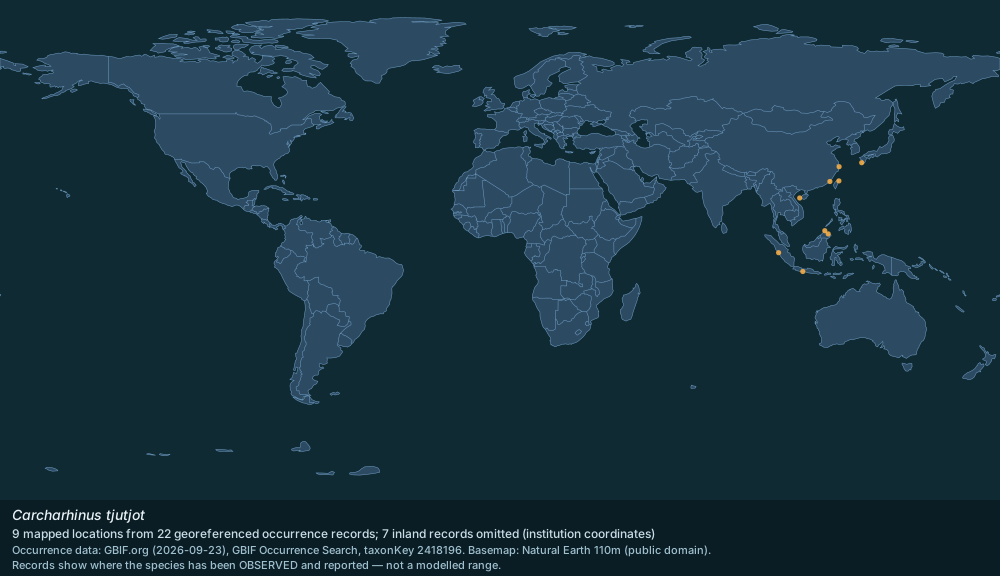
22 georeferenced occurrence records for Carcharhinus tjutjot are published through GBIF from 8 countries or marine areas. The map above plots 9 distinct locations from a sample of 22 records, omitting 7 inland records that carry an institution's coordinates rather than a collection site; it shows where the species has been observed and reported, not a modelled range.
Most records by country or area: Malaysia (8); China (3); Indonesia (3); India (2); Japan (2); Chinese Taipei (2); Philippines (1); Singapore (1).
Marine regions with a valid WoRMS distribution record: Seychellois Exclusive Economic Zone.
Source: GBIF Occurrence Search (taxonKey 2418196) — https://www.gbif.org/occurrence/search?taxon_key=2418196&has_coordinate=true (records CC0 / CC BY); WoRMS distribution records (MarineRegions) — https://www.marinespecies.org/aphia.php?p=taxdetails&id=217348 (CC BY 4.0); Natural Earth 110m basemap — https://www.naturalearthdata.com/ (public domain). Accessed 2026-09-23.
Conservation status (IUCN Red List)
The IUCN Red List assesses Carcharhinus tjutjot (Bleeker, 1852) as Vulnerable (code VU). No trend, population estimate or threat analysis is given here, because none is available from this source without the Red List API; follow the source link for the full assessment, including its date.
Source: IUCN Red List of Threatened Species (taxon 70680908) — https://www.iucnredlist.org/species/70680908/0; GBIF IUCN Red List category endpoint (taxonKey 2418196) — https://api.gbif.org/v1/species/2418196/iucnRedListCategory. Accessed 2026-09-23.
Description and natural history (Wikipedia)
Initially thought of as C. dussumieri, it was later identified as a distinct species in 2012 by morphological characteristics such as vertebral counts, dorsal and pectoral fin shape, and fin colouration. Now known as the Indonesian whaler shark, its divergence has characterized shark populations within the tropical Indo-West Pacific.
Morphological ambiguities and similarities to the blackspot shark (C. sealei) complicated the identification of C. tutjot across the Indo-West Pacific region. Distinctions arose in the genetic sampling of C. tutjot however, certain characteristics were hard to distinguish from C. sealei such as the black markings on the second dorsal fin.
The Indonesian whaler shark is often confused with C. sealei due to their similarities in morphologies. They can be identified by a black marking in the second dorsal fin, a relatively long snout, and an erect triangular first dorsal fin. Their upper anterior teeth are slanted, with jagged, knife-like cusplets flanking it. They range in size from 76 cm at first maturity to about 100 cm for males and 92 cm for females when fully mature. Size at birth is around 34–38 cm.
C. tjujot is a highly migratory species. Commonly found in the western Pacific, ranging from Indonesia and Taiwan to Borneo. They are not found in Australia or New Guinea and are not confirmed to live west of the Indo-Malay Peninsula. They prefer to live in depths ranging from the surface to 170 meters and in demersal inshore habitats.
Molecular genetic analysis have shown the presence of two distinct population groups in the eastern Indian Ocean. Studies suggest that C. tjujot has a restricted migration range in the Indian Ocean or the South China Sea.
The Indonesian whaler shark is listed as Vulnerable by the IUCN in its Red List of Threatened Species. Studies have shown that sharks landed on the Malaysian Peninsula and coast of Borneo Island are mainly juvenile, with size and maturity ranging from less than or at birth. Due to the overlap in nursery and common fishing grounds, the species is near facing threat from extinction. Small sharks are commonly caught as bycatch by long-range fisheries, sometimes without fins as they are marketable for human consumption.
Source: Wikipedia: Carcharhinus tjutjot — https://en.wikipedia.org/wiki/Carcharhinus_tjutjot (CC BY-SA 4.0). Accessed 2026-09-23.
Gallery
Spotted an error? Know more?
Reader corrections go straight into our review queue. Suggest an edit · How this site is sourced