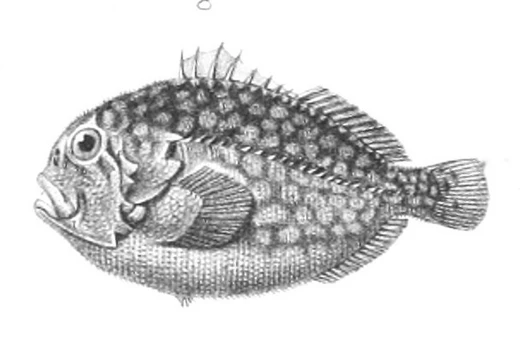
Hawaiian orbicular velvetfish (Caracanthus typicus)
Source-cited species reference: taxonomy from WoRMS, biology from FishBase, occurrence map from GBIF, conservation from IUCN Red List, description from Wikipedia.

Caracanthus typicus, the Hawaiian orbicular velvetfish, is a species of marine ray-finned fish, an orbicular velvetfish, belonging to the family Scorpaenidae. This species is endemic to the Hawaiian Islands.
- Scientific name
- Caracanthus typicus
- Authority
- Krøyer, 1845
- Family
- Scorpaenidae
- Order
- Perciformes
- Maximum length
- 2.9000000953674316 cm
- Habitat zone
- reef-associated
- Iucn red list
- Near Threatened
- Gbif occurrence records
- 135
Taxonomic Origins & Systematic Placement
The Hawaiian orbicular velvetfish occupies a uniquely isolated slot in the classification of ray-finned fishes. In 1845, Danish zoologist Henrik Nikolai Krøyer formally named this species and, in doing so, erected an entirely new genus around it. That genus, Caracanthus, stands as the sole occupant of the subfamily Caracanthinae, which in turn is the only subfamily-level grouping it belongs to within the broader family Scorpaenidae. This layered monotypy—single species, single genus, single subfamily—makes the velvetfish a genuine taxonomic curiosity. The genus name is itself a Latin compound: cara (head) joined with acanthus (thorn or spine), a deliberate reference to the prominent spines found on the infraorbital bone of C. typicus. More recently, molecular phylogenetic work has unsettled this tidy arrangement, suggesting that Caracanthinae might be better interpreted not as a subfamily at all but as a tribe nested within the subfamily Scorpaeninae, or perhaps folded directly into the tribe Scorpaenini. Either reclassification would dissolve the subfamily rank while preserving the genus-level identity of these small reef dwellers.
Morphology & the Velvet Armor
Every anatomical detail of Caracanthus typicus points to a life spent tucked inside the architecture of living coral. The body is oval and strongly laterally compressed, producing a disc-like silhouette that slides into narrow gaps between branches. Rather than a smooth scaled surface, the entire exterior is textured with tiny rough papillae, giving the skin a velvety feel that echoes the common name. The head carries miniature scales, each tipped with a single spine, reinforcing the thorn motif behind the genus name. The mouth is small and positioned terminally. A single notch divides the dorsal fin, which originates at the nape and carries six to eight spines alongside eleven to fourteen soft rays. The anal fin mirrors this pattern with two spines and a comparable count of soft rays. The pectoral fins, bearing twelve to fourteen rays, serve a critical mechanical role: the fish uses them to wedge itself firmly into coral crevices. The pelvic fins are so reduced—just a single spine and two or three tiny soft rays—that they are barely visible. In C. typicus, maximum standard length reaches only 2.9 centimeters, underscoring just how compact this creature truly is.
Four Siblings in the Genus
Although the Hawaiian orbicular velvetfish was the first species formally described under this genus, it is far from the only member. Today, four species are recognized within Caracanthus, each carrying a common name that hints at its appearance or size. The spotted coral croucher (C. maculatus) and the pygmy coral croucher (C. unipinna) were both originally described by J. E. Gray back in 1831, making them the earliest named members of the group. The spotted croucher (C. madagascariensis) followed in 1869, described by Guichenot, and its name points to a Malagasy origin. Krøyer's 1845 C. typicus sits between them chronologically. Despite sharing a genus, the species display a modest but notable size gradient: C. typicus tops out at a standard length of 2.9 centimeters, while the other three can reach a total length of up to 5 centimeters. All four share the same velvety, papillae-covered skin, the same compressed oval body plan, and the same tight association with coral, yet they occupy slightly different niches across the tropical Indo-Pacific.
Life Among the Coral Branches
The Hawaiian orbicular velvetfish is a creature of the tropical Indo-Pacific, and its world is defined almost entirely by the three-dimensional lattice of living coral. Across the Indian and Pacific Oceans, members of Caracanthus are found in close, intimate association with coral reefs, living directly among the branching structures rather than in open water or sandy substrate. This is not a casual preference; the fish's entire body plan—its compressed oval shape, its tiny terminal mouth, its small pectoral fins designed for gripping—evolves around the need to fit into and hold position within the crevices and interstices of coral branches. The velvety, papillae-covered skin likely aids in navigating these tight spaces without snagging. Because the fish is so small (under 3 centimeters in standard length for C. typicus), it can exploit microhabitats within the coral that would be inaccessible to larger reef species. Its ecological identity is therefore inseparable from the coral itself: remove the reef, and the velvetfish loses its shelter, its foraging ground, and the very reason it is shaped the way it is.
Frequently Asked Questions
What is the Hawaiian orbicular velvetfish (Caracanthus typicus)?
It is a tiny marine ray-finned fish placed in the scorpionfish family Scorpaenidae. First described by Krøyer in 1845, it belongs to the orbicular velvetfish group and is found only in ocean waters around one island chain.
Where does Caracanthus typicus live in the wild?
This species is strictly endemic to the Hawaiian Islands and has no confirmed populations anywhere else on the globe. It is a reef-associated fish, meaning it spends its life among coral reef structures rather than in open water or sandy bottoms.
How big does the Hawaiian orbicular velvetfish get?
It is an extremely small fish, topping out at roughly 2.9 centimeters in total length. That makes it one of the tiniest members of the entire Scorpaenidae family.
What is the full taxonomic placement of Caracanthus typicus?
It falls under the order Perciformes, family Scorpaenidae, and genus Caracanthus, with the species authority credited to Krøyer (1845). Its common name highlights both its round, disc-like body shape and the soft, velvet-like texture of its skin.
Can you find the Hawaiian orbicular velvetfish in other Pacific island groups?
No—its known range is confined exclusively to the waters surrounding the Hawaiian archipelago. As a species endemic to that island chain, it has no documented populations in any other ocean region.
Spotted an error? Know more?
Reader corrections go straight into our review queue. Suggest an edit · How this site is sourced