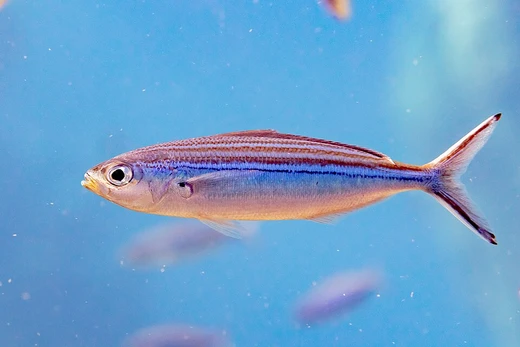
Suez fusilier (Caesio suevica)
Source-cited species reference: taxonomy from WoRMS, biology from FishBase, occurrence map from GBIF, conservation from IUCN Red List, description from Wikipedia.

Caesio suevica, the Suez fusilier, is a species of marine ray-finned fish, a fusilier belonging to the family Caesionidae. It is endemic to the Red Sea.
- Scientific name
- Caesio suevica
- Authority
- Klunzinger, 1884
- Family
- Caesionidae
- Order
- Eupercaria incertae sedis
- Maximum length
- 35 cm
- Depth range
- 2–25 m
- Habitat zone
- reef-associated
- Iucn red list
- Least Concern
- Gbif occurrence records
- 279
Taxonomic History and Naming
The Suez fusilier entered the scientific record in 1884, when the German zoologist Carl Benjamin Klunzinger published the first formal description of the species. He designated El Qoseir, a site on Egypt's Red Sea coastline, as the type locality. The specific epithet "suevica" carries the meaning "belonging to Suez," a geographic reference to the Gulf of Suez, which lies just north of the original collection site. For well over a century the species sat within the broad genus Caesio until Kent E. Carpenter undertook a sweeping 1987 revision of the Indo-Pacific family Caesionidae. In that landmark monograph, Carpenter reorganized the genus and reassigned C. suevica to the subgenus Flavicaesio, a placement reflecting broader morphological patterns he identified across the group. The same review also yielded descriptions of five additional species, a testament to how much remained to be resolved in fusilier systematics even by the late twentieth century. The species' journey from a single 19th-century description to a subgeneric placement illustrates the slow, iterative nature of marine fish taxonomy.
Morphology and Coloration
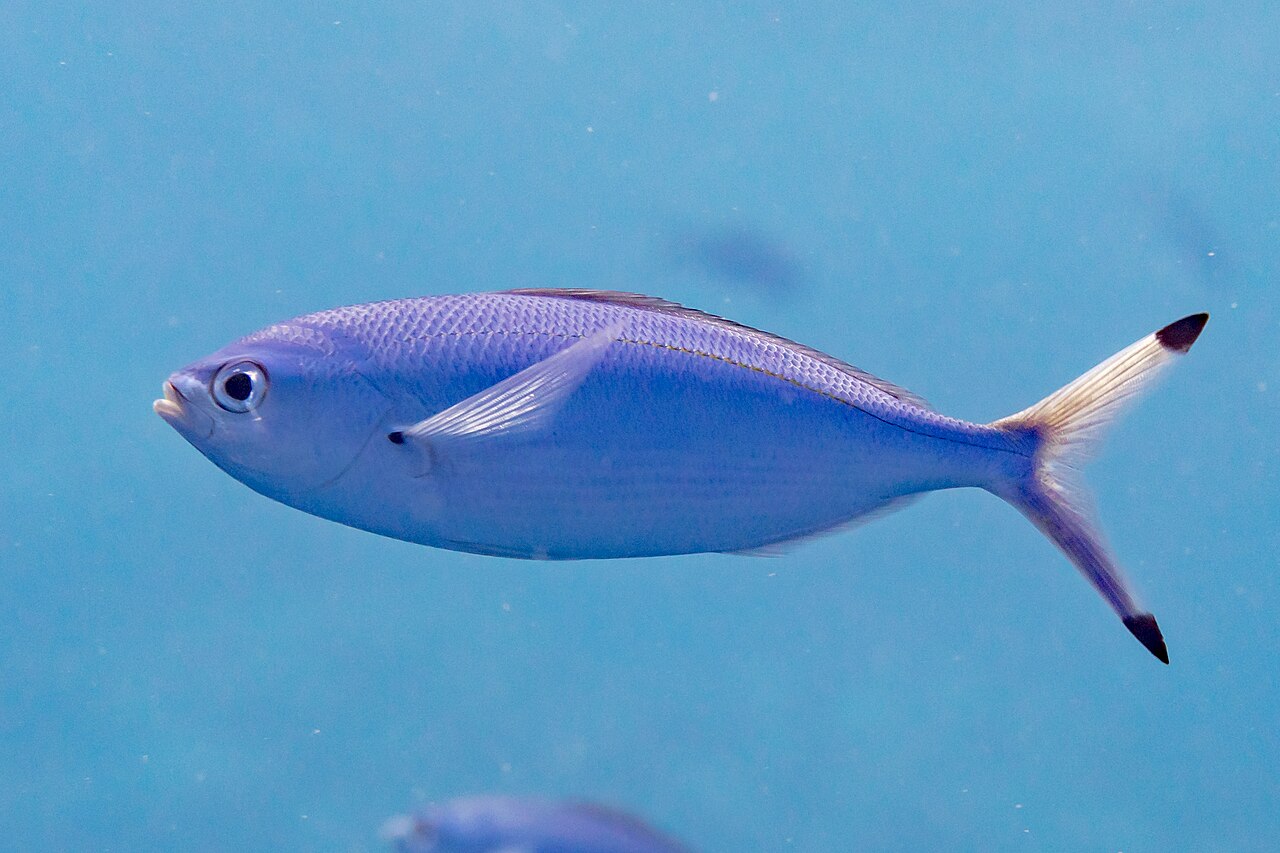
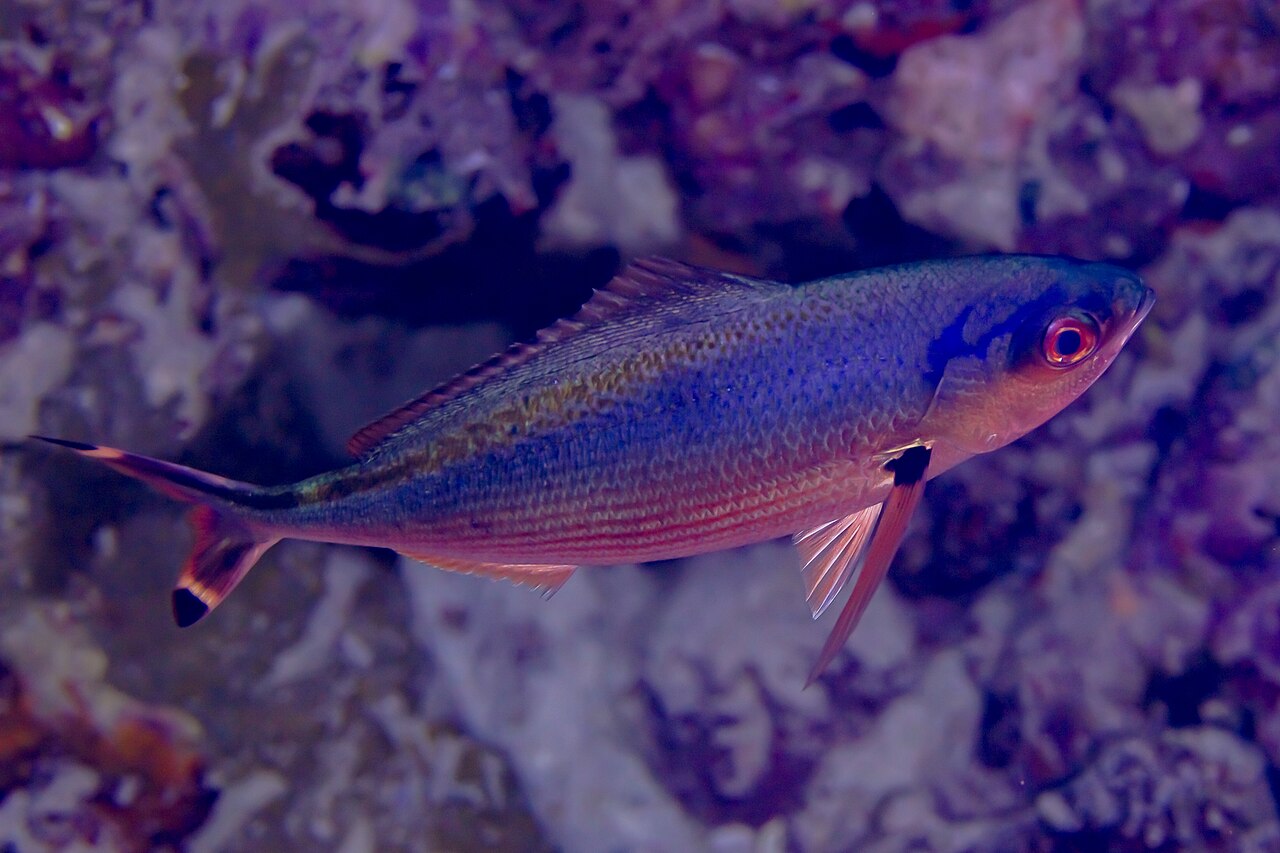
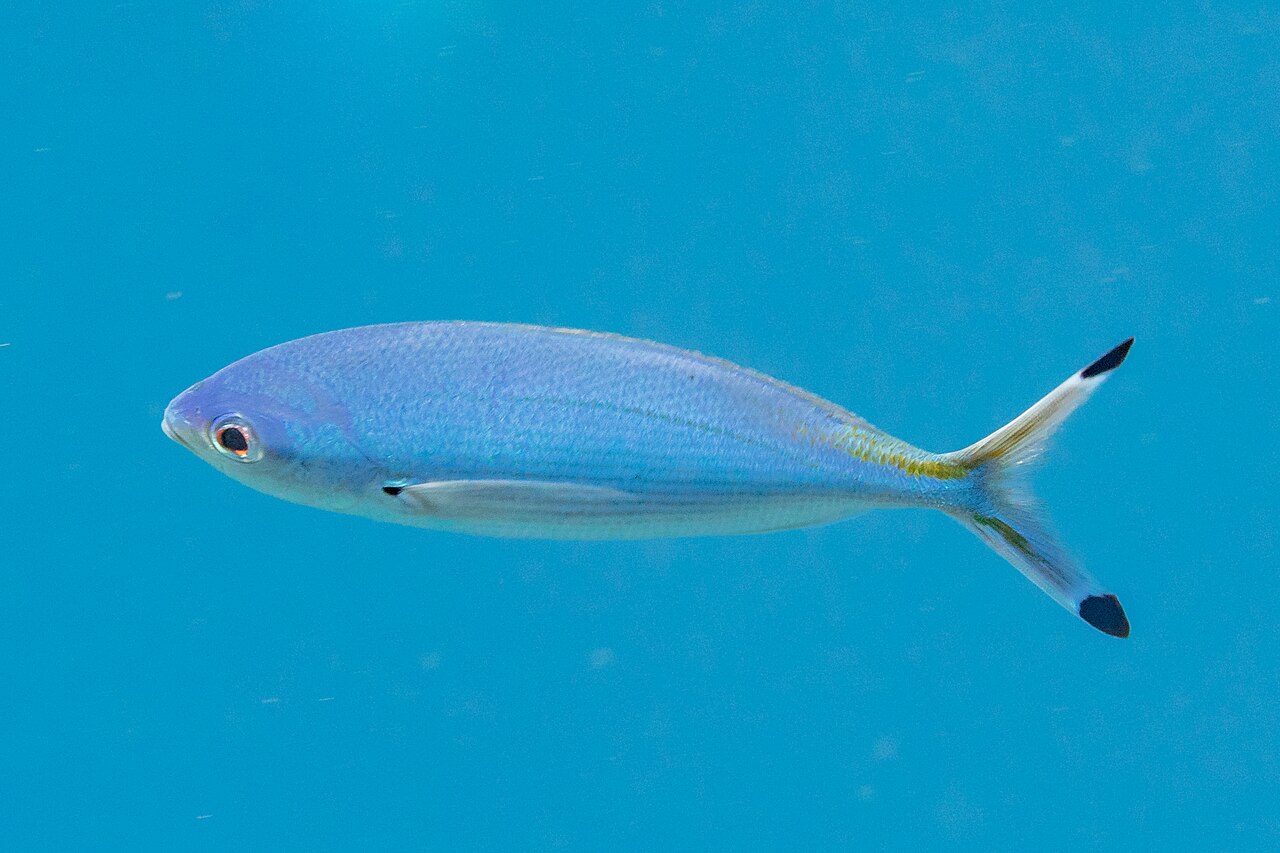
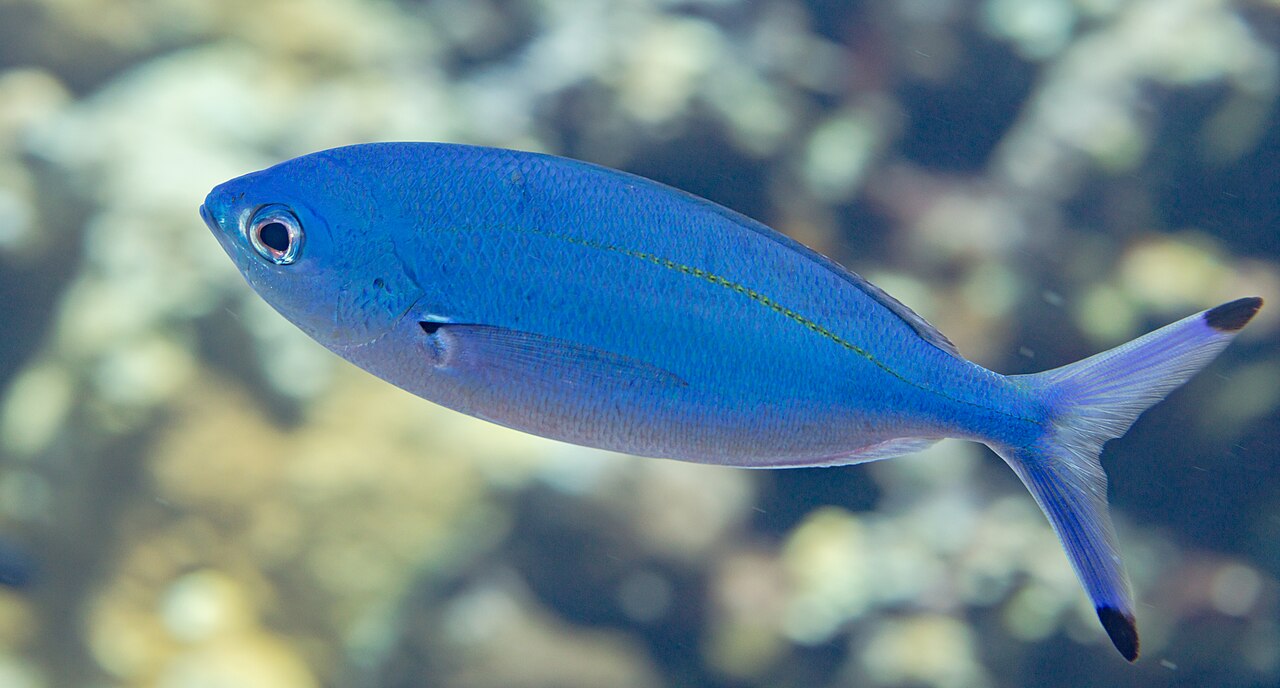
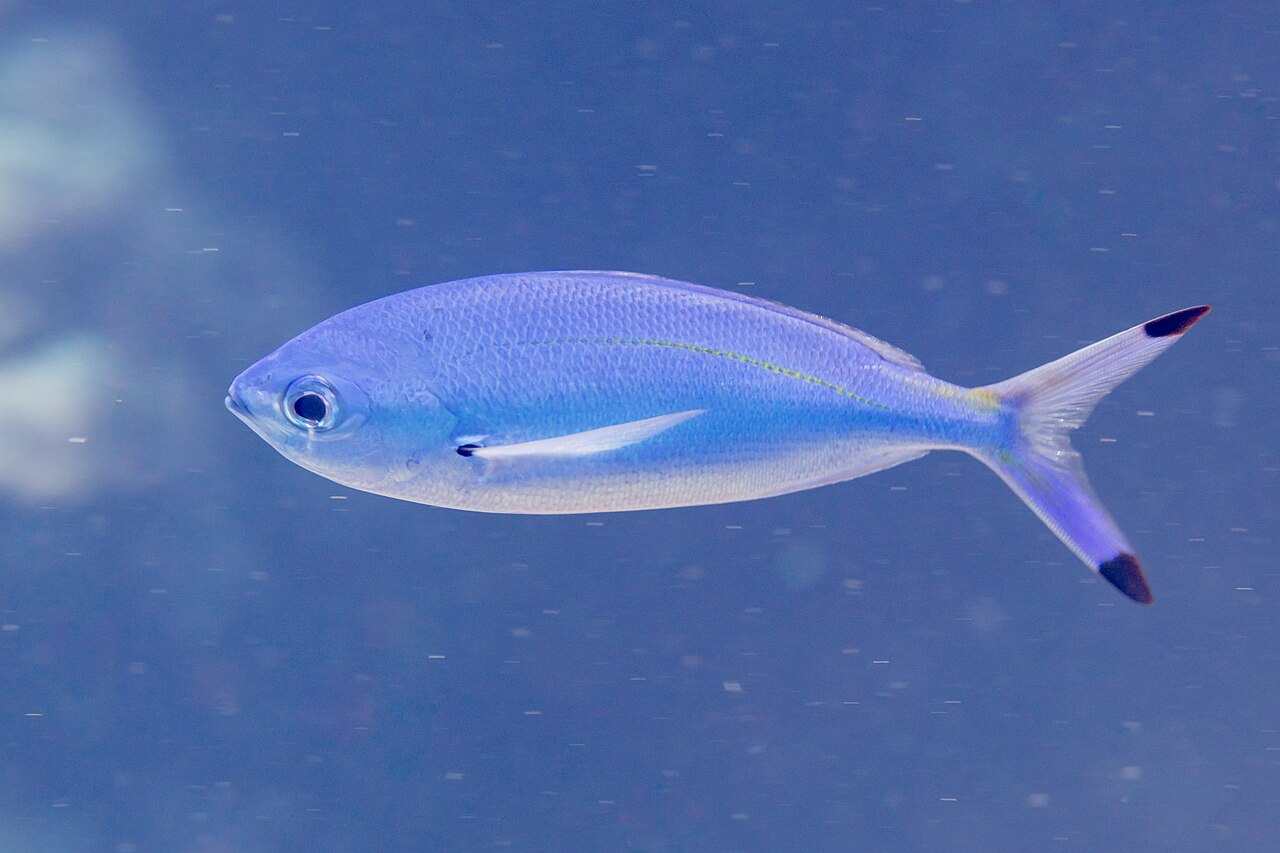
The Suez fusilier displays a moderately slender, fusiform body that is laterally compressed, a body plan well suited to maneuvering through reef channels. Its jaws, together with the vomer and palatine bones, carry small conical teeth appropriate for a zooplankton-feeding lifestyle. Fin architecture follows a consistent pattern: the dorsal fin bears 10 spines followed by 14 to 15 soft rays, while the anal fin is built from 3 spines and 12 soft rays. Adults may reach a maximum total length of 35 centimeters, or about 14 inches. Coloration is a pale silver-blue base overlaid with fine gray stripes along the flanks. A distinctive yellow line runs along the back, beginning at the base of the dorsal fin, while the belly appears noticeably paler than the upper surfaces. The most eye-catching feature sits at the tip of each caudal-fin lobe, where a black blotch is neatly framed by a crisp white band. Together these markings give the fish a clean, banded appearance that distinguishes it from many congeners.
Endemic Range and Habitat
The Suez fusilier is strictly endemic to the Red Sea, a distribution that sets it apart from the wider Indo-Pacific range enjoyed by many of its fusilier relatives. Sporadic records claiming the species in other Indian Ocean waters are almost certainly misidentifications of superficially similar species rather than genuine occurrences. Within its native basin, the fish favors coastal waters and shows a particular affinity for coral reef habitats. It is typically encountered at depths between 2 and 25 meters, squarely within the sunlit zone where photosynthetic productivity sustains the reef food web. The Red Sea's semi-enclosed geography, bordered by the deserts of northeastern Africa and the Arabian Peninsula, fosters a distinctive assemblage of marine life. The Suez fusilier's restriction to this single basin underscores the Red Sea's importance as a center of marine endemism. Because the species has no verified populations anywhere else on Earth, the health of its coral reef habitat is directly linked to its long-term survival.
Life History and Human Interactions
In the water column, Suez fusiliers are known to assemble into large midwater aggregations, a gregarious behavior that likely confers protection from predators and improves foraging efficiency. Reproduction is oviparous: females release numerous small pelagic eggs into the open water, a strategy that relies on ocean currents to disperse larvae across the reef landscape. Their diet centers on zooplankton, with a marked preference for ctenophores and scyphozoans, placing them as a mesopelagic grazer within the reef ecosystem. In terms of human interaction, the species is occasionally taken on handlines and gill nets, though it is not a frequent target of commercial fishing operations. A notable exception exists in Jordan, where the Suez fusilier holds recognized commercial importance as a locally valued catch. This limited but meaningful fishery illustrates how even a regionally endemic species can support small-scale coastal livelihoods along the Red Sea, linking the health of the reef directly to the economic well-being of nearby communities.
Gallery
Frequently Asked Questions
What is the Suez fusilier (Caesio suevica)?
It is a small marine ray-finned fish in the fusilier family Caesionidae, originally described by Klunzinger in 1884. The species occurs nowhere on Earth except the Red Sea.
Where can you find the Suez fusilier in the wild?
Caesio suevica is strictly endemic to the Red Sea, so it does not appear in the Indian Ocean or the Mediterranean. It typically inhabits shallow waters between 2 and 25 metres depth.
How large does Caesio suevica grow?
The Suez fusilier reaches a maximum total length of about 35 centimetres, making it a modestly sized member of the fusilier group.
What is the Suez fusilier's taxonomic placement?
It belongs to the family Caesionidae and is placed in the order Eupercaria incertae sedis. The binomial name Caesio suevica was established by Klunzinger in 1884.
What makes the Suez fusilier distinct from other fusiliers?
Its defining trait is being a Red Sea endemic, meaning its entire natural range is confined to that single body of water. This restricted distribution sets it apart from more widespread Caesionidae relatives.
Spotted an error? Know more?
Reader corrections go straight into our review queue. Suggest an edit · How this site is sourced