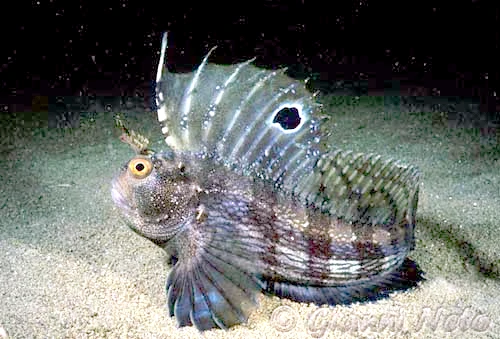
Butterfly blenny (Blennius ocellaris)
Source-cited species reference: taxonomy from WoRMS, biology from FishBase, occurrence map from GBIF, conservation from IUCN Red List, description from Wikipedia.

Wikimedia Commons · Public domain
The butterfly blenny (Blennius ocellaris) is a small marine blenniid fish of Northern and Western Europe, as well as the Mediterranean Sea and Black Sea and Morocco. It is usually found at a depth of 10 - 400 m down, especially in areas with a rocky floor.
- Scientific name
- Blennius ocellaris
- Authority
- Linnaeus, 1758
- Family
- Blenniidae
- Order
- Blenniiformes
- Maximum length
- 20 cm
- Depth range
- 10–400 m
- Habitat zone
- demersal
- Iucn red list
- Least Concern
- Gbif occurrence records
- 8,408
Classification (WoRMS)
Full classification as recorded by WoRMS: Kingdom: Animalia · Phylum: Chordata · Class: Teleostei · Order: Blenniiformes · Family: Blenniidae · Genus: Blennius.
Accepted name: Blennius ocellaris · Authority: Linnaeus, 1758 · Taxonomic status: accepted · AphiaID: 126761.
Synonyms and superseded combinations recorded for this taxon: Blennius occelaris Linnaeus, 1758.
Source: World Register of Marine Species (WoRMS) — https://www.marinespecies.org/aphia.php?p=taxdetails&id=126761 (CC BY 4.0). Accessed 2026-09-23.
Biology and life history (FishBase)
Measured values published by FishBase for Blennius ocellaris. Only fields the database actually holds for this species are shown; these are database values, not aquarium guidance.
Maximum length: 20 cm · Depth range: 10–400 m · Habitat zone: demersal · Body shape: elongated · Vulnerability index: 10 of 100 · Fishery importance: minor commercial · Aquarium trade: never/rarely.
FishBase notes: Adults are found over hard bottoms. Mainly nocturnal, they feed on small invertebrates. Oviparous. Eggs are demersal and adhesive (Ref. 205), and are attached to the substrate via a filamentous, adhesive pad or pedestal (Ref. 94114). Eggs are laid under mussel-shells or stones and guarded by the male (Ref. 5981). Larvae are planktonic, often found in shallow, coastal waters (Ref. 94114). Spawn in April (Marseille) or July (England) (Ref. 5981).
Source: FishBase species summary (SpecCode 49) — https://www.fishbase.se/summary/Blennius-ocellaris.html (CC BY-NC 3.0 — non-commercial use only). Accessed 2026-09-23.
Distribution and occurrence records (GBIF)
8,408 georeferenced occurrence records for Blennius ocellaris are published through GBIF from 28 countries or marine areas. The map above plots 178 distinct locations from a sample of 3,000 records, omitting 21 inland records that carry an institution's coordinates rather than a collection site; it shows where the species has been observed and reported, not a modelled range.
Most records by country or area: Spain (4,817); United Kingdom of Great Britain and Northern Ireland (1,379); France (951); Portugal (540); Ireland (277).
The full country table, WoRMS marine regions and the sampling notes are on this species' Distribution page.
Source: GBIF Occurrence Search (taxonKey 2395359) — https://www.gbif.org/occurrence/search?taxon_key=2395359&has_coordinate=true (records CC0 / CC BY); WoRMS distribution records (MarineRegions) — https://www.marinespecies.org/aphia.php?p=taxdetails&id=126761 (CC BY 4.0); Natural Earth 110m basemap — https://www.naturalearthdata.com/ (public domain). Accessed 2026-09-23.
Conservation status (IUCN Red List)
The IUCN Red List assesses Blennius ocellaris Linnaeus, 1758 as Least Concern (code LC). No trend, population estimate or threat analysis is given here, because none is available from this source without the Red List API; follow the source link for the full assessment, including its date.
Source: IUCN Red List of Threatened Species (taxon 185126) — https://www.iucnredlist.org/species/185126/0; GBIF IUCN Red List category endpoint (taxonKey 2395359) — https://api.gbif.org/v1/species/2395359/iucnRedListCategory. Accessed 2026-09-23.
Description and natural history (Wikipedia)
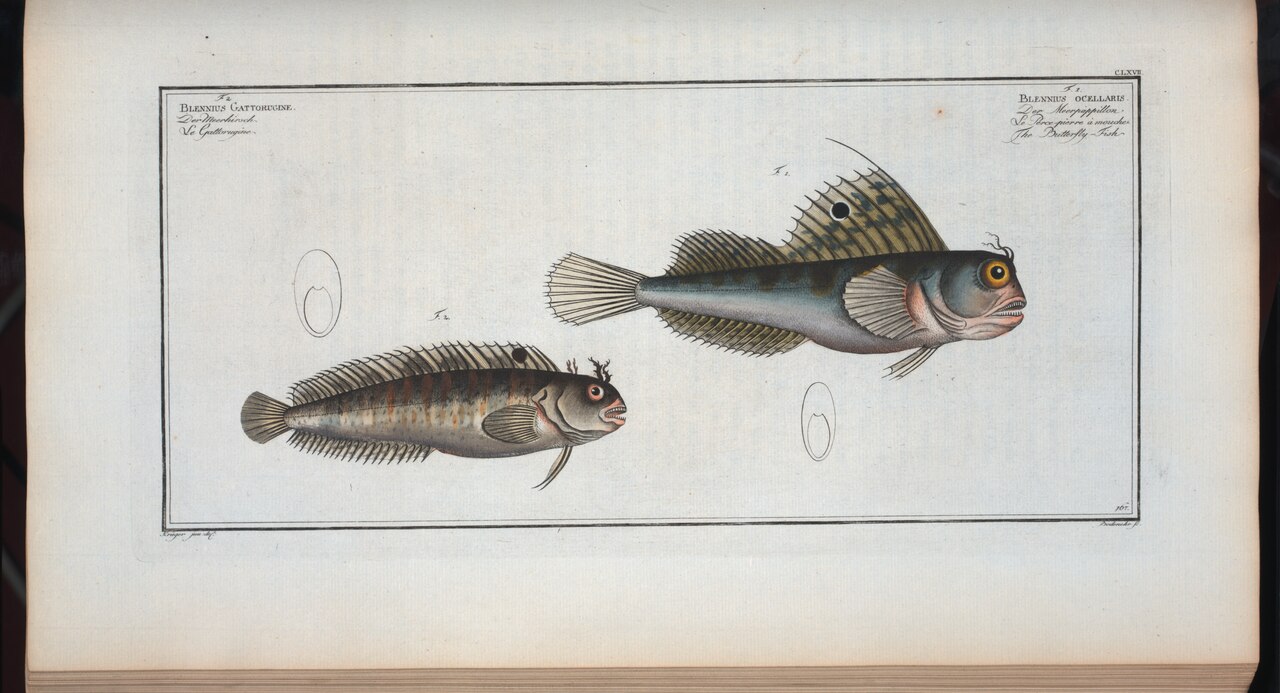
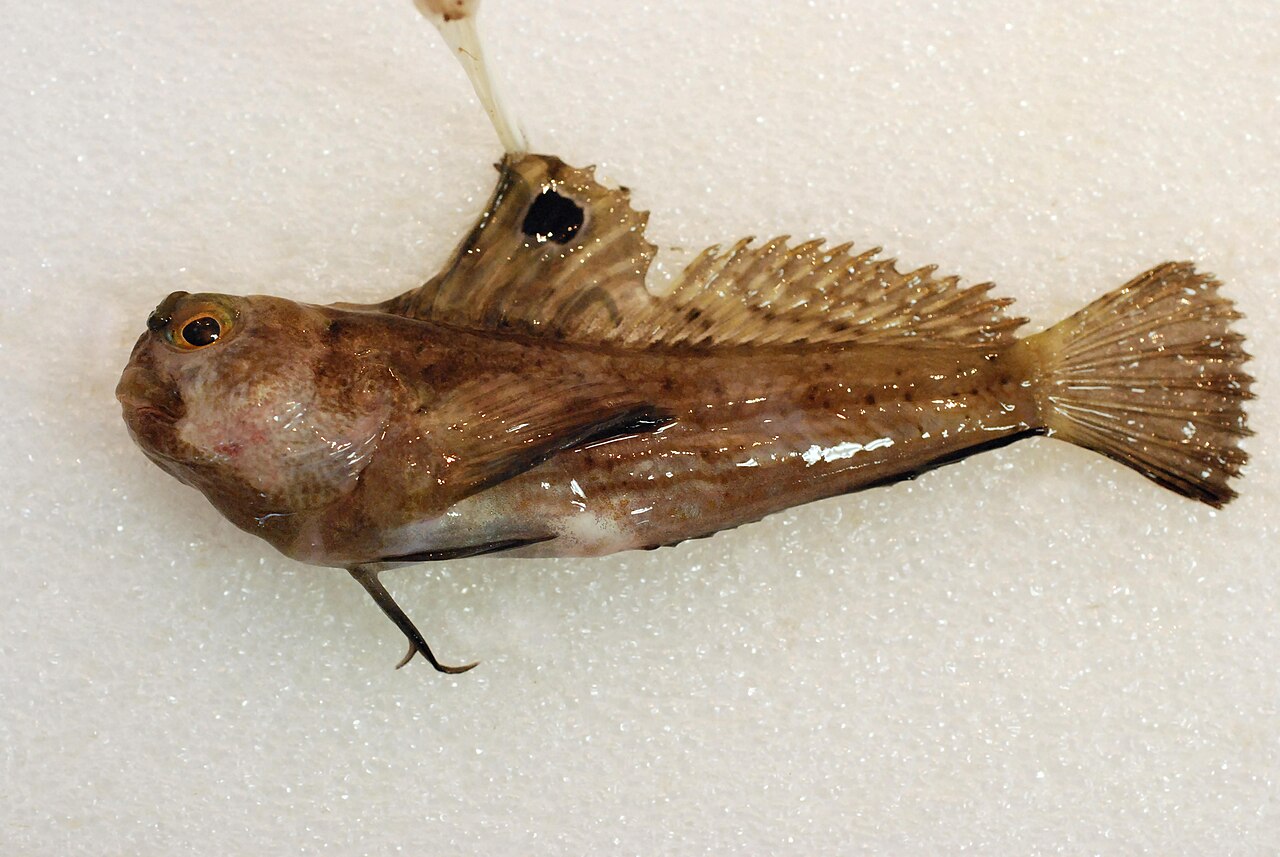
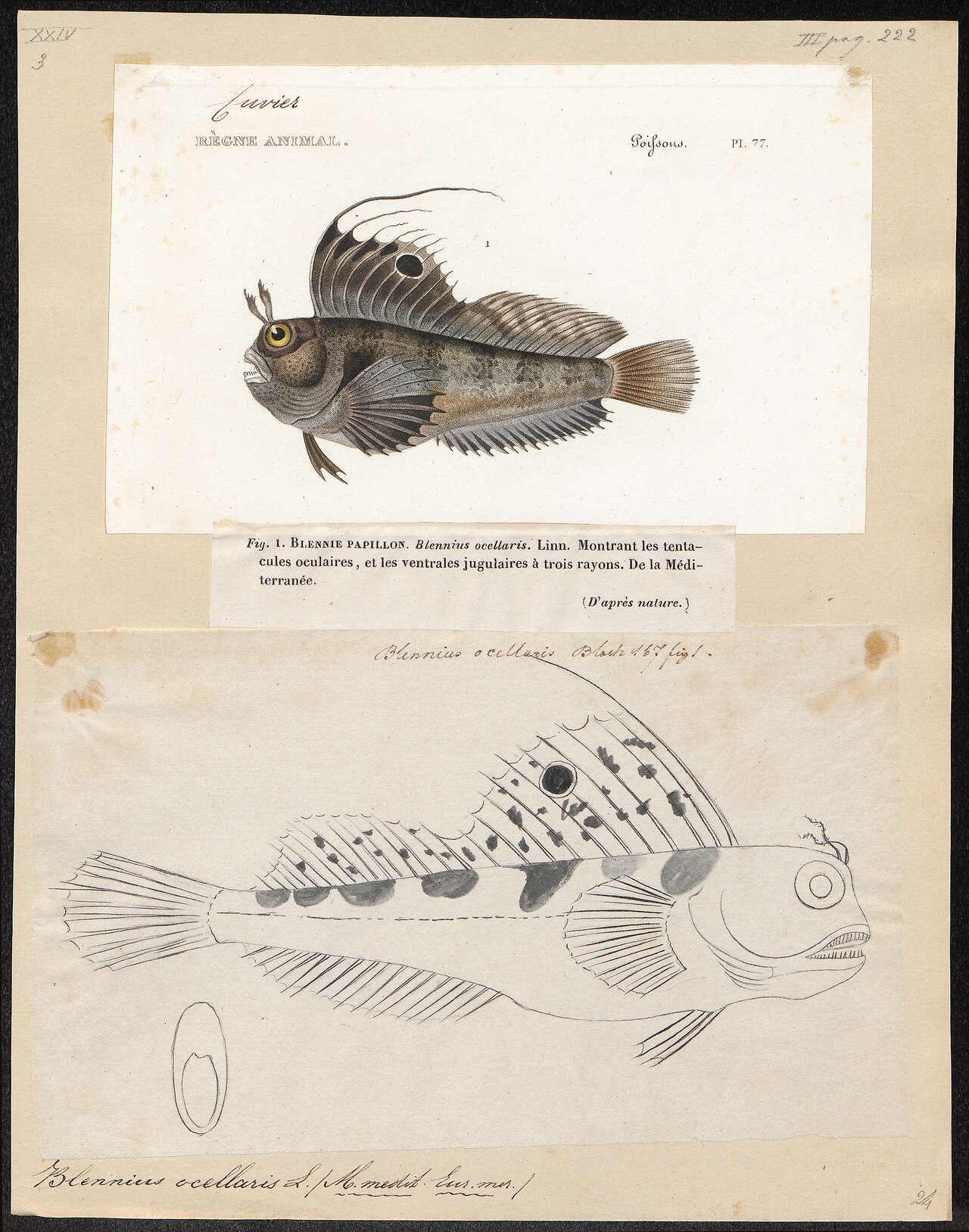
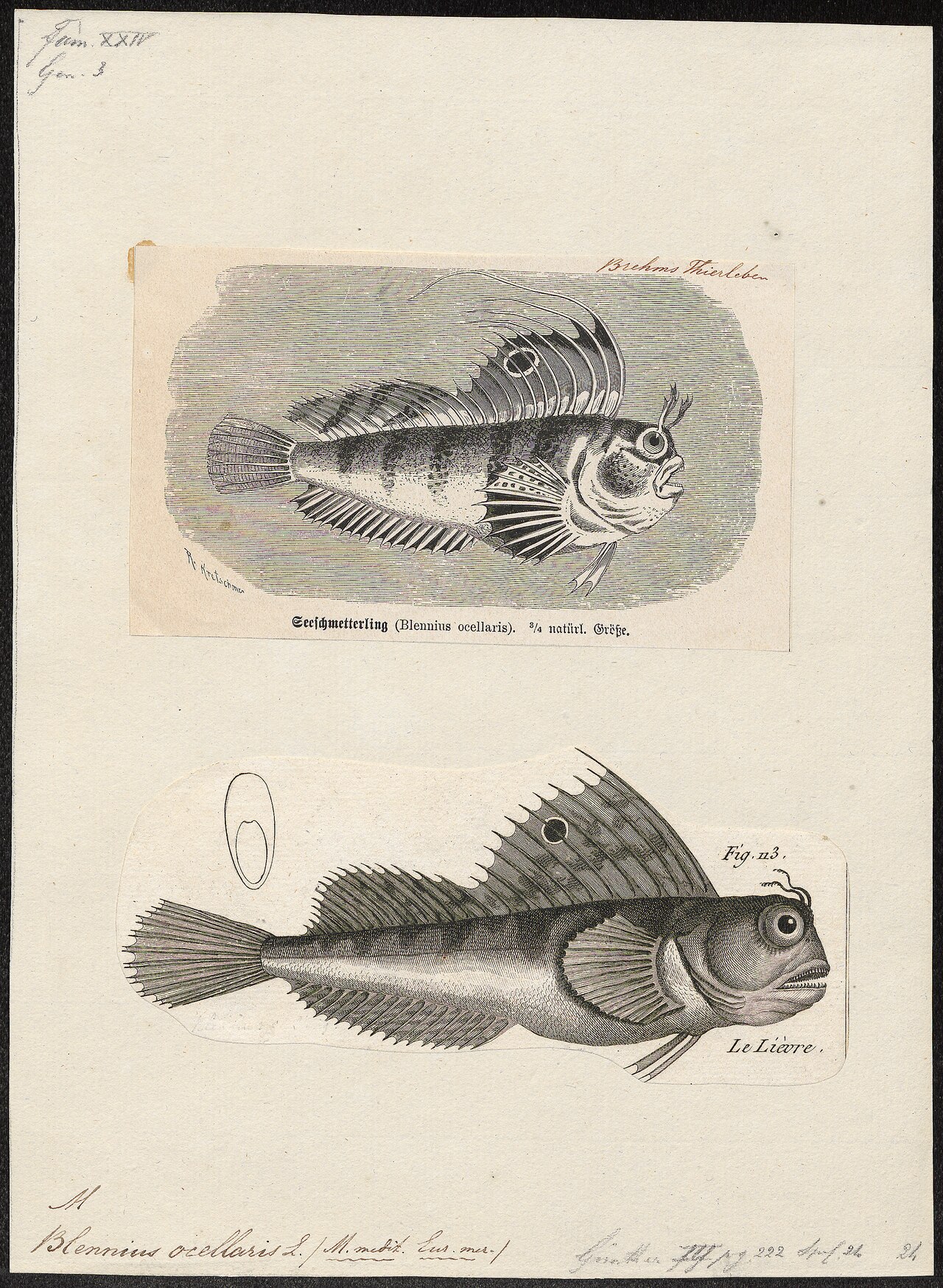
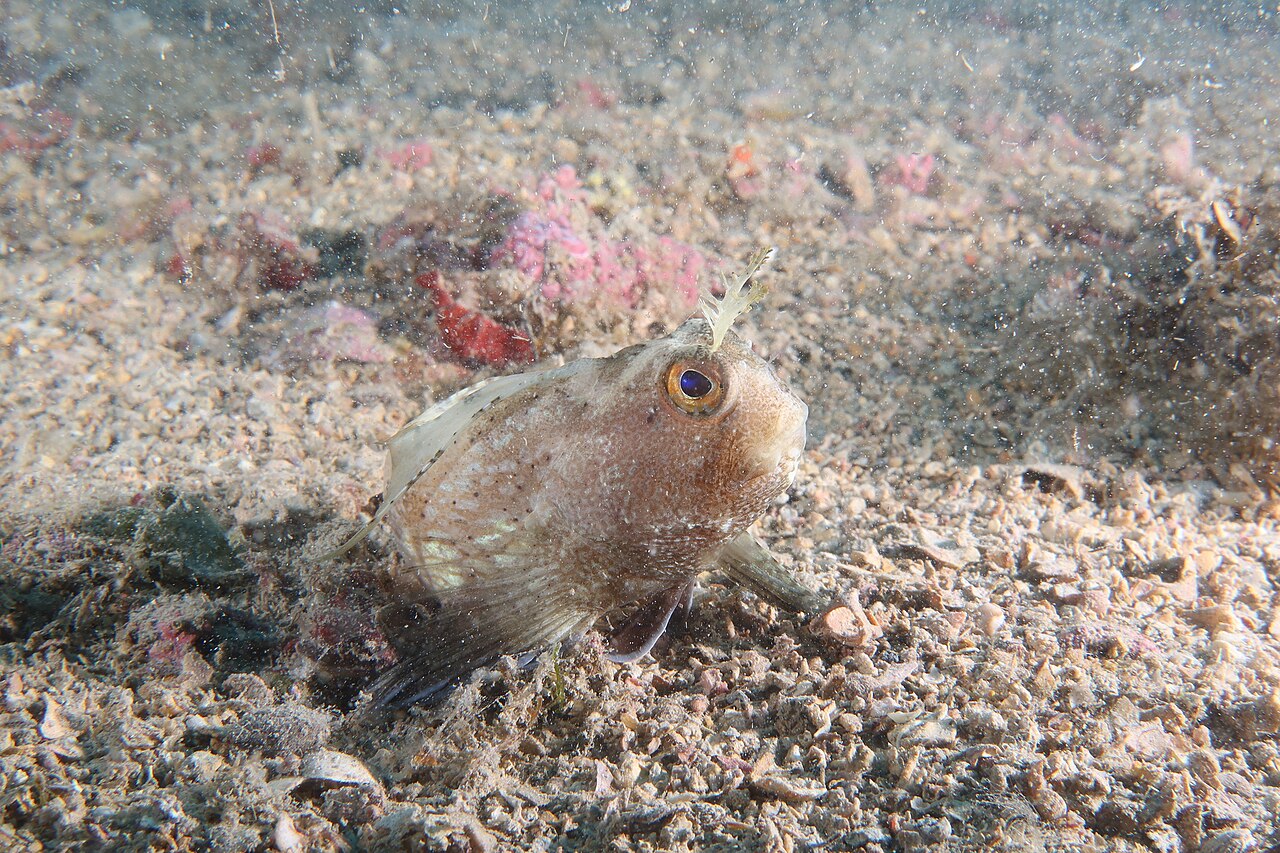
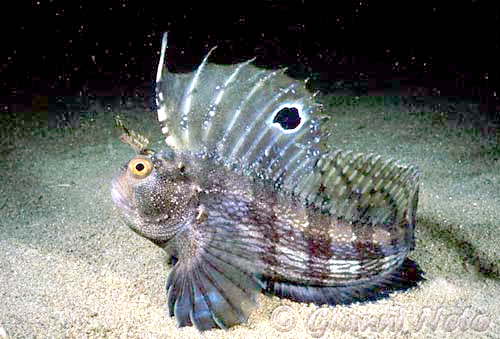
The butterfly blenny has a deep body at the front, tapering rather quickly to the caudal peduncle. It can grow as large as 20 cm in length. It has 11 to 12 dorsal spines, 14 to 16 dorsal soft rays, 2 anal spines and 15 to 16 anal soft rays. It has tentacles on the nasal opening, above the eye and on the nape near the first dorsal fin ray. The lateral line is discontinuous. The front part of the dorsal fin is much higher than the remainder of the fin, and the anal fin is also long, running half the body length. The pelvic fins are set well forward and are divided in two. This fish is a mottled brownish-grey, with five to seven dark vertical bars. There is a large bluish-black eyespot surrounded by a white ring on the 6th and 7th rays of the dorsal fin.
The butterfly blenny has a range that extends from the Mediterranean Sea, up the coast of Spain, Portugal and France to the English Channel and the Irish Sea. It is found over rocky substrates covered with seaweed and this means that it is seldom caught in trawls, and may be more common than it seems. It occurs in the subtidal zone, and its depth range is down to about 100 m.
It spawns in late spring (as late as June in the English Channel) and hides the eggs under an abandoned shell; the male guards the eggs. An individual near Plymouth was found to be nesting inside the cavity of a large thigh bone.
Source: Wikipedia: Butterfly blenny — https://en.wikipedia.org/wiki/Butterfly_blenny (CC BY-SA 4.0). Accessed 2026-09-23.
Gallery
Frequently Asked Questions
Who is Butterfly blenny (Blennius ocellaris)?
The butterfly blenny is a small marine fish belonging to the blenny family (Blenniidae) and the order Blenniiformes. It was first formally described by Linnaeus back in 1758.
Where does Butterfly blenny (Blennius ocellaris) live?
You'll find this species across Northern and Western European seas, the Mediterranean, the Black Sea, and waters off Morocco. It strongly favors rocky substrates at the seafloor.
How deep can you find Butterfly blenny (Blennius ocellaris)?
The species occupies a remarkably wide vertical range, from roughly 10 metres down to as deep as 400 metres. Most sightings, however, cluster in shallower rocky habitats well above the lower limit.
How large does Butterfly blenny (Blennius ocellaris) get?
It stays relatively petite, topping out at about 20 cm in total length. That makes it one of the smaller members of the blenny family.
Why is Butterfly blenny (Blennius ocellaris) important to fish enthusiasts and scientists?
As a well-documented, wide-ranging European blenny, it serves as a handy reference species for studying Blenniidae ecology and biodiversity across multiple seas. Its broad depth and geographic range also make it a useful indicator of rocky-habitat health.
Related in Butterfly blenny
Links follow this subject's own source article.
Elsewhere in Butterfly blenny
Spotted an error? Know more?
Reader corrections go straight into our review queue. Suggest an edit · How this site is sourced