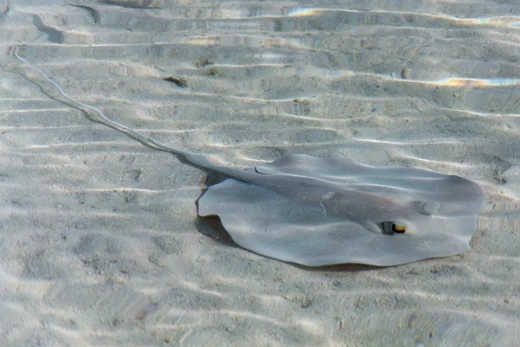
Bengal whipray (Brevitrygon walga)
Source-cited species reference: taxonomy from WoRMS, biology from FishBase, occurrence map from GBIF, conservation from IUCN Red List, description from Wikipedia.

Brevitrygon walga, the dwarf whipray or mangrove whipray, is a small stingray, a cartilaginous fish in the family Dasyatidae. It is a demersal fish and is found over the continental and insular shelf of the west central Pacific Ocean where it is heavily fished. The IUCN has assessed it as being "near-threatened".
- Scientific name
- Brevitrygon walga
- Authority
- (Müller & Henle, 1841)
- Family
- Dasyatidae
- Order
- Myliobatiformes
- Maximum length
- 20.299999237060547 cm
- Depth range
- 0–40 m
- Habitat zone
- demersal
- Iucn red list
- Near Threatened
- Gbif occurrence records
- 110
Morphology & Defensive Arsenal
The Bengal whipray belongs to the family Dasyatidae, a group of rays within the order Myliobatiformes that are immediately recognizable by their flattened pectoral fin discs, which can range from oval to diamond-like in outline. What truly sets these animals apart is their elongated, whip-like tail, which stretches well beyond the disc and carries no dorsal or caudal fins. Near the base of this tail, most dasyatid species—including the Bengal whipray—bear one or more venomous stingers. These defensive weapons are pointy, sharp, and lined with jagged edges. When a threat approaches, the ray jerks its tail, driving the stinger into the attacker; the barbed tip often breaks off and remains lodged in the wound. Beyond physical defense, members of this family possess a sophisticated sensory network: the ampullae of Lorenzini, electroreceptors dispersed across the skin, allow them to detect the faint electric fields emitted by nearby organisms. This electroreceptive capability gives the Bengal whipray a perceptual window into its surroundings that extends far beyond simple sight or touch.
Habitat & Benthic Lifestyle
As a member of Dasyatidae, the Bengal whipray is a demersal species, meaning it spends the majority of its life at the bottom of marine environments. Whiptail rays of this family are commonly encountered in shallow tropical waters, though their range extends into temperate regions as well. They favor continental shelves, often burying themselves in sand or mud with only their eyes protruding above the substrate, a behavior that helps them evade predators such as hammerhead sharks. Typical habitat depths for dasyatids span roughly 100 to 200 meters, though some species venture as deep as 600 meters. While many relatives occupy mangrove swamps or open-ocean settings, the family as a whole is found worldwide in tropical to temperate marine waters, with several lineages having also colonized freshwater systems in Africa, Asia, and Australia. The Bengal whipray, as a marine dasyatid, would be expected to inhabit the shallow coastal and shelf environments where its flattened body and sand-burrowing behavior offer both camouflage and a strategic vantage point for detecting approaching prey or threats.
Feeding Ecology & Electroreceptive Foraging
The diet of dasyatid rays, including the Bengal whipray, centers on mollusks, crustaceans, jellyfish, and bony fish. Rather than chasing prey through the water column, these rays typically forage by digging into the sandy or muddy substrate to extract buried organisms. A remarkable feature underlying this feeding strategy is the family's highly developed electroreception. Electroreceptors, organized into structures called the ampullae of Lorenzini, are dispersed across the skin in a network of pores. This sensory system enables the ray to detect the weak electric fields generated by living prey from a distance, effectively mapping the relative location of food items before it even begins to dig. In a few well-known locations, such as Stingray City in Grand Cayman and Hamelyn Bay in Western Australia, rays have adapted to human presence by accepting food scraps from tourists or gathering at fishers' cleaning stations. This behavioral flexibility, layered on top of their innate electroreceptive hunting toolkit, illustrates the ecological versatility of the family to which the Bengal whipray belongs.
Conservation Pressures & Human Interactions
Many species within the whiptail ray family face declining populations, with numerous taxa classified as threatened, endangered, or critically endangered on conservation lists. The Bengal whipray, as a member of Dasyatidae, exists within a family broadly affected by a suite of anthropogenic pressures. Bycatch resulting from overfishing operations, water contamination, and the loss of coastal habitat all contribute to population declines. Tourism, while sometimes generating economic benefit through aquarium exhibits and ecotourism encounters, also introduces stress and disturbance to wild populations. Climate change compounds these threats by driving increased water temperatures that alter habitat suitability. On the positive side, some dasyatid species are valued by humans: their flesh is salted and dried for consumption in parts of South-West Asia, and their skin is processed into leather goods such as wallets and shoes. Yet the breadth of these pressures underscores the urgency of protecting the shallow marine and shelf environments where the Bengal whipray and its relatives depend on undisturbed sandy substrates for survival.
Spotted an error? Know more?
Reader corrections go straight into our review queue. Suggest an edit · How this site is sourced