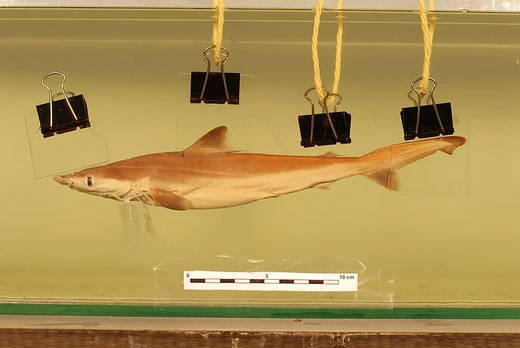
Borneo shark (Carcharhinus borneensis)
Source-cited species reference: taxonomy from WoRMS, biology from FishBase, conservation from IUCN Red List, description from Wikipedia.

Naturalis Biodiversity Center · CC0
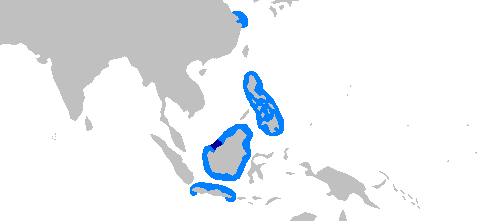
The Borneo shark (Carcharhinus borneensis) is a species of requiem shark, and part of the family Carcharhinidae. Extremely rare, it is known only from inshore waters around Mukah in northwestern Borneo, though it may once have been more widely distributed. A small, gray shark reaching 65 cm in length, this species is the only member of its genus with a row of enlarged pores above the corners of its mouth. It has a slender body with a long, pointed snout and a low second dorsal fin placed posterior to the anal fin origin.
- Scientific name
- Carcharhinus borneensis
- Authority
- (Bleeker, 1858)
- Family
- Carcharhinidae
- Order
- Carcharhiniformes
- Maximum length
- 70 cm
- Habitat zone
- demersal
- Iucn red list
- Critically Endangered
Taxonomy and the Long Search for Specimens
The Borneo shark first entered scientific literature in 1858, when Dutch ichthyologist Pieter Bleeker described it under the name Carcharias (Prionodon) borneensis in the journal Acta Societatis Regiae Scientiarum Indo-Neêrlandicae. His account relied on a single newborn male measuring just 24 centimeters, hauled from waters off Singkawang in western Kalimantan. Subsequent taxonomists reclassified the species into the genus Carcharhinus, where it remains today. For nearly a century after Bleeker's description, the species was defined by a mere five specimens, all of them immature and all collected before 1937. That scarcity changed in April and May of 2004, when a team from Universiti Malaysia Sabah, conducting a fishery-resources survey across Sabah and Sarawak, recovered a number of additional individuals. Despite this modest boost in known material, the species' evolutionary placement within Carcharhinus remains unsettled. Jack Garrick's 1982 morphological analysis could not link it closely to any congener, while Leonard Compagno's 1988 revision tentatively clustered it with the smalltail, blackspot, spottail, creek whaler, whitecheek, hardnose, and Pondicherry sharks. Certain traits, notably the distinctive enlarged pores flanking the mouth, echo those seen in sharpnose sharks, yet the broader morphological picture keeps the Borneo shark firmly within its own genus.
A Slim, Pointed-Headed Shark with a Unique Facial Feature
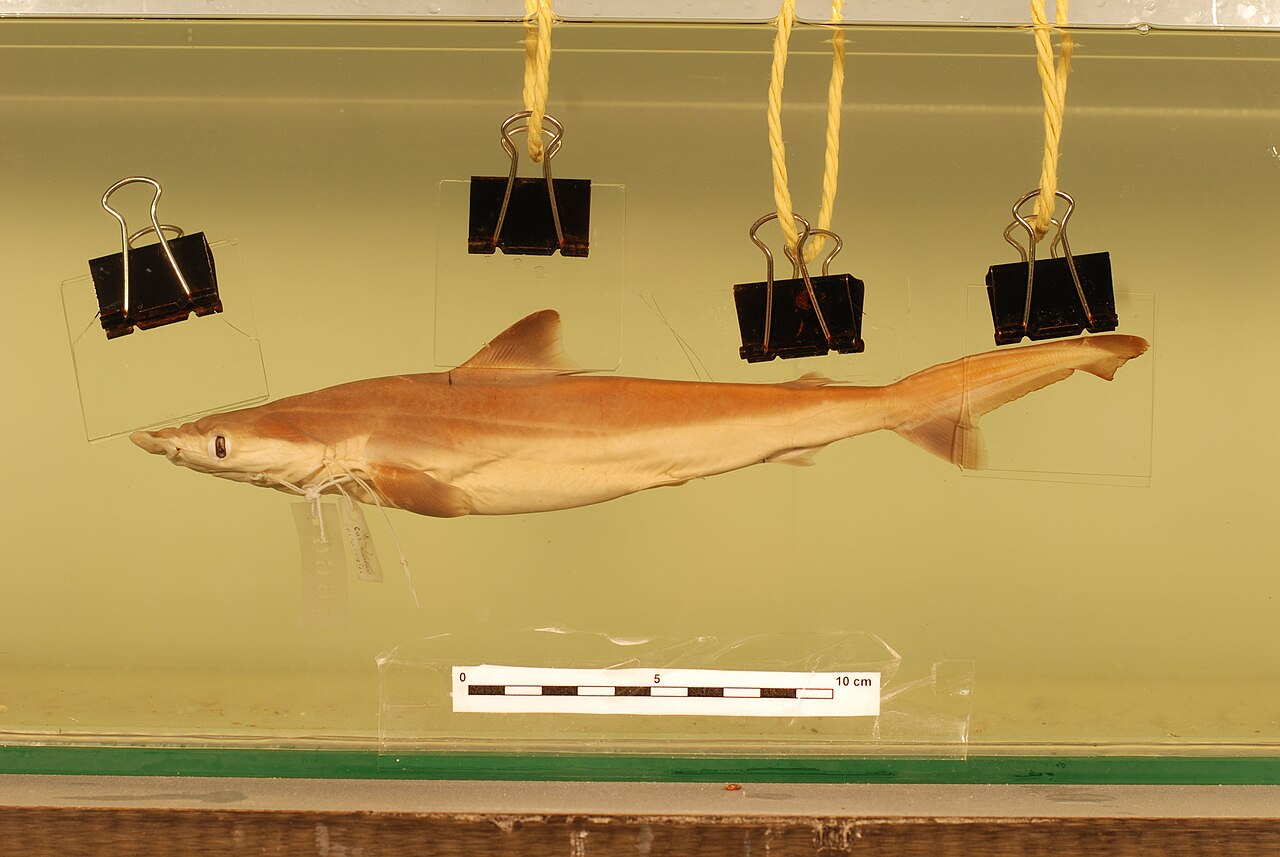
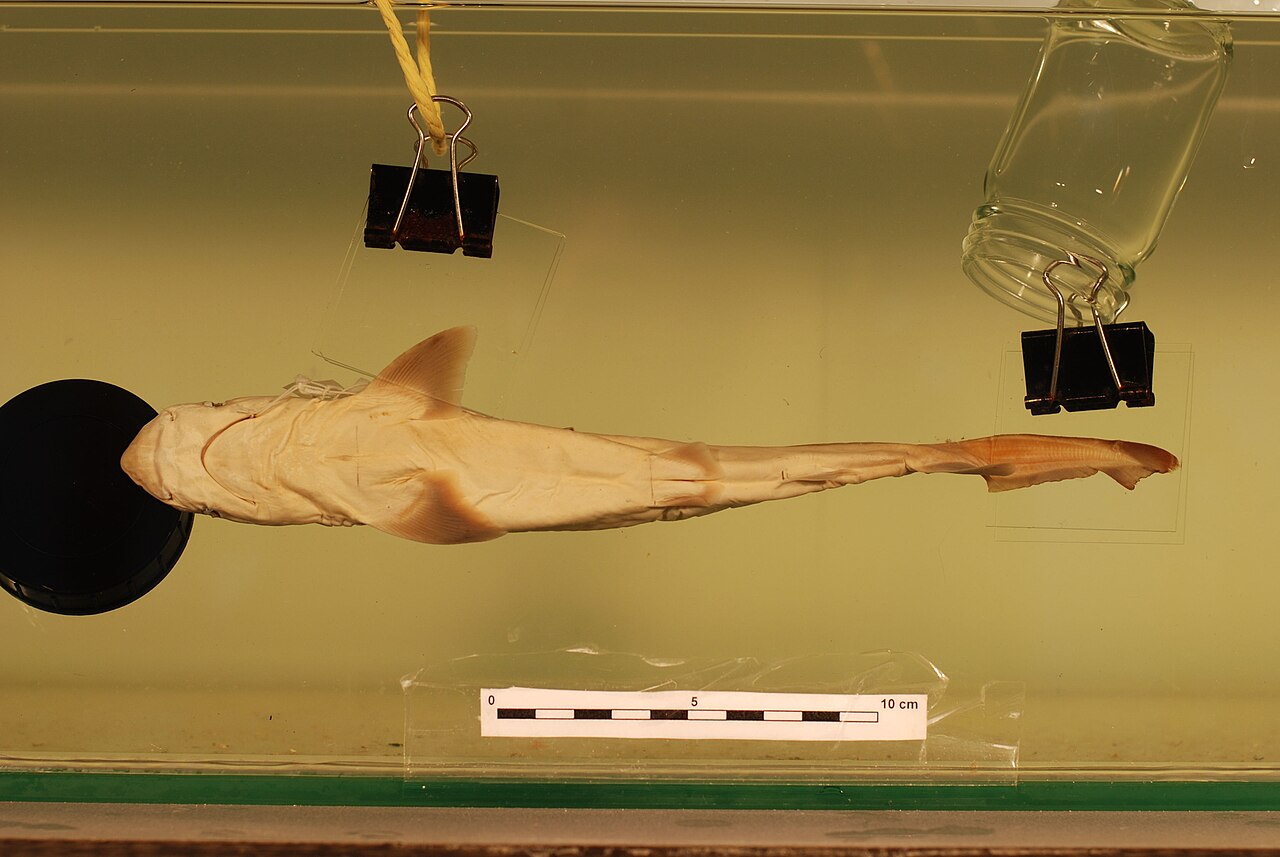
The Borneo shark presents a slender, streamlined silhouette capped by a long, pointed snout. Its nostrils are oblique and slit-like, each preceded by a narrow, nipple-shaped skin flap. The eyes are notably large and round, protected by nictitating membranes. The most diagnostically unique feature within the entire genus Carcharhinus is a row of enlarged pores sitting immediately above the corners of the sizable mouth, which itself bears short, indistinct furrows at each angle. Dentition consists of 25 to 26 rows of upper teeth and 23 to 25 rows of lower teeth; the upper set carries a single narrow, oblique cusp with strongly serrated edges and prominent cusplets along the trailing side, while the lower teeth are somewhat more slender and finely serrated. Five pairs of short gill slits line the head. The pectoral fins are short, pointed, and falcate; the pelvic fins are small and triangular. The first dorsal fin is fairly large and triangular with a blunt apex, positioned over the free rear tips of the pectoral fins. The second dorsal is small and low, originating over the middle of the anal fin base, with no ridge separating the two. The caudal peduncle features a deep crescent-shaped pit, and the asymmetrical tail fin has a well-developed lower lobe. Coloration is slate-gray dorsally, darkening toward the fin tips, with a white ventral surface extending up the flanks as a vague pale band. The largest recorded individual measures 65 centimeters.
A Vanishing Range and a Deep Fossil Heritage
Every recent specimen of the Borneo shark has been pulled from fishery landing sites at Mukah in Sarawak, despite exhaustive surveys across the rest of Borneo, including the very locality where the original type specimen was caught. This concentration suggests the species' range may now be confined to shallow, inshore waters in the northwestern corner of the island. Yet earlier records paint a broader picture: four of the five pre-2004 specimens came from Borneo, while one originated from Zhoushan Island in China. Additional, unsubstantiated reports place the shark in Borongan, Philippines, in 1895 and in Java in 1933, but no subsequent sightings have confirmed those occurrences. The species' lineage stretches far deeper than its modern scarcity implies. Fossil remains dating to the Late Miocene have been recovered from Ambug Hill in Brunei, where they lie alongside the bones of blacktip sharks and members of the genera Paragaleus, Chiloscyllium, Rhinobatos, Scoliodon, and Lamiopsis. This Miocene assemblage indicates that the Borneo shark, or a very close relative, was part of a diverse shallow-marine shark community millions of years before its present-day isolation to a single stretch of coastline.
Reproduction, Diet, and a Precarious Conservation Future
Almost nothing is confirmed about the Borneo shark's day-to-day ecology, but the available evidence points to bony fishes as its principal prey. Like its requiem-shark relatives, the species is viviparous: developing embryos are sustained by the mother through a placental connection that forms from the depleted yolk sac. Litters consist of six pups, each measuring roughly 24 to 28 centimeters at birth. Sexual maturity appears to be reached at under 55 to 58 centimeters in males and under 61 to 65 centimeters in females, based on the limited specimen data. The International Union for Conservation of Nature classifies the Borneo shark as Critically Endangered. Although an extant population has been confirmed, the species faces ongoing pressure because its entire known range falls within waters subjected to intensive artisanal and commercial fishing. It is taken by line gear and sold for meat, though it carries minimal commercial value. The combination of an extremely restricted distribution, a small population, and persistent fishing pressure means that even a confirmed surviving population remains highly vulnerable to local extinction.
Gallery
Spotted an error? Know more?
Reader corrections go straight into our review queue. Suggest an edit · How this site is sourced