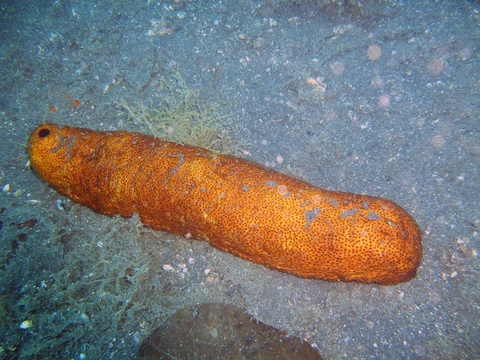
Chalky cucumber (Bohadschia marmorata)
Source-cited species reference: taxonomy from WoRMS, biology from SeaLifeBase, occurrence map from GBIF, conservation from IUCN Red List, description from Wikipedia.

Bohadschia marmorata, commonly known as the brown sandfish or chalky cucumber, is a species of sea cucumber in the family Holothuriidae. It lives on the seabed in shallow waters in the Indo-Pacific region.
- Scientific name
- Bohadschia marmorata
- Authority
- Jaeger, 1833
- Family
- Holothuriidae
- Order
- Holothuriida
- Maximum length
- 40 cm
- Depth range
- 0–20 m
- Habitat zone
- reef-associated
- Iucn red list
- Data Deficient
- Gbif occurrence records
- 722
Classification (WoRMS)
Full classification as recorded by WoRMS: Kingdom: Animalia · Phylum: Echinodermata · Class: Holothuroidea · Order: Holothuriida · Family: Holothuriidae · Genus: Bohadschia.
Accepted name: Bohadschia marmorata · Authority: Jaeger, 1833 · Taxonomic status: accepted · AphiaID: 210762.
Synonyms and superseded combinations recorded for this taxon: Holothuria (Holothuria) marmorata Jaeger, 1833; Sporadipus (Colpochirota) ualanensis Brandt, 1835.
Source: World Register of Marine Species (WoRMS) — https://www.marinespecies.org/aphia.php?p=taxdetails&id=210762 (CC BY 4.0). Accessed 2026-09-23.
Biology and life history (SeaLifeBase)
Measured values published by SeaLifeBase for Bohadschia marmorata. Only fields the database actually holds for this species are shown; these are database values, not aquarium guidance.
Maximum length: 40 cm · Depth range: 0–20 m · Habitat zone: reef-associated · Vulnerability index: 30 of 100 · Fishery importance: commercial · Aquarium trade: never/rarely.
SeaLifeBase notes: Cuverian tubules are extruded almost immediately after disturbance (Ref. 800). It occurs in coarse coral sand, from the intertidal to a depth of 20 m (Ref. 800). It is a burrowing form and comes out of the mud during cloudy days and at night (Ref. 118) being a nocturnal species (Ref. 85218). Particularly prefers reef flats and seagrass beds (Ref. 85218). Small individuals are usually buried in the sand while larger specimens are covered with a thin layer of sand (Ref. 800).
Source: SeaLifeBase species summary (SpecCode 84439) — https://www.sealifebase.se/summary/Bohadschia-marmorata.html (CC BY-NC 3.0 — non-commercial use only). Accessed 2026-09-23.
Distribution and occurrence records (GBIF)
722 georeferenced occurrence records for Bohadschia marmorata are published through GBIF from 29 countries or marine areas. The map above plots 113 distinct locations from a sample of 722 records, omitting 21 inland records that carry an institution's coordinates rather than a collection site; it shows where the species has been observed and reported, not a modelled range.
Most records by country or area: Australia (218); New Caledonia (117); Fiji (74); Vanuatu (59); Palau (45); Papua New Guinea (33); Philippines (32); Tonga (30); Madagascar (16); Mozambique (16); Micronesia (Federated States of) (11); Indonesia (11); French Polynesia (10); Guam (8); Solomon Islands (8).
Marine regions with a valid WoRMS distribution record: Mascarene Basin; Eastern Africa & Madagascar; Red Sea; Kenyan Exclusive Economic Zone; Madagascar; East Africa; Aldabra; Seychellois Exclusive Economic Zone.
Source: GBIF Occurrence Search (taxonKey 5721581) — https://www.gbif.org/occurrence/search?taxon_key=5721581&has_coordinate=true (records CC0 / CC BY); WoRMS distribution records (MarineRegions) — https://www.marinespecies.org/aphia.php?p=taxdetails&id=210762 (CC BY 4.0); Natural Earth 110m basemap — https://www.naturalearthdata.com/ (public domain). Accessed 2026-09-23.
Conservation status (IUCN Red List)
The IUCN Red List assesses Bohadschia marmorata (Jaeger, 1833) as Data Deficient (code DD). No trend, population estimate or threat analysis is given here, because none is available from this source without the Red List API; follow the source link for the full assessment, including its date.
Source: IUCN Red List of Threatened Species (taxon 180411) — https://www.iucnredlist.org/species/180411/0; GBIF IUCN Red List category endpoint (taxonKey 5721581) — https://api.gbif.org/v1/species/5721581/iucnRedListCategory. Accessed 2026-09-23.
Description and natural history (Wikipedia)
Bohadschia marmorata is cylindrical in shape and grows to about 35 cm long. The body wall is tough and leathery and has a rough texture due to the calcareous spicules it contains. It is covered in translucent papillae up to 1 cm across and a few short spines. The anterior end of the body is somewhat narrowed and has a mouth surrounded by a ring of retractile tentacles. The posterior end is rounded and has an anal opening. Adjoining this is the cloaca through which defensive white sticky threads, the cuvierian tubules, may be ejected when the animal is stressed. The cloaca is also connected to the respiratory tree, into and out of which water is pumped for gas exchange. The body colour is cream or orange partially obscured by variable numbers of dark brown speckles and blotches. On the underside is a wide pale-coloured longitudinal stripe and many short, slender tube feet with knobbly tips.
Bohadschia marmorata is found in the Indo-Pacific Ocean. The range extends from the Red Sea and east coast of Africa to Japan, the Philippines and Australia. It lives on the sandy or gravelly bottoms of shallow water areas and seagrass meadows at depths down to about 36 m. It is often semi-submerged in the sand.
Bohadschia marmorata is a detritivore. It uses its tube feet to move around and scoops sand, mud and debris into its mouth with its oral tentacles. Having processed this material in its gut, it voids the remains, leaving a characteristic trail of sand on the seabed.
Source: Wikipedia: Bohadschia marmorata — https://en.wikipedia.org/wiki/Bohadschia_marmorata (CC BY-SA 4.0). Accessed 2026-09-23.
Spotted an error? Know more?
Reader corrections go straight into our review queue. Suggest an edit · How this site is sourced