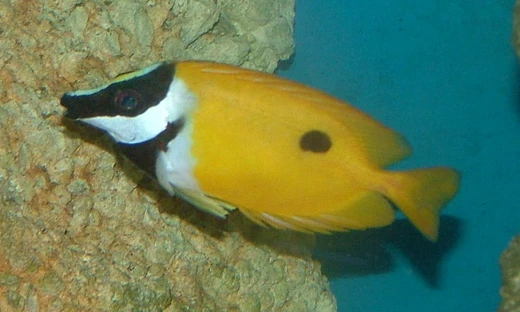
Blotched foxface (Siganus unimaculatus)
Source-cited species reference: taxonomy from WoRMS, biology from FishBase, occurrence map from GBIF, conservation from IUCN Red List, description from Wikipedia.

Rob Upchurch · CC BY 3.0
The blotched foxface (Siganus unimaculatus), also called the blackblotch foxface or one-spot foxface, is a species of marine ray-finned fish, a rabbitfish belonging to the family Siganidae. It is found at reefs and lagoons in the central Indo-Pacific. Except for the black spot on the rear upper body, it resembles the closely related foxface rabbitfish.
- Scientific name
- Siganus unimaculatus
- Authority
- (Evermann & Seale, 1907)
- Family
- Siganidae
- Order
- Acanthuriformes
- Maximum length
- 20 cm
- Habitat zone
- reef-associated
- Iucn red list
- Data Deficient
- Gbif occurrence records
- 111
Taxonomy & the Fox-Like Name
The blotched foxface traces its formal scientific lineage back to 1845, when German zoologists Hermann Schlegel and Salomon Müller first described the species under the name Amphacanthus vulpinus, designating Ternate Island in Indonesia's Molucca archipelago as the type locality. The specific epithet "vulpinus" translates to "fox-like," a reference the original authors never fully explained, though it is widely believed to allude to the fish's distinctive pointed snout. Over the years the species has accumulated a colorful array of common names—foxface, black-face rabbitfish, badger fish, and common foxface—all reflecting that fox-like facial profile. The blotched foxface (Siganus unimaculatus) is distinguished from its close relative S. vulpinus by a single prominent black spot situated below the soft-rayed portion of the dorsal fin. Despite this visible difference, the two forms coexist in the same waters and are not phylogenetically distinct. Researchers have suggested they may represent recently diverged species or, more conservatively, mere color morphs that should arguably be reunited under the single name S. vulpinus. This taxonomic ambiguity keeps the blotched foxface in a fascinating gray area of classification.
Body Plan, Coloration & Camouflage
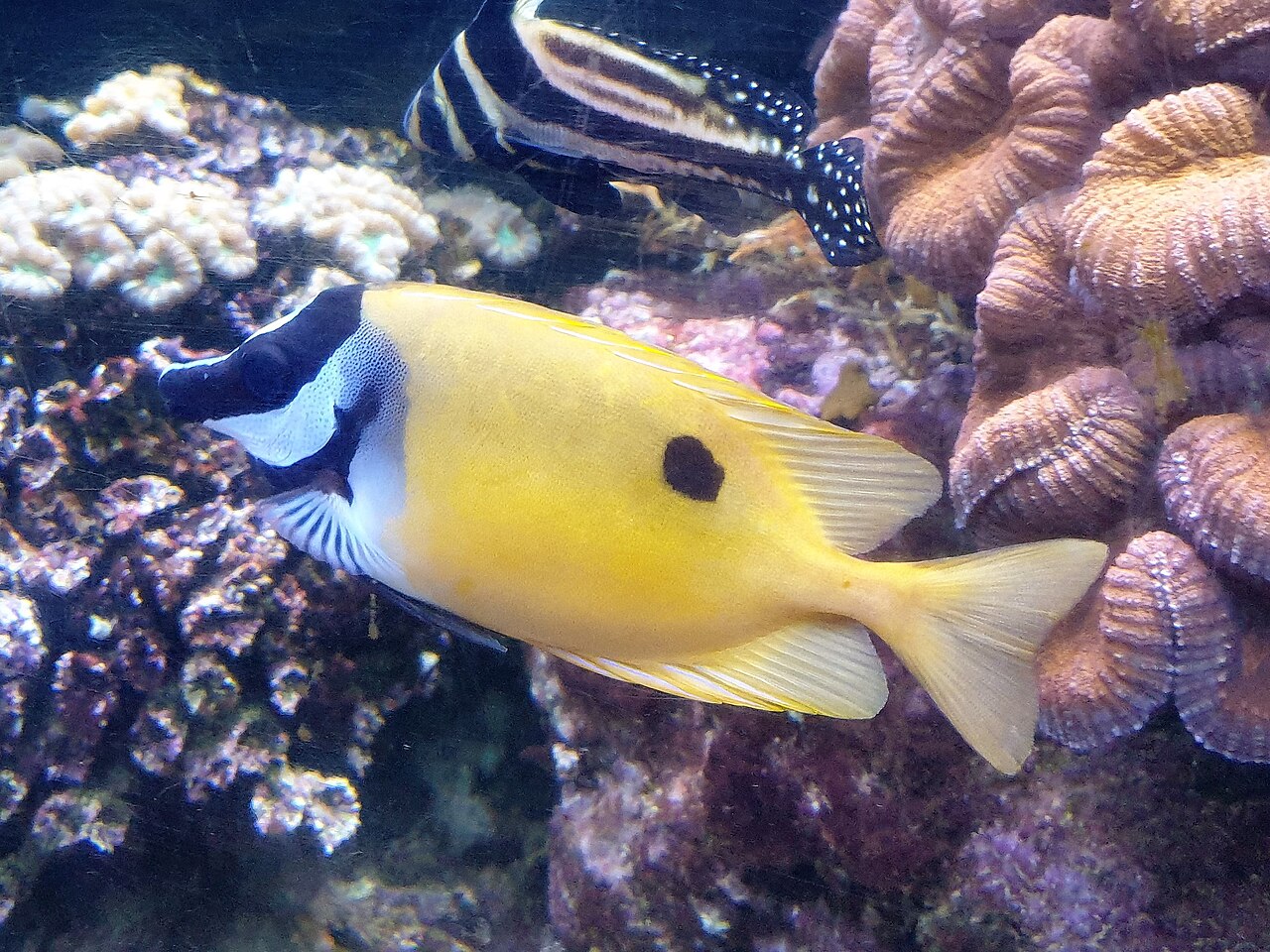
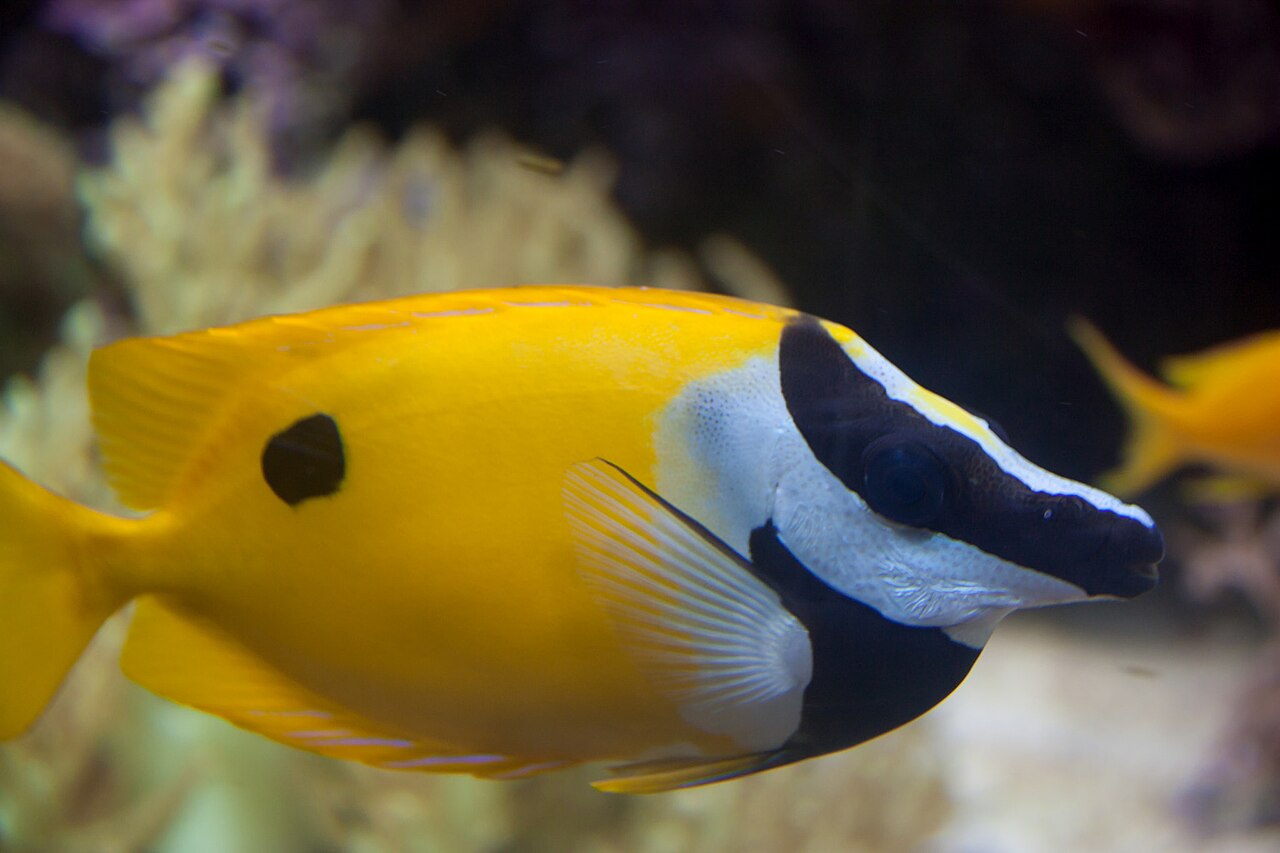
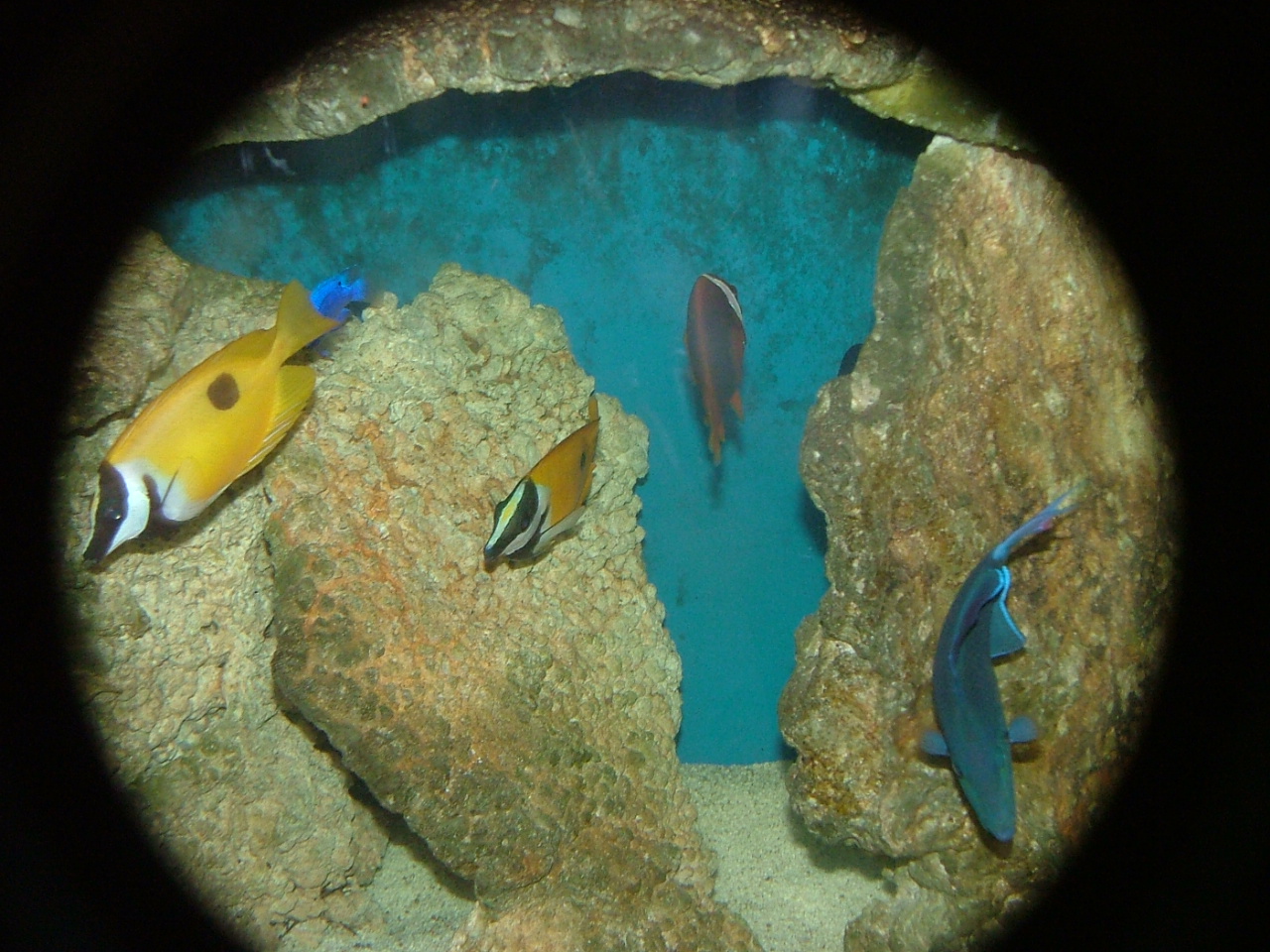
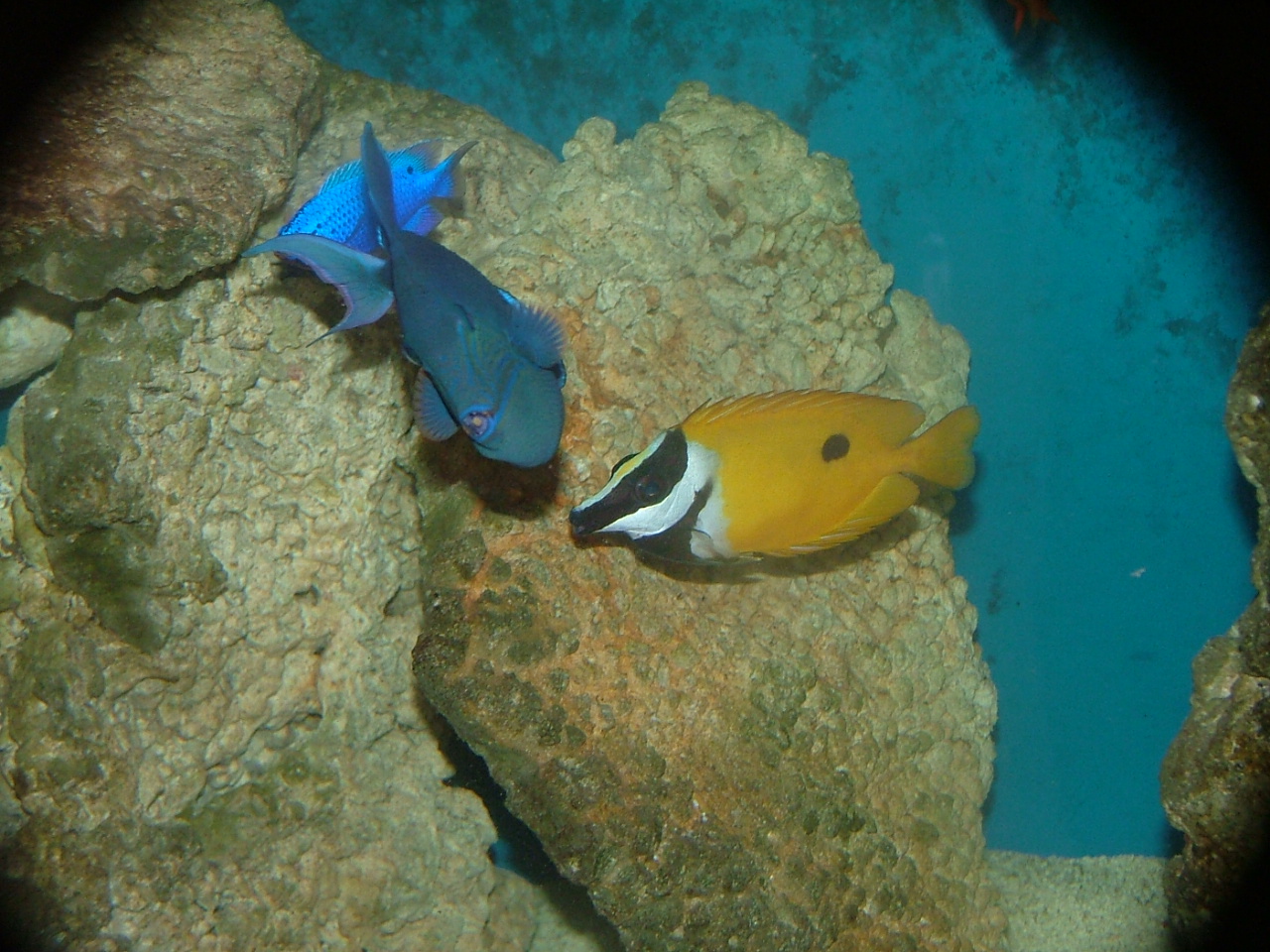
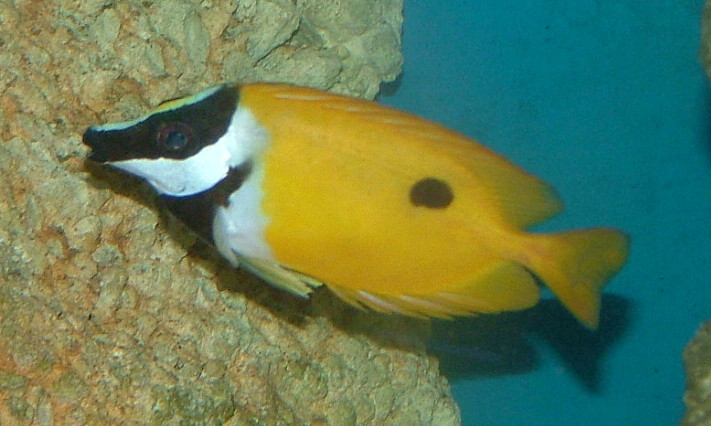
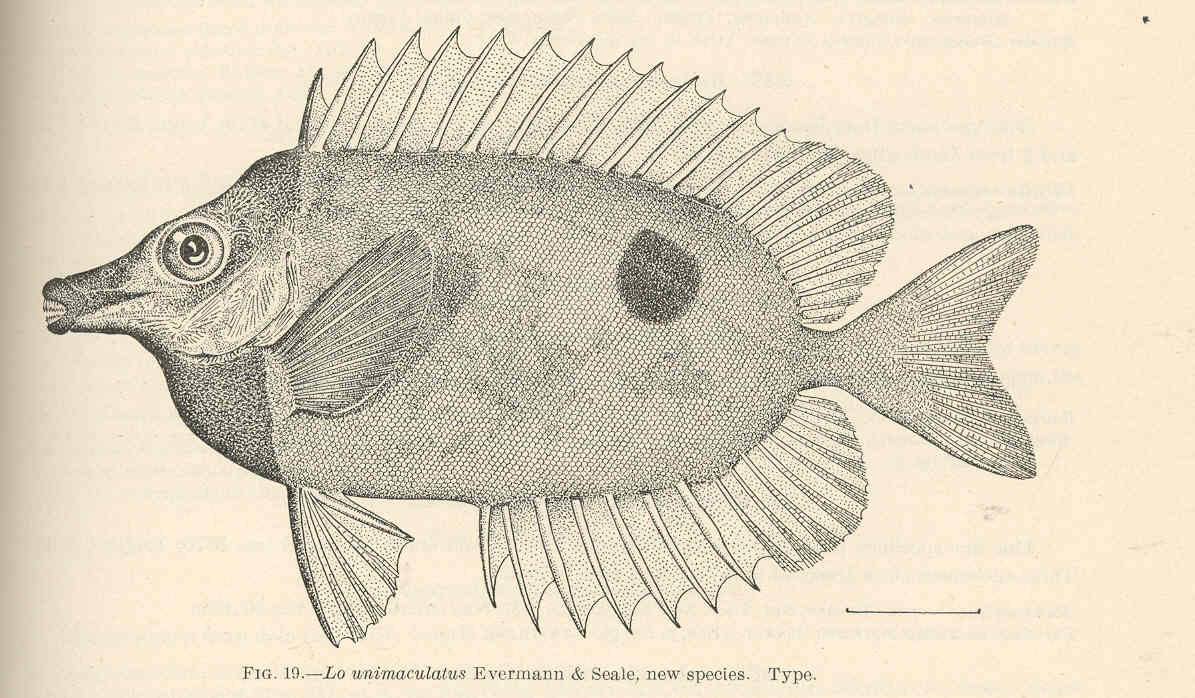
The blotched foxface is a laterally compressed marine ray-finned fish whose body depth fits into its standard length roughly 1.9 to 2.4 times, giving it a deep, compact silhouette. The head presents a steep dorsal profile behind the eye, a noticeable indentation between the two eyes, and a distinctive tubular snout that lends the fish its fox-like appearance. A procumbent spine sits in the nape just ahead of the dorsal fin, and the caudal fin is only weakly forked. The dorsal fin carries 13 spines and 10 soft rays, while the anal fin bears 7 spines and 9 soft rays—each spine housing venom glands. Adults reach a maximum total length of 25 centimeters, though 20 centimeters is more commonly observed. In its resting coloration the fish displays vivid yellow across the body with white covering the head and anterior region. A bold black band sweeps backward from the mouth, through the eye, to the base of the dorsal fin, and a dark patch on the breast tapers upward just past the pectoral-fin base. Most remarkably, when threatened the foxface can rapidly shift its entire coloration to a dark brown, effectively blending into its surroundings.
Range & Reef Habitat
The blotched foxface occupies a broad swath of the far eastern Indian Ocean and the western Pacific. Its range stretches from Indonesia eastward to the Marshall and Gilbert Islands, extends north to the waters around Taiwan, and reaches south to New Caledonia and the Australian coast. Within Australian waters the species has been documented on the northern reefs of Western Australia, at Ashmore Reef in the Timor Sea, and along the Queensland coast from the northern reaches of the Great Barrier Reef down to the Capricorn Islands. Records place the species at depths of up to 30 meters, though it is most at home in shallower environments. The foxface favors lagoons and seaward reefs characterized by abundant coral growth, and it shows a particular association with branching Acropora corals. This preference for structurally complex, coral-rich habitats makes it a familiar sight on healthy reef systems throughout its tropical range. The species' presence across such a wide geographic span—from the Moluccas to the Pacific atolls—underscores its adaptability within the coral-reef ecosystems of the Indo-Pacific.
Feeding, Social Life & Venom
As an omnivore, the blotched foxface draws its nutrition primarily from algae and zooplankton. Its social structure shifts with life stage: adults tend to be territorial, typically encountered either as solitary individuals or in pairs, and maintain a close association with branching Acropora corals. In contrast, juveniles and subadults may gather into large schools, grazing on the algae that colonize the bases of those same Acropora colonies. This transition from gregarious youth to territorial adulthood is a notable feature of its ecology. Perhaps the most consequential biological trait of the foxface is the venom it produces in the spines of its dorsal and anal fins. Research on a congener revealed that rabbitfish venom shares characteristics with the venom of stonefishes, a reminder that even a modest 20-centimeter reef fish carries a sting of comparable potency. In terms of human interaction, the species appears in the aquarium trade and occasionally turns up in mixed spearfishing catches of reef fish, though no formal catch statistics are maintained for the species.
Gallery
Frequently Asked Questions
What is the Blotched foxface (Siganus unimaculatus)?
It is a small reef-dwelling rabbitfish native to the central Indo-Pacific, most easily spotted by a single prominent black blotch on the upper rear of its body. Enthusiasts also call it the blackblotch foxface or one-spot foxface, and it belongs to the Siganidae family.
How do I tell the Blotched foxface apart from the regular foxface rabbitfish?
The two species share nearly the same body shape, size, and general coloration, so they are often confused in the field. The one reliable visual cue is that the blotched foxface carries a single dark spot on the upper rear portion of its flank, which the plain foxface lacks.
Where can I find a Blotched foxface in the wild?
This species is a reef-associated fish that hangs around coral structures and sheltered lagoons throughout the central Indo-Pacific. It does not venture into open ocean water and is typically seen near the reef face or in calm lagoon environments.
How big does a Blotched foxface get?
Adults top out at roughly 20 centimeters in total length, placing it in the small-to-medium range for reef fish. That makes it a manageable size for observation dives or well-maintained marine aquaria.
What is the full taxonomic placement of the Blotched foxface?
Siganus unimaculatus was originally described by Evermann and Seale in 1907 and sits in the genus Siganus, family Siganidae, order Acanthuriformes. As a ray-finned marine fish (Actinopterygii), it groups with other rabbitfishes and surgeonfishes under the broader acanthuriform lineage.
Spotted an error? Know more?
Reader corrections go straight into our review queue. Suggest an edit · How this site is sourced