
Blacktip shark (Carcharhinus limbatus)
Source-cited species reference: taxonomy from WoRMS, biology from FishBase, occurrence map from GBIF, conservation from IUCN Red List, description from Wikipedia.
The blacktip shark (Carcharhinus limbatus) is a species of requiem shark in the family Carcharhinidae. It is common to coastal tropical and subtropical waters around the world, including brackish habitats. Genetic analyses have revealed substantial variation within this species, with populations from the western Atlantic Ocean isolated and distinct from those in the rest of its range. The blacktip shark has a stout, fusiform body with a pointed snout, long gill slits, and no ridge between the dorsal fins. Most individuals have black tips or edges on the pectoral, dorsal, pelvic, and caudal fins. It usually attains a length of 1.5 m.
- Scientific name
- Carcharhinus limbatus
- Authority
- (Valenciennes, 1839)
- Family
- Carcharhinidae
- Order
- Carcharhiniformes
- Maximum length
- 286 cm
- Depth range
- 0–140 m
- Habitat zone
- reef-associated
- Iucn red list
- Vulnerable
- Gbif occurrence records
- 44,579
Classification (WoRMS)
Full classification as recorded by WoRMS: Kingdom: Animalia · Phylum: Chordata · Class: Elasmobranchii · Order: Carcharhiniformes · Family: Carcharhinidae · Genus: Carcharhinus.
Accepted name: Carcharhinus limbatus · Authority: (Valenciennes, 1839) · Taxonomic status: accepted · AphiaID: 105793.
Synonyms and superseded combinations recorded for this taxon: Carcharhinus aethalorus (Jordan & Gilbert, 1882); Carcharhinus natator Meek & Hildebrand, 1923; Carcharhinus pleurotaenia (Bleeker, 1852); Carcharias abbreviatus Klunzinger, 1871; Carcharias aethalorus Jordan & Gilbert, 1882; Carcharias ehrenbergi Klunzinger, 1871; Carcharias limbatus Valenciennes, 1839; Carcharias maculipinna Günther, 1868; Carcharias microps Lowe, 1841; Carcharias muelleri Steindachner, 1867; Carcharias phorcys Jordan & Evermann, 1903; Carcharias pleurotaenia Bleeker, 1852; Carcharinus limbatus (Valenciennes, 1839); Eulamia aethalorus (Jordan & Gilbert, 1882); Eulamia pleurotaenia (Bleeker, 1852); Gymnorhinus abbreviatus (Klunzinger, 1871).
Source: World Register of Marine Species (WoRMS) — https://www.marinespecies.org/aphia.php?p=taxdetails&id=105793 (CC BY 4.0). Accessed 2026-09-23.
Biology and life history (FishBase)
Measured values published by FishBase for Carcharhinus limbatus. Only fields the database actually holds for this species are shown; these are database values, not aquarium guidance.
Maximum length: 286 cm · Common length: 150 cm · Depth range: 0–140 m · Habitat zone: reef-associated · Body shape: fusiform / normal · Vulnerability index: 55.5 of 100 · Fishery importance: commercial · Aquarium trade: never/rarely.
FishBase notes: An inshore and offshore shark found on or adjacent to continental and insular shelves (Ref. 244). Often off river mouths and estuaries, muddy bays, mangrove swamps, lagoons, and coral reef drop-offs (Ref. 244). Bottom associated or pelagic (Ref. 58302). Young common along beaches (Ref. 9710). Active hunter in midwater (Ref. 5485). Feeds mainly on pelagic and benthic fishes, also small sharks and rays, cephalopods and crustaceans (Ref. 5578; 37816). Viviparous (Ref. 50449). Produces litters of one to 10 young (Ref. 26938, 1602). Incriminated in very few attacks but dangerous when provoked (Ref. 244). Often taken by shore anglers (Ref. 5485). Used fresh for human consumption, hides for leather, liver for oil (Ref. 244). Parthenogenesis has been observed in a captive female (Ref. 80664).
Source: FishBase species summary (SpecCode 874) — https://www.fishbase.se/summary/Carcharhinus-limbatus.html (CC BY-NC 3.0 — non-commercial use only). Accessed 2026-09-23.
Distribution and occurrence records (GBIF)
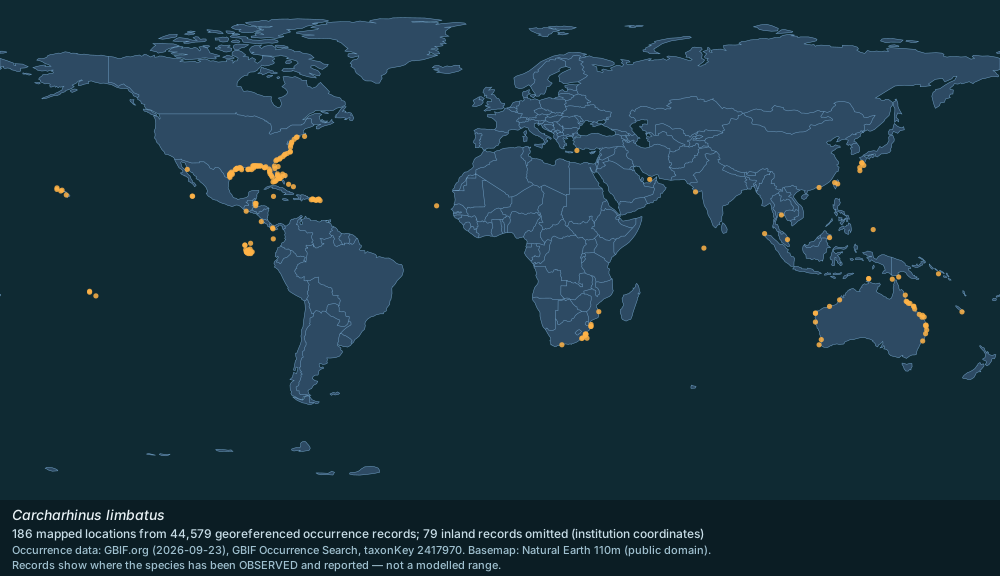
44,579 georeferenced occurrence records for Carcharhinus limbatus are published through GBIF from 93 countries or marine areas. The map above plots 186 distinct locations from a sample of 3,000 records, omitting 79 inland records that carry an institution's coordinates rather than a collection site; it shows where the species has been observed and reported, not a modelled range.
Most records by country or area: Australia (20,937); United States of America (18,136); Puerto Rico (2,445); Ecuador (653); Mexico (294).
The full country table, WoRMS marine regions and the sampling notes are on this species' Distribution page.
Source: GBIF Occurrence Search (taxonKey 2417970) — https://www.gbif.org/occurrence/search?taxon_key=2417970&has_coordinate=true (records CC0 / CC BY); WoRMS distribution records (MarineRegions) — https://www.marinespecies.org/aphia.php?p=taxdetails&id=105793 (CC BY 4.0); Natural Earth 110m basemap — https://www.naturalearthdata.com/ (public domain). Accessed 2026-09-23.
Conservation status (IUCN Red List)
The IUCN Red List assesses Carcharhinus limbatus (Valenciennes in Müller & Henle, 1839) as Vulnerable (code VU). No trend, population estimate or threat analysis is given here, because none is available from this source without the Red List API; follow the source link for the full assessment, including its date.
Source: IUCN Red List of Threatened Species (taxon 3851) — https://www.iucnredlist.org/species/3851/0; GBIF IUCN Red List category endpoint (taxonKey 2417970) — https://api.gbif.org/v1/species/2417970/iucnRedListCategory. Accessed 2026-09-23.
Description and natural history (Wikipedia)
Swift, energetic piscivores, blacktip sharks are known to make spinning leaps out of the water while attacking schools of small fish. Their demeanor has been described as "timid" compared to other large requiem sharks. Both juveniles and adults form groups of varying size. Like other members of its family, the blacktip shark is viviparous; females bear one to 10 pups every other year. Young blacktip sharks spend the first months of their lives in shallow nurseries, and grown females return to the nurseries where they were born to give birth themselves. In the absence of males, females are also capable of asexual reproduction.
Normally wary of humans, blacktip sharks can become aggressive in the presence of food and have been responsible for a number of attacks on people. This species is of importance to both commercial and recreational fisheries across many parts of its range, with its meat, skin, fins, and liver oil used. It has been assessed as vulnerable by the International Union for Conservation of Nature on the basis of its low reproductive rate and high value to fishers.
The blacktip shark was first described by French zoologist Achille Valenciennes as Carcharias (Prionodon) limbatus in Johannes Müller and Friedrich Henle's 1839 Systematische Beschreibung der Plagiostomen. The type specimens were two individuals caught off Martinique, both of which have since been lost. Later authors moved this species to the genus Carcharhinus. The specific epithet limbatus is Latin for "bordered", referring to the black edges of this shark's fins. Other common names used for the blacktip shark include blackfin shark, blacktip whaler, common or small blacktip shark, grey shark, and spotfin ground shark.
The closest relatives of the blacktip shark originally were thought to be the graceful shark (C. amblyrhynchoides) and spinner shark (C. brevipinna), due to similarities in morphology and behavior. This interpretation, though, has not been borne out by studies of mitochondrial and ribosomal DNA, which instead suggest affinity with the blacknose shark (C. acronotus). More work is required to fully resolve the relationship between the blacktip shark and other Carcharhinus species.
Analysis of mitochondrial DNA has also revealed two distinct lineages within this species, one occupying the western Atlantic and the other occupying the eastern Atlantic, Indian, and Pacific Oceans. This suggests that Indo-Pacific blacktip sharks are descended from those in the eastern Atlantic, while the western Atlantic sharks became isolated by the widening Atlantic Ocean on one side and the formation of the Isthmus of Panama on the other. Blacktip sharks from these two regions differ in morphology, coloration, and life history characteristics, and the eastern Atlantic lineage may merit species status. Fossil teeth belonging to this species have been found in Early Miocene (23–16 million-year-old) deposits in Delaware and Florida. They are also known from the Miocene of India (Odisha) and Colombia and the Pliocene of Italy.
The blacktip shark has a robust, streamlined body with a long, pointed snout and relatively small eyes. The five pairs of gill slits are longer than those of similar requiem shark species. The jaws contain 15 tooth rows on either side, with two symphysial teeth (at the jaw midline) in the upper jaw and one symphysial tooth in the lower jaw. The teeth are broad-based with a high, narrow cusp and serrated edges. The first dorsal fin is tall and falcate (sickle-shaped) with a short, free rear tip; no ridge runs between the first and second dorsal fins. The large pectoral fins are falcate and pointed.
The coloration is gray to brown above and white below, with a conspicuous white stripe running along the sides. The pectoral fins, second dorsal fin, and the lower lobe of the caudal fin usually have black tips. The pelvic fins and rarely the anal fin may also be black-tipped. The first dorsal fin and the upper lobe of the caudal fin typically have black edges. Some larger individuals have unmarked or nearly unmarked fins. Blacktip sharks can temporarily lose almost all their colors during blooms, or "whitings", of coccolithophores. This species attains a maximum known length of 2.8 m, though a length of 1.5 m is more typical, and a maximum known weight of 123 kg.
The blacktip shark has a worldwide distribution in tropical and subtropical waters. In the Atlantic, it is found from Massachusetts to Brazil, including the Gulf of Mexico and the Caribbean Sea, and from the Mediterranean Sea, Madeira, and the Canary Islands to the Democratic Republic of the Congo. It occurs all around the periphery of the Indian Ocean, from South Africa and Madagascar to the Arabian Peninsula and the Indian subcontinent, to Southeast Asia. In the western Pacific, it is found from the Ryukyu Islands of Japan to northern Australia, including southern China, the Philippines, and Indonesia. In the eastern Pacific, it occurs from Southern California to Peru. It has also been reported at a number of Pacific islands, including New Caledonia, Tahiti, the Marquesas, Hawaii, Revillagigedo, and the Galápagos.
Most blacktip sharks are found in water less than 30 m deep over continental and insular shelves, though they may dive to 64 m. Favored habitats are muddy bays, island lagoons, and the drop-offs near coral reefs; they are also tolerant of low salinity and enter estuaries and mangrove swamps. Although an individual may be found some distance offshore, blacktip sharks do not inhabit oceanic waters. Seasonal migration has been documented for the population off the East Coast of the United States, moving north to North Carolina in the summer and south to Florida in the winter.
The blacktip shark is an extremely fast, energetic predator that is usually found in groups of varying size. Segregation by sex and age does not occur; adult males and nonpregnant females are found apart from pregnant females, and both are separated from juveniles. In Terra Ceia Bay, Florida, a nursery area for this species, juvenile blacktips form aggregations during the day and disperse at night. They aggregate most strongly in the early summer when the sharks are youngest, suggesting that they are seeking refuge from predators (mostly larger sharks) in numbers. Predator avoidance may also be the reason why juvenile blacktips do not congregate in the areas of highest prey density in the bay. Adults have no known predators. Known parasites of the blacktip shark include the copepods Pandarus sinuatus and P. smithii, and the monogeneans Dermophthirius penneri and Dionchus spp., which attach the shark's skin. This species is also parasitized by nematodes in the family Philometridae (genus Philometra), which infest the ovaries.
Like the spinner shark, the blacktip shark is known to leap out of the water and spin three or four times about its axis before returning. Some of these jumps are the end product of feeding runs, in which the shark corkscrews vertically through schools of small fish, and its momentum launches it into the air. Observations in the Bahamas suggest that blacktip sharks may also jump out of the water to dislodge attached sharksuckers, which irritate the shark's skin and compromise its hydrodynamic shape. The speed attained by the shark during these jumps has been estimated to average 6.3 m/s (21 ft/s).
Blacktip sharks have a timid disposition and consistently lose out to Galapagos sharks (C. galapagensis) and silvertip sharks (C. albimarginatus) of equal size when competing for food. If threatened or challenged, they may perform an agonistic display; the shark swims towards the threat and then turns away, while rolling from side to side, lowering its pectoral fins, tilting its head and tail upwards, and making sideways biting motions. The entire sequence lasts around 25 seconds. This behavior is similar to the actions of a shark attempting to remove a sharksucker; one of these behaviors possibly is derived from the other.
Fish make up some 90% of the blacktip shark's diet.
Source: Wikipedia: Blacktip shark — https://en.wikipedia.org/wiki/Blacktip_shark (CC BY-SA 4.0). Accessed 2026-09-23.
Gallery
Related in Blacktip shark
Links follow this subject's own source article.
Elsewhere in Blacktip shark
Spotted an error? Know more?
Reader corrections go straight into our review queue. Suggest an edit · How this site is sourced