
Blacktip reef shark (Carcharhinus melanopterus)
Source-cited species reference: taxonomy from WoRMS, biology from FishBase, occurrence map from GBIF, conservation from IUCN Red List, description from Wikipedia.
The blacktip reef shark (Carcharhinus melanopterus) is a species of requiem shark, in the family Carcharhinidae, which can be easily identified by the prominent black tips on its fins (especially on the first dorsal fin and its caudal fin). Among the most abundant sharks inhabiting the tropical coral reefs of the Indian and Pacific Oceans, this species prefers shallow, inshore waters. Its exposed first dorsal fin is a common sight in the region. The blacktip reef shark is usually found over reef ledges and sandy flats, though it has also been known to enter brackish and freshwater environments. It typically attains a length of 1.6 m. Like other sharks, the females are larger than the males.
- Scientific name
- Carcharhinus melanopterus
- Authority
- (Quoy & Gaimard, 1824)
- Family
- Carcharhinidae
- Order
- Carcharhiniformes
- Maximum length
- 200 cm
- Depth range
- 0–75 m
- Habitat zone
- reef-associated
- Iucn red list
- Vulnerable
- Gbif occurrence records
- 227,611
Classification (WoRMS)
Full classification as recorded by WoRMS: Kingdom: Animalia · Phylum: Chordata · Class: Elasmobranchii · Order: Carcharhiniformes · Family: Carcharhinidae · Genus: Carcharhinus.
Accepted name: Carcharhinus melanopterus · Authority: (Quoy & Gaimard, 1824) · Taxonomic status: accepted · AphiaID: 105795.
Synonyms and superseded combinations recorded for this taxon: Carcharhinus melanoptures (Quoy & Gaimard, 1824); Carcharhinus melanoterus (Quoy & Gaimard, 1824); Carcharias commersoni (Blainville, 1816); Carcharias elegans Ehrenberg, 1871; Carcharias marianensis Engelhardt, 1912; Carcharias melanopterus Quoy & Gaimard, 1824; Carcharias playfairii Günther, 1870; Carcharinus melanoptera (Quoy & Gaimard, 1824); Carcharinus melanopterus (Quoy & Gaimard, 1824); Hypoprion playfairi (Günther, 1870); Squalus carcharias minor Forsskål, 1775; Squalus commersonii Blainville, 1816; Squalus ustus Duméril, 1824.
Source: World Register of Marine Species (WoRMS) — https://www.marinespecies.org/aphia.php?p=taxdetails&id=105795 (CC BY 4.0). Accessed 2026-09-23.
Biology and life history (FishBase)
Measured values published by FishBase for Carcharhinus melanopterus. Only fields the database actually holds for this species are shown; these are database values, not aquarium guidance.
Maximum length: 200 cm · Depth range: 0–75 m · Habitat zone: reef-associated · Body shape: fusiform / normal · Vulnerability index: 56.8 of 100 · Fishery importance: commercial · Aquarium trade: public aquariums.
FishBase notes: Inhabits shallow water close inshore on coral reefs and in the intertidal zone (reef flats), near reef drop-offs and close offshore (Ref. 244, 58302). Also found in mangrove areas, moving in and out with the tide (Ref. 6871) and even in fresh water, but not in tropical lakes and rivers far from the sea (Ref. 9997). Occurs singly or in small groups (Ref. 244, 54301). Prefers fishes but also feeds on crustaceans, cephalopods and other mollusks (Ref. 6871). Viviparous (Ref. 50449). May become aggressive to spear fishers and has been reported to bite people wading in shallow water (Ref. 6871). Reported to cause poisoning (Ref. 4690). 2 to 4 young of 46 to 52 cm are born per litter (Ref. 1602). Generally marketed fresh (as fillet), may be dried, salted, smoked (Ref. 5284) or frozen (Ref. 9987). Fins are valued for shark-fin soup (Ref. 9987); liver as source of oil (Ref. 9997). This species is commonly seen in public aquaria (Ref. 54301). Maximum reported weight from IGFA was 13.550 kg (Ref. 40637). Minimum depth reported taken from Ref. 128797.
Source: FishBase species summary (SpecCode 877) — https://www.fishbase.se/summary/Carcharhinus-melanopterus.html (CC BY-NC 3.0 — non-commercial use only). Accessed 2026-09-23.
Distribution and occurrence records (GBIF)
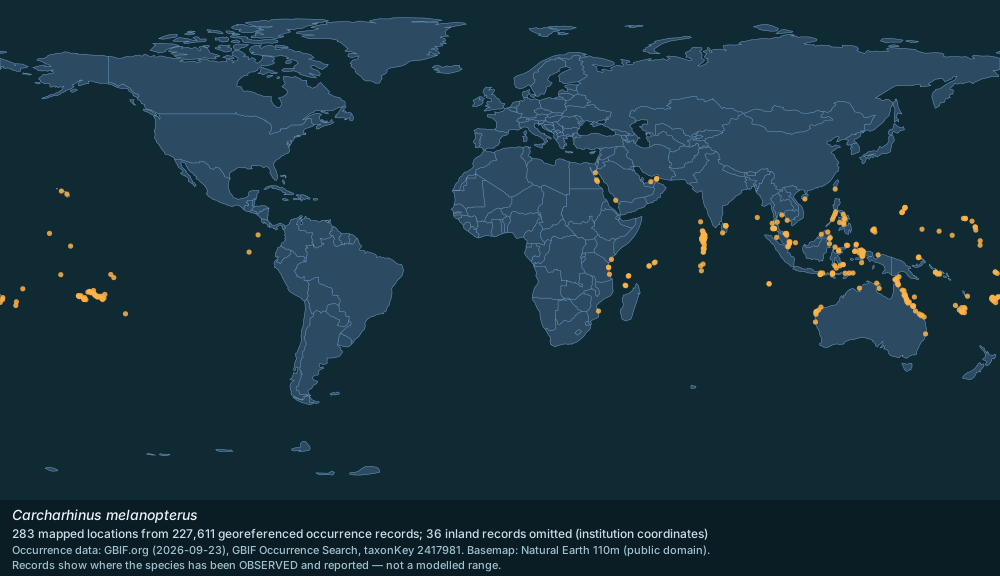
227,611 georeferenced occurrence records for Carcharhinus melanopterus are published through GBIF from 78 countries or marine areas. The map above plots 283 distinct locations from a sample of 3,000 records, omitting 36 inland records that carry an institution's coordinates rather than a collection site; it shows where the species has been observed and reported, not a modelled range.
Most records by country or area: Australia (223,256); French Polynesia (1,056); Maldives (645); Indonesia (433); United States Minor Outlying Islands (312).
The full country table, WoRMS marine regions and the sampling notes are on this species' Distribution page.
Source: GBIF Occurrence Search (taxonKey 2417981) — https://www.gbif.org/occurrence/search?taxon_key=2417981&has_coordinate=true (records CC0 / CC BY); WoRMS distribution records (MarineRegions) — https://www.marinespecies.org/aphia.php?p=taxdetails&id=105795 (CC BY 4.0); Natural Earth 110m basemap — https://www.naturalearthdata.com/ (public domain). Accessed 2026-09-23.
Conservation status (IUCN Red List)
The IUCN Red List assesses Carcharhinus melanopterus (Quoy & Gaimard, 1824) as Vulnerable (code VU). No trend, population estimate or threat analysis is given here, because none is available from this source without the Red List API; follow the source link for the full assessment, including its date.
Source: IUCN Red List of Threatened Species (taxon 39375) — https://www.iucnredlist.org/species/39375/0; GBIF IUCN Red List category endpoint (taxonKey 2417981) — https://api.gbif.org/v1/species/2417981/iucnRedListCategory. Accessed 2026-09-23.
Description and natural history (Wikipedia)
The blacktip reef shark has extremely small home ranges and exhibits strong site fidelity, remaining within the same local area for up to several years at a time. It is an active predator of small bony fish, cephalopods, and crustaceans, and has also been known to feed on sea snakes and seabirds. Accounts of the blacktip reef shark's life history have been variable and sometimes contradictory, in part reflecting geographical differences within the species. Like other members of its family, this shark is viviparous, with females giving birth to two to five young on a biennial, annual, or possibly biannual cycle. Reports of the gestation period range from 7–9, through 10–11, to possibly 16 months. Mating is preceded by the male following closely behind the female, likely attracted by her chemical signals. Newborn sharks are found further inshore and in shallower water than adults, frequently roaming in large groups over areas flooded by high tide.
Timid and skittish, the blacktip reef shark is difficult to approach and seldom poses a danger to humans unless roused by food. However, people wading through shallow water are at risk of having their legs mistakenly bitten. This shark is used for its meat, fins, and liver oil, but is not considered to be a commercially significant species. The International Union for Conservation of Nature has assessed the blacktip reef shark as Vulnerable. Although the species as a whole remains widespread and relatively common, overfishing of this slow-reproducing shark has led to its decline at a number of locales.
French naturalists Jean René Constant Quoy and Joseph Paul Gaimard originally described the blacktip reef shark during the 1817–1820 exploratory voyage of the corvette Uranie. In 1824, their account was published as part of Voyage autour du monde...sur les corvettes de S.M. l'Uranie et la Physicienne, Louis de Freycinet's 13-volume report on the voyage. The type specimen was a 59 cm-long juvenile male caught off the island of Waigeo, west of New Guinea. Quoy and Gaimard chose the name Carcharias melanopterus, from the Greek melas meaning "black" and pteron meaning "fin" or "wing", in reference to this shark's prominent fin markings.
Subsequent authors moved the blacktip reef shark to the genus Carcharhinus; in 1965 the International Commission on Zoological Nomenclature designated it as the type species for the genus. In some earlier literature, the scientific name of this shark was mistakenly given as C. spallanzani, now recognized as a synonym of the spottail shark (C. sorrah). Other common names for this species include blackfin reef shark, black-finned shark, blacktip shark, reef blacktip shark, and guliman.
Like most other members of its genus, the phylogenetic position of the blacktip reef shark remains indeterminate. Based on morphology, Jack Garrick proposed in 1982 that the closest relative of the blacktip reef shark was the nervous shark (C. cautus). Leonard Compagno's 1988 morphological analysis suggested affinity not only between this species and the nervous shark, but also four other species, and could not resolve their relationships further. A 1998 allozyme analysis by Gavin Naylor again yielded ambiguous results, finding that the blacktip reef shark forms a polytomy (irresolvable group) with 10 other Carcharhinus species.
The blacktip reef shark is found throughout nearshore waters of the tropical and subtropical Indo-Pacific. In the Indian Ocean, it occurs from South Africa to the Red Sea, including Madagascar, Mauritius, and the Seychelles, and from there eastward along the coast of the Indian subcontinent to Southeast Asia, including Sri Lanka, the Andaman Islands, and the Maldives. In the Pacific Ocean, it is found from southern China and the Philippines to Indonesia, northern Australia and New Caledonia, and also inhabits numerous oceanic islands, including the Marshall, Gilbert, Society, and Hawaiian Islands and Tuamotu. Contrary to what most sources state, there is a report suggesting that the specimens of this species from Japanese waters might be from Taiwan, however a number of sightings and captures of this species have been reported from the inshore waters of Ishigaki Island of Okinawa Prefecture in southern Japan. A Lessepsian migrant, this shark has colonized the eastern Mediterranean Sea by way of the Suez Canal.
Although it has been reported from a depth of 75 m, the blacktip reef shark is usually found in water only a few meters deep, and can often be seen swimming close to shore with its dorsal fin exposed. Younger sharks prefer shallow, sandy flats, while older sharks are most common around reef ledges and can also be found near reef drop-offs. This species has also been reported from brackish estuaries and lakes in Madagascar, and freshwater environments in Malaysia, though it is not able to tolerate low salinity to the same degree as the bull shark (C. leucas). At Aldabra in the Indian Ocean, blacktip reef sharks congregate in the channels between reef flats during low tide and travel to the mangroves when the water rises. There is equivocal evidence that sharks from the northern and southern extremes of its distribution are migratory.
A robustly built species with a streamlined "typical shark" form, the blacktip reef shark has a short, wide, rounded snout and moderately large, oval eyes. Each nostril has a flap of skin in front that is expanded into a nipple-shaped lobe. Not counting small symphysial (central) teeth, the tooth rows number 11–13 (usually 12) on either side of the upper jaw and 10–12 (usually 11) on either side of the lower jaw. The upper teeth are upright to angled and narrowly triangular in shape, bearing serrations that are more coarse on the bases; the lower teeth are similar, but more finely serrated. The teeth of adult males are more abruptly curved than those of females.
The pectoral fins are large and narrowly falcate (sickle-shaped), tapering to points. The sizable first dorsal fin is high with a curving S-shaped rear margin, and originates over the free rear tips of the pectoral fins. The second dorsal fin is relatively large with a short rear margin, and is placed opposite the anal fin. There is no ridge between the dorsal fins. This shark is a pale grayish-brown above and white below, with an obvious white band on the sides extending forward from above the anal fin. All the fins have black tips highlighted by lighter-colored borders, which are especially striking on the first dorsal fin and lower caudal fin lobe. Most blacktip reef sharks are no more than 1.6 m long, though rarely individuals may reach 1.8 m or possibly 2.0 m. The maximum weight on record with the International Game Fish Association is 13.6 kg.
Along with the grey reef shark (C. amblyrhinchos) and the whitetip reef shark (Triaenodon obesus), the blacktip reef shark is one of the three most common sharks inhabiting coral reefs in the Indo-Pacific. This species predominates in shallow habitats, while the other two are mostly found deeper. Fast-swimming and active, the blacktip reef shark may be encountered alone or in small groups; large "social" aggregations have also been observed. For the most part, juvenile and adult sharks are not segregated by sex, save for the movements of pregnant females to give birth. Individuals exhibit strong fidelity to particular areas, where they may remain for several years.
A tracking study off Palmyra Atoll in the central Pacific has found the blacktip reef shark has a home range of around 0.55 km2, among the smallest of any shark species. The size and location of the range does not change with time of day. Within this range, 3–17% of the area constitute favored hunting patches that are disproportionately occupied by the resident shark.
Source: Wikipedia: Blacktip reef shark — https://en.wikipedia.org/wiki/Blacktip_reef_shark (CC BY-SA 4.0). Accessed 2026-09-23.
Gallery
Related in Blacktip reef shark
Links follow this subject's own source article.
Elsewhere in Blacktip reef shark
Spotted an error? Know more?
Reader corrections go straight into our review queue. Suggest an edit · How this site is sourced