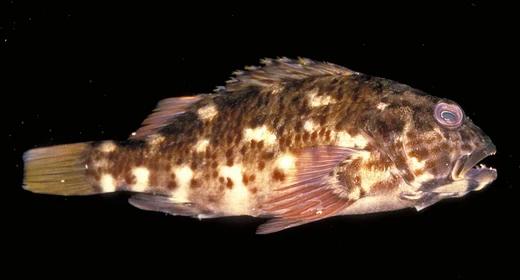
Blackspotted hawkfish (Cristacirrhitus punctatus)
Source-cited species reference: taxonomy from WoRMS, biology from FishBase, conservation from IUCN Red List, description from Wikipedia.

The blackspotted hawkfish (Cristacirrhitus punctatus) is a species of marine ray-finned fish, a hawkfish belonging to the family Cirrhitidae. It is native to rocky shores of the western Indian Ocean. This species grows to 17 cm in total length. This species is the only known member of its genus.
- Scientific name
- Cristacirrhitus punctatus
- Authority
- (Cuvier, 1829)
- Family
- Cirrhitidae
- Order
- Centrarchiformes
- Maximum length
- 17 cm
- Habitat zone
- demersal
- Iucn red list
- Least Concern
Taxonomic Journey and the Story Behind Its Name
The blackspotted hawkfish first entered the scientific record in 1829, when the French zoologist Georges Cuvier formally described it under the name Cirrhitus punctatus, assigning Madagascar as the type locality. For over seven decades, the species remained nested within the broad genus Cirrhitus, the type genus of the hawkfish family Cirrhitidae. That arrangement changed in 2001 when ichthyologist John Ernest Randall recognized enough distinguishing characteristics to warrant a new, monotypic genus: Cristacirrhitus. The genus name is a deliberate compound, blending the Latin word crista, meaning "crest," which alludes to the prominent bony ridge arching over the eye, with Cirrhitus itself, honoring the family's foundational genus. The specific epithet punctatus, simply meaning "spotted," captures the fish's most eye-catching coloration pattern of brown blotches and dark spots. Together, these two names encode both a structural oddity and a visual signature, making the full binomial Cristacirrhitus punctatus a compact summary of what sets this small hawkfish apart from its relatives.
Morphology and Distinctive Features
The blackspotted hawkfish presents a deep-bodied silhouette with a snout that is relatively short rather than dramatically elongated. Its dentition is arranged in two distinct tiers: an outer ring of prominent canine teeth and an inner row of much smaller villiform teeth, with the canines being especially large at the front of the upper jaw and along the side of the lower jaw. Two rows of cirri, along with a small flap on the posterior edge of the anterior nostril, add to its sensory apparatus. The pectoral fins are notably long and extend beyond the tips of the pelvic fins, with the lowest seven rays remaining unbranched and robust. The dorsal fin carries ten spines and eleven soft rays, while the anal fin has three spines and six soft rays. Perhaps the most striking structural feature is a bony ridge that begins just behind the eye and stretches a length equal to half the eye's diameter. The caudal fin is either truncate or rounded. Coloration consists of irregular mottling in brown and light brown across the body, while the upper two-thirds of the head are peppered with numerous small blackish spots, and a dark stripe arcs rearward from the eye.
Range and Rocky-Shore Habitat
The blackspotted hawkfish is a marine ray-finned fish whose entire known range is confined to the western Indian Ocean. It inhabits rocky shorelines, a habitat that provides the structural complexity this species appears to require. Its distribution spans a chain of coastal regions and island nations, including South Africa, Mozambique, Madagascar, Mauritius, and Réunion. Madagascar holds particular taxonomic significance as the type locality where Cuvier's original 1829 description was based. The species does not appear to extend into the eastern Indian Ocean or into other ocean basins, making its range relatively restricted compared to some of its hawkfish relatives. As a resident of rocky coastal environments, the blackspotted hawkfish occupies a niche among the benthic fauna of these western Indian Ocean waters. Its maximum published total length of 17 centimeters, roughly 6.7 inches, places it among the smaller members of the hawkfish family, a size well suited to maneuvering among the crevices and overhangs of rocky reef habitats where it is known to occur.
Singular Taxonomic Status and Ecological Niche
One of the most remarkable aspects of the blackspotted hawkfish is its taxonomic solitude: it is the only known species within the genus Cristacirrhitus, making the genus monotypic. This singular status, established by John Ernest Randall in 2001, underscores that the fish possesses a combination of traits—most notably the bony crest over the eye and its particular dentition and fin structure—that no other cirrhitid shares in quite the same way. Despite this uniqueness, the species remains modest in size, reaching a maximum of 17 centimeters in total length, and it is restricted to a relatively narrow stretch of western Indian Ocean coastline. Its mottled brown and light-brown body, combined with the dark spots and arcing stripe on the head, likely provides effective camouflage against the rocky substrates it favors. As a solitary representative of its genus, the blackspotted hawkfish occupies a small but distinct evolutionary branch within the family Cirrhitidae, a lineage of marine ray-finned fishes that has diversified across tropical and subtropical waters. Its continued presence in rocky shore habitats from South Africa to Réunion marks it as a quiet but irreplaceable component of western Indian Ocean reef biodiversity.
Spotted an error? Know more?
Reader corrections go straight into our review queue. Suggest an edit · How this site is sourced