
Blacknose shark (Carcharhinus acronotus)
Source-cited species reference: taxonomy from WoRMS, biology from FishBase, occurrence map from GBIF, conservation from IUCN Red List, description from Wikipedia.
The blacknose shark (Carcharhinus acronotus) is a species of requiem shark, belonging to the family Carcharhinidae, common in the tropical and subtropical waters of the western Atlantic Ocean. This species generally inhabits coastal seagrass, sand, or rubble habitats, with adults preferring deeper water than juveniles. A small shark typically measuring 1.3 m long, the blacknose has a typical streamlined "requiem shark" shape with a long, rounded snout, large eyes, and a small first dorsal fin. Its common name comes from a characteristic black blotch on the tip of its snout, though this may be indistinct in older individuals.
- Scientific name
- Carcharhinus acronotus
- Authority
- (Poey, 1860)
- Family
- Carcharhinidae
- Order
- Carcharhiniformes
- Maximum length
- 200 cm
- Depth range
- 9–64 m
- Habitat zone
- reef-associated
- Iucn red list
- Endangered
- Gbif occurrence records
- 625
Classification (WoRMS)
Full classification as recorded by WoRMS: Kingdom: Animalia · Phylum: Chordata · Class: Elasmobranchii · Order: Carcharhiniformes · Family: Carcharhinidae · Genus: Carcharhinus.
Accepted name: Carcharhinus acronotus · Authority: (Poey, 1860) · Taxonomic status: accepted · AphiaID: 158508.
Synonyms and superseded combinations recorded for this taxon: Prionodon cucuri Castelnau, 1855; Prionodon curcuri Castelnau, 1855; Squalus acronotus Poey, 1860.
Source: World Register of Marine Species (WoRMS) — https://www.marinespecies.org/aphia.php?p=taxdetails&id=158508 (CC BY 4.0). Accessed 2026-09-23.
Biology and life history (FishBase)
Measured values published by FishBase for Carcharhinus acronotus. Only fields the database actually holds for this species are shown; these are database values, not aquarium guidance.
Maximum length: 200 cm · Depth range: 9–64 m · Habitat zone: reef-associated · Body shape: fusiform / normal · Vulnerability index: 60.3 of 100 · Fishery importance: minor commercial · Aquarium trade: never/rarely.
FishBase notes: Found on continental and insular shelves, mainly over sandy, shell, and coral bottoms. Feeds on small fishes, including pinfish (Sparidae) and porcupine fish. Preyed on by larger sharks. Viviparous (with a yolk-sac placenta), with 3 to 6 young per litter. Performs a 'hunch' display, with back arched, caudal lowered and head raised, as a possible threat display when confronted by divers. Utilized dried salted for human consumption. Minimum depth from Ref. 055176.
Source: FishBase species summary (SpecCode 857) — https://www.fishbase.se/summary/Carcharhinus-acronotus.html (CC BY-NC 3.0 — non-commercial use only). Accessed 2026-09-23.
Distribution and occurrence records (GBIF)
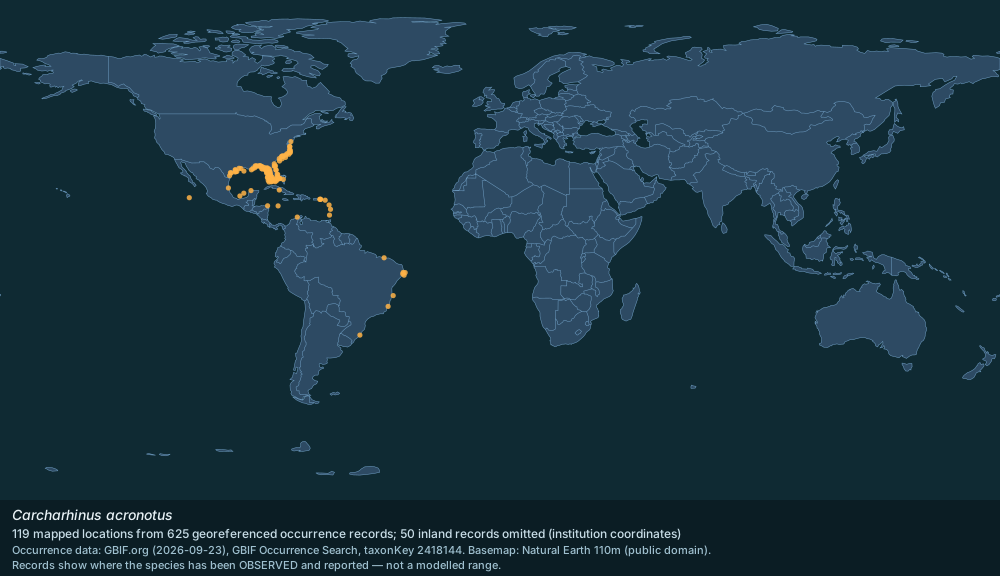
625 georeferenced occurrence records for Carcharhinus acronotus are published through GBIF from 16 countries or marine areas. The map above plots 119 distinct locations from a sample of 625 records, omitting 50 inland records that carry an institution's coordinates rather than a collection site; it shows where the species has been observed and reported, not a modelled range.
Most records by country or area: United States of America (548); Brazil (22); Bahamas (12); Mexico (12); Puerto Rico (5); Saint Barthélemy (4); Virgin Islands (U.S.) (4); Colombia (3); French Guiana (3); Guadeloupe (3); Martinique (3); Cuba (2); Honduras (1); Peru (1); Saint Vincent and the Grenadines (1).
Marine regions with a valid WoRMS distribution record: North West Atlantic; Gulf of Mexico.
Source: GBIF Occurrence Search (taxonKey 2418144) — https://www.gbif.org/occurrence/search?taxon_key=2418144&has_coordinate=true (records CC0 / CC BY); WoRMS distribution records (MarineRegions) — https://www.marinespecies.org/aphia.php?p=taxdetails&id=158508 (CC BY 4.0); Natural Earth 110m basemap — https://www.naturalearthdata.com/ (public domain). Accessed 2026-09-23.
Conservation status (IUCN Red List)
The IUCN Red List assesses Carcharhinus acronotus (Poey, 1860) as Endangered (code EN). No trend, population estimate or threat analysis is given here, because none is available from this source without the Red List API; follow the source link for the full assessment, including its date.
Source: IUCN Red List of Threatened Species (taxon 161378) — https://www.iucnredlist.org/species/161378/0; GBIF IUCN Red List category endpoint (taxonKey 2418144) — https://api.gbif.org/v1/species/2418144/iucnRedListCategory. Accessed 2026-09-23.
Description and natural history (Wikipedia)
Blacknose sharks feed primarily on small bony fishes and cephalopods, and in turn fall prey to larger sharks. Like other members of their family, they exhibit a viviparous mode of reproduction in which the developing embryos are sustained by a placental connection. The females give birth to three to six young in late spring or early summer, either annually or biennially, after a gestation period of eight to 11 months. This species is not known to attack humans, though it has been documented performing a threat display towards divers. It is of moderate commercial and recreational importance. In 2009, the U.S. National Oceanic and Atmospheric Administration announced the populations of the blacknose shark off the United States are being overfished, and proposed new conservation measures.
The Cuban naturalist Felipe Poey published the first description of the blacknose shark in 1860 as Squalus acronotus, in his Memorias sobre la historia natural de la Isla de Cuba. Later authors moved this species to the genus Carcharhinus. The type specimen was a 98-cm (3.2-ft)-long male caught off Cuba.
Based on morphological data, Jack Garrick suggested in 1982 that the blacknose shark has a sister relationship to a group containing the whitecheek shark (C. dussumieri) and the blackspot shark (C. sealei), while Leonard Compagno proposed in 1988 that this shark belongs in a group with five other species, including the silky shark (C. falciformis) and the blacktip reef shark (C. melanopterus). Molecular analyses have been similarly equivocal regarding the blacknose shark's phylogenetic relationships: Gavin Naylor's 1992 allozyme analysis found this species to be the most basal member of Carcharhinus, while Mine Dosay-Abkulut's 2008 ribosomal DNA analysis indicated affinity between it and the blacktip shark (C. limbatus) or the smalltail shark (C. porosus). The whitenose shark (Nasolamia velox), found along the tropical western coast of the Americas, may be descended from blacknose sharks that experienced the teratogenic effects of incipient cyclopia.
The blacknose shark inhabits the continental and insular shelves off the eastern coast of the Americas, as far north as North Carolina and as far south as southern Uruguay, including the Bahamas, the Gulf of Mexico, and the Caribbean Sea. They frequent coastal waters over beds of seagrass, sandy flats, and shell or coral rubble. This species is spatially segregated by size and sex. Generally, only young sharks are encountered in shallow water, as the adults prefer depths greater than 9 m and is most common at 18 - 64 m. Blacknose sharks in the South Atlantic Bight (off the Atlantic coast of the southern United States) migrate northward in the summer and southward (or possibly offshore) in the winter; a similar migration occurs for sharks in the Gulf of Mexico.
The blacknose shark has a slender, streamlined body with a long, rounded snout and large eyes. A well-developed flap of skin occurs in front of each nostril, defining the inflow and outflow openings. Twelve to 13 and 11 to 12 tooth rows occur on either side of the upper and lower jaws, respectively, with one or two teeth at the symphysis (middle). The teeth are triangular and oblique, with serrated edges; the upper teeth are stouter than the lower teeth. The five pairs of gill slits are short, measuring less a third the length of the first dorsal fin base.
The first dorsal fin is small and somewhat sickle-shaped, with a pointed apex and a short, free, rear tip; its origin lies over the free rear tips of the pectoral fins. The second dorsal fin is relatively large, though still less than half the height of the first. No ridge is seen between the dorsal fins. The pectoral fins are short and tapered. The body is covered with overlapping dermal denticles that bear five to seven longitudinal ridges (three in very young individuals) leading to three to five marginal teeth. The coloration is yellowish to greenish-gray or brown above and white to yellow below. A distinctive dark blotch at the tip of the snout is most obvious in young sharks. The tips of the second dorsal fin, upper caudal fin lobe, and sometimes the lower caudal fin lobe, are dark. Blacknose sharks are typically 1.3 - 1.4 m long and 10 kg in weight. The maximum length and weight on record is 2.0 m and 18.9 kg, respectively.
A small, fast-swimming predator, the blacknose shark feeds primarily on small, bony fishes, including pinfish, croakers, porgies, anchovies, spiny boxfish, and porcupinefish, as well as on octopus and other cephalopods. When competing for bait, their speed allows them to snatch food from larger sharks such as the Caribbean reef shark (C. perezi). This species may form large schools that are sometimes associated with anchovies and mullet. Blacknose sharks demonstrate a high degree of philopatry: both juveniles and adults have been documented returning to the same local area year after year.
Blacknose sharks are preyed upon by larger sharks, and captives have been observed to perform an apparent threat display towards encroaching divers or newly introduced members of their species. The display consists of the shark hunching its back, lowering its pectoral fins, gaping its jaws, and swimming with an exaggerated side-to-side motion. Known parasites of this species include the copepods Nesippus orientalis, Perissopus dentatus, Pandarus sinuatus, Kroyeria sphyrnae, Nemesis atlantica, and Eudactylina spinifera, as well as tapeworms in the genera Paraorygmatobothrium and Platybothrium.
As in other requiem sharks, the blacknose shark is viviparous; after the developing embryos exhaust their supply of yolk, the empty yolk sac develops into a placental connection through which the mother provides nourishment. Off the United States, males are thought to reproduce every year, while females reproduce every other year.
However, off northeastern Brazil, the female reproductive cycle is short enough to occur annually. Vitellogenesis (the formation of yolk within the ovary) occurs in the late summer, and is immediately followed by mating and fertilization in the fall, with the young being born the following spring to summer. The seasonality of these events means the reproductive cycle is offset by six months between populations in the Northern and Southern Hemispheres. The gestation period has been variously estimated at eight months off northeastern Brazil and 9–11 months off the southeastern United States.
Females typically give birth to litters of one to six pups in shallow nursery areas, such as coastal bays or mangrove swamps; one known nursery area is Bulls Bay off South Carolina. No relationship is seen between female size and the number of young. The newborns measure 38 - 50 cm long. Female blacknose sharks grow more slowly, attain a larger ultimate size, and have a longer lifespan than males. In addition, Gulf of Mexico sharks are slower-growing and longer-lived than those from the South Atlantic Bight.
In the South Atlantic Bight, both sexes mature at a fork length (from snout tip to caudal fin fork) around 90 cm, corresponding to ages of 4.3 years for males and 4.5 years for females. In the Gulf of Mexico, both sexes mature at a fork length around 85 cm, corresponding to ages of 5.4 years for males and 6.6 years for females. The maximum lifespan has been calculated as 19 years in South Atlantic Bight and 16.5 years in the Gulf of Mexico.
The blacknose shark has never been implicated in an attack on humans. However, caution should be exercised if it begins to perform a threat display. This species is regarded as a game fish and offers a respectable fight on light tackle (a more delicate fishing line). It is also of regional commercial importance, being taken intentionally and as bycatch via gillnets and surface longlines across its range, most significantly off southwestern Florida, Venezuela, and Brazil; the meat is sold dried and salted.
Source: Wikipedia: Blacknose shark — https://en.wikipedia.org/wiki/Blacknose_shark (CC BY-SA 4.0). Accessed 2026-09-23.
Gallery
Spotted an error? Know more?
Reader corrections go straight into our review queue. Suggest an edit · How this site is sourced