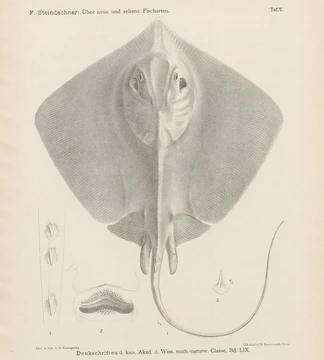
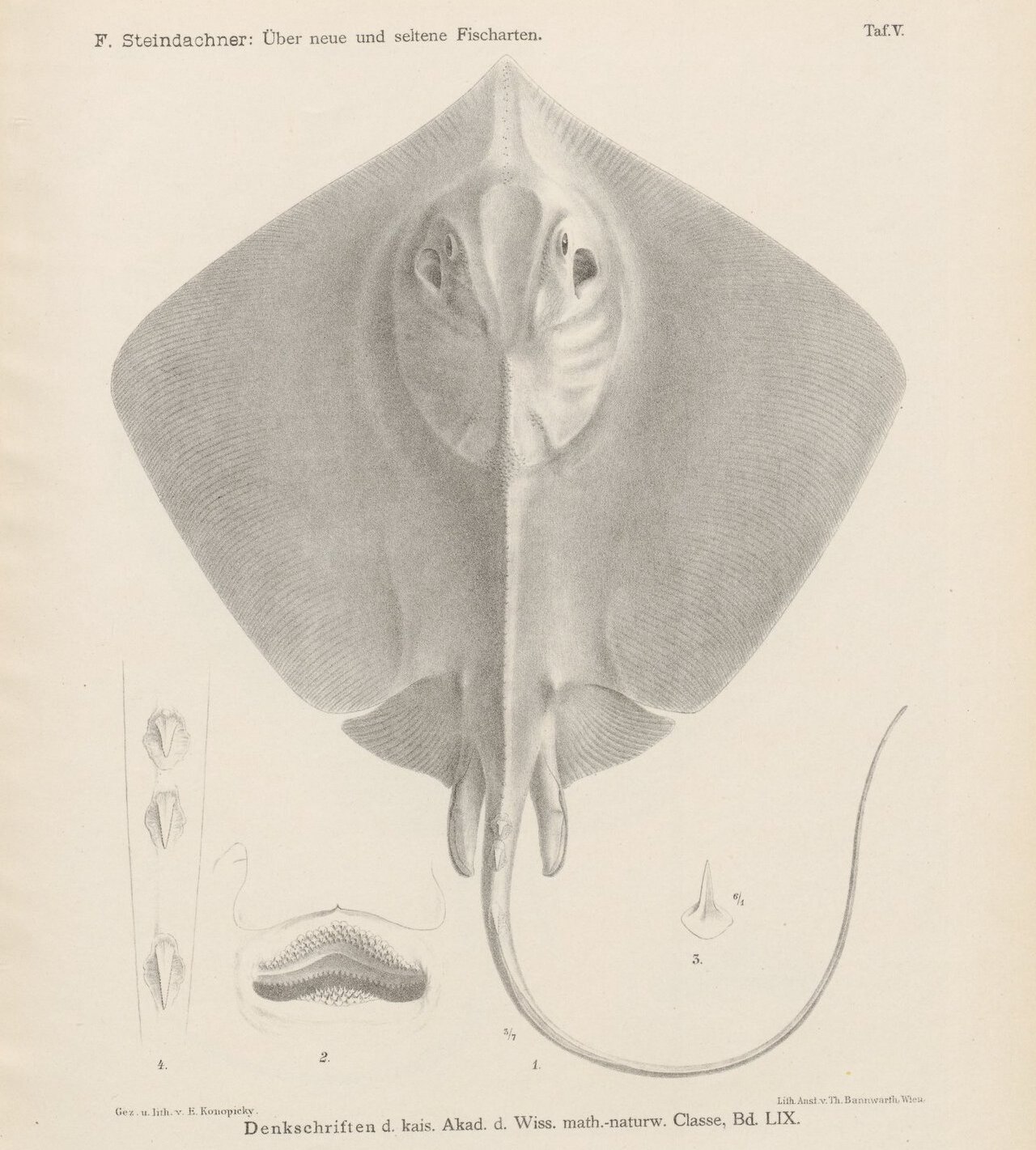
Blackish stingray (Hemitrygon navarrae)
Source-cited species reference: taxonomy from WoRMS, biology from FishBase, conservation from IUCN Red List, description from Wikipedia.

Steindachner, 1892 · Public domain
The blackish stingray (Hemitrygon navarrae) is a little-known species of stingray in the family Dasyatidae, found in the northwestern Pacific Ocean off the coasts of mainland China and Taiwan. This species reaches 38 cm across and has a chocolate brown, diamond-shaped pectoral fin disc nearly as long as wide. Its whip-like tail bears three large tubercles in front of the stinging spine, as well as both dorsal and ventral fin folds with the ventral fold half as long as the disc. Caught as bycatch in bottom trawls, the blackish stingray is frequently marketed as food in China.
- Scientific name
- Hemitrygon navarrae
- Authority
- (Steindachner, 1892)
- Family
- Dasyatidae
- Order
- Myliobatiformes
- Maximum length
- 32 cm
- Habitat zone
- demersal
- Iucn red list
- Vulnerable
Taxonomy & Discovery
The blackish stingray first entered the scientific record in 1892, when the Austrian zoologist Franz Steindachner formally described the species under the name Trygon navarrae. His account appeared in a volume of the Denkschriften der Mathematisch-Naturwissenschaftlichen Classe der Kaiserlichen Akademie der Wissenschaften in Wien, a prestigious Viennese publication of the Imperial Academy of Sciences. The holotype he examined was a male individual measuring 32 centimetres across the disc, collected from the waters off Shanghai, China. More than a century later, the species has been reclassified into the genus Hemitrygon and placed within the family Dasyatidae, the broad-nosed stingrays. Despite over 130 years since its original description, the blackish stingray remains a relatively obscure member of the group, known to most people only through its presence in Chinese fish markets rather than through any deep ecological study. Its scientific profile is therefore still thin, with much of its natural history left undocumented.
Morphology & Physical Features
Adult blackish stingrays grow to a maximum disc width of 38 centimetres and a total body length between 60 and 94 centimetres. Their most striking feature is the diamond-shaped pectoral fin disc, which is nearly as long as it is wide, with gently undulating front edges, narrowly rounded outer corners, and trailing margins that run almost straight. The triangular snout projects forward and accounts for roughly a quarter of the disc length, bearing two to three rows of enlarged sensory pores along its midline. Behind the small eyes sit a pair of proportionally larger spiracles, and the bow-shaped mouth on the ventral surface is marked by three small papillae. The dentition is notable: adults possess 40 rows of upper teeth and 37 lower rows, with males developing pointed teeth while females and juveniles retain blunt ones. The whip-like tail carries a dorsal stinging spine, flanked anteriorly by three conspicuously enlarged tubercles, and bears both dorsal and ventral fin folds, the latter measuring about half the disc length. Colouration is uniformly dark chocolate brown dorsally and pale whitish ventrally.
Range & Habitat
The blackish stingray is restricted to the northwestern Pacific, where it inhabits coastal waters along the mainland coast of China and the island of Taiwan. Its known range spans the Yellow Sea, the Bohai Sea, and the East China Sea, extending as far south as the waters surrounding Taiwan. As a benthic, bottom-dwelling species, it is typically encountered in relatively shallow, nearshore environments rather than in open ocean or deep-water settings. One notable record places the species in the estuary of the Yellow River, demonstrating its tolerance for the brackish, sediment-rich conditions found where major rivers meet the sea. Despite occupying a geographically defined and ecologically diverse stretch of coastline, the blackish stingray has received remarkably little dedicated field research. Its preference for soft-bottom, coastal habitats makes it particularly susceptible to the kinds of disturbance that accompany rapid industrial and urban development along China's eastern seaboard, a vulnerability that is explored further in the conservation context of this species.
Conservation & Human Impact
Although the blackish stingray is not a primary target of fisheries, it is regularly swept up as bycatch in commercial bottom trawling operations along the Chinese coast. Once landed, it is one of the three most commonly sold stingray species in Chinese markets, though it commands relatively low value compared with other ray species. The cumulative effect of this incidental capture, combined with what is described as intense fishing pressure across its entire range, has placed the species under significant threat. Compounding the direct fishing impact is the progressive degradation of its coastal and estuarine habitats driven by ongoing urban and industrial development along China's eastern shoreline. In recognition of these pressures, the International Union for Conservation of Nature has assessed the blackish stingray as Vulnerable. Very little is known about its reproductive biology, though it is presumed to be aplacental viviparous, consistent with other members of the family Dasyatidae. Documented parasites include the copepod Caligus dasyaticus and the monogenean Heterocotyle chinensis, offering a small window into its ecological interactions.
Gallery
Spotted an error? Know more?
Reader corrections go straight into our review queue. Suggest an edit · How this site is sourced