Blackcap basslet (Gramma melacara)
Source-cited species reference: taxonomy from WoRMS, biology from FishBase, occurrence map from GBIF, conservation from IUCN Red List, description from Wikipedia.
Last updated

The original uploader was Aquaimages at English Wikipedia. · via Wikipedia: Blackcap basslet · CC BY-SA 2.5
The blackcap basslet (Gramma melacara), or blackcap gramma, is a species of fish inhabiting reefs in the tropical western Atlantic Ocean. It prefers vertical surfaces with crevices in which it can hide. It can be found at depths from 10 to 180 m (usually between 20 and 60 m). This species can also be found in the aquarium trade.
Scientific classification
- KingdomAnimalia
- PhylumChordata
- ClassActinopterygii
- DivisionTeleostei
- OrderBlenniiformes
- FamilyGrammatidae
- GenusGramma
- SpeciesGramma melacara
Named by J. E. Böhlke & J. E. Randall, 1963
Close relatives
Other species of Gramma with a Codexery entry.
- Golden fairy basslet Gramma dejongi
- Royal gramma Gramma loreto
Sources: Wikipedia taxobox: Blackcap basslet (CC BY-SA 4.0) · differs from this box at order: WoRMS AphiaID 280933 (CC BY 4.0)
Conservation status
Least Concern (LC)
- LC▲ this species
- NT
- VU
- EN
- CR
- EW
- EX
Source: IUCN Red List assessment · GBIF copy of the Red List category
How big is it?
Largest length in the source, 0.1 m, next to a 1.8 m person.
Diagram: drawn by Codexery, schematic shapes to scale (not a likeness). Length: Wikipedia: Blackcap basslet
Where the blackcap basslet (gramma melacara) has been recorded
Each dot is a place where the species has been observed and reported (225 records, half-degree grid) — not a modelled range. 6 inland records left out (institution coordinates). 1 isolated far-off record not drawn.
Map: drawn by Codexery. Data: GBIF occurrence search (records CC0 / CC BY) · Natural Earth basemap (public domain) · place coordinates: Wikipedia (CC BY-SA 4.0)
Classification (WoRMS)
Full classification as recorded by WoRMS: Kingdom: Animalia · Phylum: Chordata · Class: Teleostei · Order: Ovalentaria incertae sedis · Family: Grammatidae · Genus: Gramma.
Accepted name: Gramma melacara · Authority: Böhlke & Randall, 1963 · Taxonomic status: accepted · AphiaID: 280933.
Source: World Register of Marine Species (WoRMS) — https://www.marinespecies.org/aphia.php?p=taxdetails&id=280933 (CC BY 4.0). Accessed 2026-09-25.
Biology and life history (FishBase)
Measured values published by FishBase for Gramma melacara. Only fields the database actually holds for this species are shown; these are database values, not aquarium guidance.
Maximum length: 10 cm · Depth range: 10–180 m · Habitat zone: reef-associated · Body shape: elongated · Vulnerability index: 10 of 100 · Fishery importance: commercial · Aquarium trade: commercial.
FishBase notes: A solitary species (Ref. 26340) found on nearly vertical cliffs and drop-offs beyond outer reefs. Often upside-down. Retreats into recesses when alarmed (Ref. 9710).
Has been reared in captivity (Ref. 35420). Most common in water more than 30 m deep. Gradually replaces G. loreto at depths of 15-30 m (Ref. 26938).
Source: FishBase species summary (SpecCode 12131) — https://www.fishbase.se/summary/Gramma-melacara.html (CC BY-NC 3.0 — non-commercial use only). Accessed 2026-09-25.
Distribution and occurrence records (GBIF)
225 georeferenced occurrence records for Gramma melacara are published through GBIF from 13 countries or marine areas. The map above plots 38 distinct locations from a sample of 225 records, omitting 6 inland records that carry an institution's coordinates rather than a collection site; it shows where the species has been observed and reported, not a modelled range.
Most records by country or area: Belize (46); Honduras (46); Bahamas (40); Colombia (29); Jamaica (19); Cuba (14); Cayman Islands (8); Mexico (8); Tonga (6); Turks and Caicos Islands (4); Martinique (3); Dominican Republic (1); Panama (1).
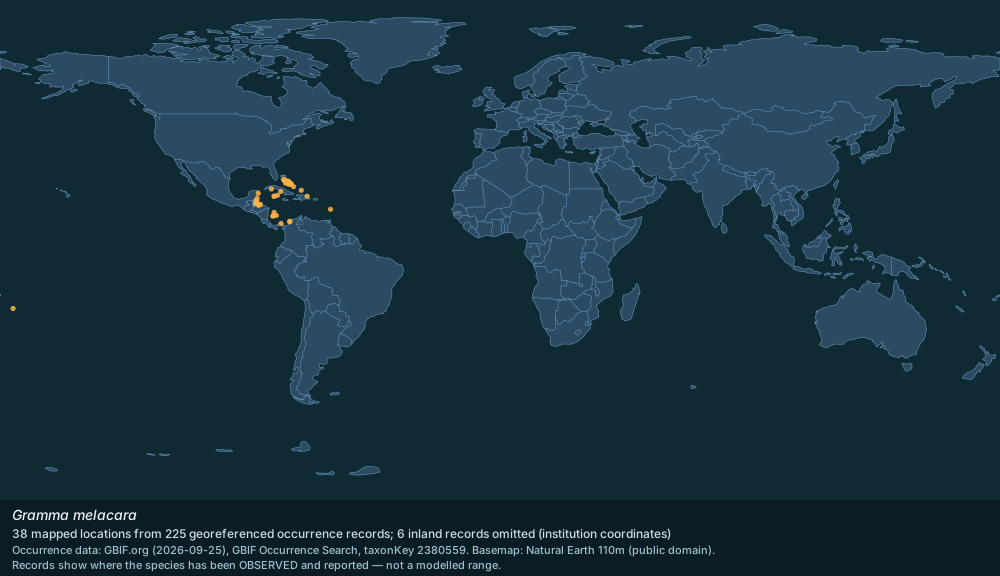
Source: GBIF Occurrence Search (taxonKey 2380559) — https://www.gbif.org/occurrence/search?taxon_key=2380559&has_coordinate=true (records CC0 / CC BY); WoRMS distribution records (MarineRegions) — https://www.marinespecies.org/aphia.php?p=taxdetails&id=280933 (CC BY 4.0); Natural Earth 110m basemap — https://www.naturalearthdata.com/ (public domain). Accessed 2026-09-25.
Conservation status (IUCN Red List)
The IUCN Red List assesses Gramma melacara Böhlke & Randall, 1963 as Least Concern (code LC). No trend, population estimate or threat analysis is given here, because none is available from this source without the Red List API; follow the source link for the full assessment, including its date.
Source: IUCN Red List of Threatened Species (taxon 185920) — https://www.iucnredlist.org/species/185920/0; GBIF IUCN Red List category endpoint (taxonKey 2380559) — https://api.gbif.org/v1/species/2380559/iucnRedListCategory. Accessed 2026-09-25.
Description and natural history (Wikipedia)
A small fish, reaching a length of 10 cm TL, it is purple with a diagonal black cap on its head. The body colour varies from magenta to purple, and there is a jet-black diagonal cap running from the lip to the fore dorsal fin. The largest scientifically measured blackcap gramma was 10.0 cm / 3.9 inches.
In the aquarium
A hardy fish, it is typically peaceful and can be kept in a reef aquarium. Care should be taken, however, to only add one fish to an aquarium, as they are territorial and do not accept other members of the same, or similar looking species in the same aquarium.
Small shrimp also may get eaten by this fish. Since it likes to hide, it should only be kept in an aquarium with large amounts of live rock. When these fish are frightened, they hide among rocks.
An aquarium that is 30 gallons or larger is ideal. If it is desired to keep more than one in an aquarium, a tank that is at least 6 feet in length should be used and they should be added at the same time.
It is not advisable to house the blackcap gramma in an aquarium smaller than 30 gallons (115 litres). A lot of rocks, crevices and caves in the set up is ideal. Since it is commonly found in deep waters, it is best to avoid sharp aquarium lights.
The blackcap gramma is considered reef compatible, and is commonly kept in reef aquariums. It should be kept in mind, however, that it might devour small invertebrates, such as copepods, amphipods, and isopods. The blackcap gramma can start acting territorially towards other fishes, including members of its own species, once it has settled in an aquarium.
The recommended water temperature for blackcap gramma is 72 – 78 F. Keep the specific gravity at 1.020-1.025 and the pH-value between 8.1 and 8.4.
The blackcap gramma is a carnivorous species that needs to be kept on a meaty diet in the aquarium. It will normally accept dead food, and it can be fed mysid shrimp, fish flesh, crustacean flesh, and mixed frozen preparations suitable for marine carnivores.
Source: Wikipedia: Blackcap basslet — https://en.wikipedia.org/wiki/Blackcap_basslet (CC BY-SA 4.0). Accessed 2026-09-25.
Sources
Compiled from Wikipedia and the sources listed below. Text from Wikipedia is available under CC BY-SA 4.0; this entry is adapted from it.
- Wikipedia: Blackcap basslet (CC BY-SA 4.0).
- Classification: the source article's taxobox; compare WoRMS, the World Register of Marine Species (CC BY 4.0).
- Conservation status: IUCN Red List assessment.
- Occurrence records: GBIF (CC0 / CC BY). Basemap: Natural Earth (public domain).
- Word definitions: the , each quoted from its Wikipedia article.
Spotted an error? Know more?
Reader corrections go straight into our review queue. Suggest an edit · How this site is sourced