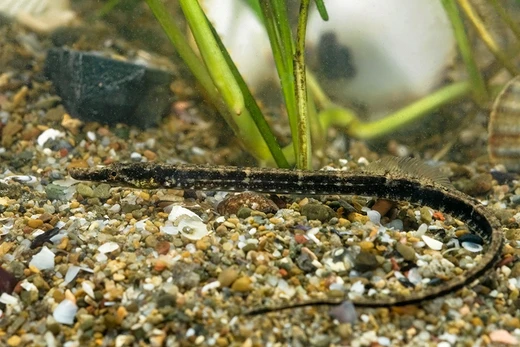
Black-striped pipefish (Syngnathus abaster)
Source-cited species reference: taxonomy from WoRMS, biology from FishBase, occurrence map from GBIF, conservation from IUCN Red List, description from Wikipedia.

The black-striped pipefish (Syngnathus abaster) is a species of fish in the family Syngnathidae. It is found in the eastern Atlantic from the southern Gulf of Biscay to Gibraltar, also in the Mediterranean and Black Seas. As the introduced species it is mentioned in the Caspian Sea and fresh waters of its basin.
- Scientific name
- Syngnathus abaster
- Authority
- Risso, 1827
- Family
- Syngnathidae
- Order
- Syngnathiformes
- Maximum length
- 22.100000381469727 cm
- Depth range
- 0–5 m
- Habitat zone
- demersal
- Iucn red list
- Least Concern
- Gbif occurrence records
- 2,418
Classification (WoRMS)
Full classification as recorded by WoRMS: Kingdom: Animalia · Phylum: Chordata · Class: Teleostei · Order: Syngnathiformes · Family: Syngnathidae · Genus: Syngnathus.
Accepted name: Syngnathus abaster · Authority: Risso, 1827 · Taxonomic status: accepted · AphiaID: 127386.
Synonyms and superseded combinations recorded for this taxon: Syngnathus abaster ganzirrensis D'Ancona, 1934; Syngnathus abaster ganzirriensis D'Ancona, 1934; Syngnathus agassiz Michahelles, 1829; Syngnathus agassizi Michahelles, 1829; Syngnathus agassizii Michahelles, 1829; Syngnathus algeriensis Günther, 1870; Syngnathus anguisigola Nardo, 1847; Syngnathus bucculentus Rathke, 1837; Syngnathus ethon Risso, 1827; Syngnathus ethon aeolicus Di Caporiacco, 1948; Syngnathus flavescens Kaup, 1856; Syngnathus microchirus Moreau, 1891; Syngnathus nigrolineatus Eichwald, 1831; Syngnathus nigrolineatus maeoticus Slastenenko, 1938.
Source: World Register of Marine Species (WoRMS) — https://www.marinespecies.org/aphia.php?p=taxdetails&id=127386 (CC BY 4.0). Accessed 2026-09-23.
Biology and life history (FishBase)
Measured values published by FishBase for Syngnathus abaster. Only fields the database actually holds for this species are shown; these are database values, not aquarium guidance.
Maximum length: 22.100000381469727 cm · Depth range: 0–5 m · Habitat zone: demersal · Body shape: eel-like · Vulnerability index: 36.4 of 100.
FishBase notes: Euryhaline, found among detritus or vegetation over sand or mud, within a temperature range of 8° to 24°C. Probably an amphidromous species (Ref. 51243) but migratory behavior needs verification. Ovoviviparous (Ref. 205). The male carries the eggs in a brood pouch which is found under the tail (Ref. 205). Early free-living young measure 23 mm TL (Ref. 6733).
Source: FishBase species summary (SpecCode 1769) — https://www.fishbase.se/summary/Syngnathus-abaster.html (CC BY-NC 3.0 — non-commercial use only). Accessed 2026-09-23.
Distribution and occurrence records (GBIF)
2,418 georeferenced occurrence records for Syngnathus abaster are published through GBIF from 22 countries or marine areas. The map above plots 47 distinct locations from a sample of 2,418 records, omitting 205 inland records that carry an institution's coordinates rather than a collection site; it shows where the species has been observed and reported, not a modelled range.
Most records by country or area: Ukraine (801); Spain (692); France (535); Russian Federation (161); Italy (57).
The full country table, WoRMS marine regions and the sampling notes are on this species' Distribution page.
Source: GBIF Occurrence Search (taxonKey 8056718) — https://www.gbif.org/occurrence/search?taxon_key=8056718&has_coordinate=true (records CC0 / CC BY); WoRMS distribution records (MarineRegions) — https://www.marinespecies.org/aphia.php?p=taxdetails&id=127386 (CC BY 4.0); Natural Earth 110m basemap — https://www.naturalearthdata.com/ (public domain). Accessed 2026-09-23.
Conservation status (IUCN Red List)
The IUCN Red List assesses Syngnathus abaster Risso, 1827 as Least Concern (code LC). No trend, population estimate or threat analysis is given here, because none is available from this source without the Red List API; follow the source link for the full assessment, including its date.
Source: IUCN Red List of Threatened Species (taxon 21257) — https://www.iucnredlist.org/species/21257/0; GBIF IUCN Red List category endpoint (taxonKey 8056718) — https://api.gbif.org/v1/species/8056718/iucnRedListCategory. Accessed 2026-09-23.
Description and natural history (Wikipedia)
Syngnathus abaster, common name the black-striped pipefish, is a close relative of the seahorse. It is usually found in the Mediterranean Sea, living in relatively shallow waters around seaweed and sea grass, and is also found in brackish waters. Pipefish are true fish. Their long, narrow bodies have an external skeleton made of bony plates, and their mouths are very small and pipe-shaped. They swim using a side to side wiggling motion that is similar to the movement of a snake or by undulation of their dorsal fin. The pipefish's diet is mainly small crustaceans, fish fry, and zooplankton. The roles males and females take on in reproduction are similar to those of male and female seahorses. The males carry the fertilized eggs in specialized pouches on their bodies. The eggs mature in this pouch, and the young are expelled through a longitudinal slit in the front of the pouch.
The black-striped pipefish is found in coastal waters and in the lower reaches of rivers in the Caspian, Black and Mediterranean Sea basins, along the European Atlantic coast from Gibraltar north to the southern part of the Bay of Biscay; in the Danube reaching west to the frontier between Romania and Hungary, as well as in the Dnieper up to Kyiv. It was introduced into reservoirs of the middle and lower Volga with mysids brought from the Don estuary, where it is now expanding its range and has been recorded to the south of Moscow.
The pipefish has significantly expanded its range within the Volga River basin. It is now a common and often abundant species in the coastal fish communities of the Lower Volga reservoirs, the unregulated section of the river, and the Volga Delta. Genetic studies suggest that the Volga pipefish populations are closely related to those from the Black Sea basin, indicating a dispersal route from the Azov-Black Sea region.
Pipefish are mainly marine, with a few species also found in freshwater. Syngnathus abaster is a marine species living in shallow-water seagrass in the Mediterranean Sea.
The long bodies are encased in bony plates resembling scales. These plates are a protective armour and serve as camouflage. Even though pipefish have these bony plates, their bodies are very flexible and have the ability to move much like snakes do. Their elongated head looks like a horse head and resembles that of the related seahorses. They also have the ability to wrap their tails around sea grasses to anchor themselves, just as sea horses do. Unlike sea horses, pipefish swim horizontally. Another unique feature is their long snout, which is where the pipefish gets its name.
As stated above, a pipefish's diet consists mostly of newborn fish and small crustaceans. As the pipefish does not chew its food, the prey needs to be small enough to fit in the mouth and be swallowed whole. The long pipe-like mouth of the pipefish is used as a sucking tool when it eats. The pipefish wraps its tail around sea grass, using it as an anchor. It patiently waits until its prey swims close, and then sucks it up, puffing out its cheeks in the process. The tube is dilated which creates a small, strong current in the water near the fish's mouth. According to Guenther Sterba, author of Freshwater Fishes of the World, the current is accompanied by a sucking noise, much like a small vacuum cleaner. Many species of large fish prey on pipefish, as do otters and blue crabs. This particular species of pipefish has no real defense against predators aside from camouflage and swimming away, making it an easy target.
The sexes can generally be differentiated by the number of bands on the body. Males have a larger number of colored bands than females do. During mating, the fish intertwine as part of a courtship dance. The female transfers the eggs to the male's brooding pouch through her long ovipositor. The brooding pouch is located near the anus of the pipefish. The eggs stay in the male's brooding pouch until the young are developed enough to be independent. At this point, the young exit the pouch with the help of muscular contractions of the male's body. If the young sense danger or feel threatened, they are able to re-enter the brooding pouch.
Source: Wikipedia: Black-striped pipefish — https://en.wikipedia.org/wiki/Black-striped_pipefish (CC BY-SA 4.0). Accessed 2026-09-23.
Frequently Asked Questions
What is the Black-striped pipefish (Syngnathus abaster)?
It is a small pipefish in the family Syngnathidae, originally described by Risso in 1827. Like other members of the order Syngnathiformes, it is a close relative of seahorses and other syngnathid species.
Where can you find the Black-striped pipefish in the wild?
Its native range spans the eastern Atlantic from the southern Gulf of Biscay down to Gibraltar, and it also occurs in the Mediterranean and Black Seas. It has additionally been recorded as an introduced species in the Caspian Sea and the fresh waters of that basin.
How big does the Black-striped pipefish get and at what depth does it live?
The species tops out at roughly 22.1 cm in total length. It is a shallow-water fish, typically encountered from the surface down to about 5 metres.
What is the full taxonomic classification of Syngnathus abaster?
It belongs to the family Syngnathidae within the order Syngnathiformes. The species authority is credited to Risso, 1827.
Is the Black-striped pipefish a freshwater species?
No, it is fundamentally a marine fish tied to coastal and semi-enclosed seas of the eastern Atlantic, Mediterranean, and Black Sea regions. Its only freshwater association is as an introduced presence in the Caspian Sea basin, not as a native habitat.
Related in Black-striped pipefish
Links follow this subject's own source article.
Elsewhere in Black-striped pipefish
Spotted an error? Know more?
Reader corrections go straight into our review queue. Suggest an edit · How this site is sourced