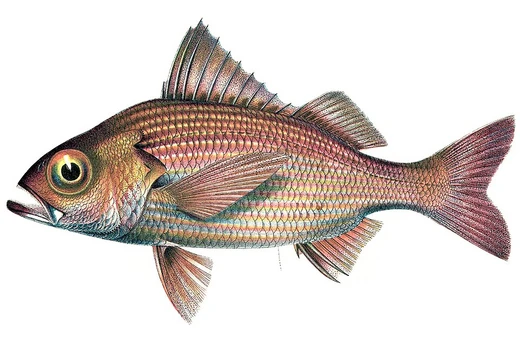
Bigeye grunt (Brachydeuterus auritus)
Source-cited species reference: taxonomy from WoRMS, biology from FishBase, occurrence map from GBIF, conservation from IUCN Red List, description from Wikipedia.

The bigeye grunt (Brachydeuterus auritus) is a species of marine ray-finned fish, a grunt belonging to the family Haemulidae. It is native to the Atlantic coast of Africa.
- Scientific name
- Brachydeuterus auritus
- Authority
- (Valenciennes, 1832)
- Family
- Haemulidae
- Order
- Eupercaria incertae sedis
- Maximum length
- 30 cm
- Depth range
- 10–100 m
- Habitat zone
- benthopelagic
- Iucn red list
- Near Threatened
- Gbif occurrence records
- 997
Classification (WoRMS)
Full classification as recorded by WoRMS: Kingdom: Animalia · Phylum: Chordata · Class: Teleostei · Order: Eupercaria incertae sedis · Family: Haemulidae · Genus: Brachydeuterus.
Accepted name: Brachydeuterus auritus · Authority: (Valenciennes, 1832) · Taxonomic status: accepted · AphiaID: 126943.
Synonyms and superseded combinations recorded for this taxon: Larimus auritus Valenciennes, 1832; Otoperca aurita (Valenciennes, 1832); Pristipoma macrophthalmus Bleeker, 1863.
Source: World Register of Marine Species (WoRMS) — https://www.marinespecies.org/aphia.php?p=taxdetails&id=126943 (CC BY 4.0). Accessed 2026-09-23.
Biology and life history (FishBase)
Measured values published by FishBase for Brachydeuterus auritus. Only fields the database actually holds for this species are shown; these are database values, not aquarium guidance.
Maximum length: 30 cm · Common length: 23 cm · Depth range: 10–100 m · Habitat zone: benthopelagic · Body shape: fusiform / normal · Vulnerability index: 19.6 of 100 · Fishery importance: highly commercial · Aquarium trade: never/rarely.
FishBase notes: Inhabits coastal waters (Ref. 2683). Semipelagic, remains near the bottom during the day and moves up to the open water at night (Ref. 5377, 57395). Occasionally enters lagoons and estuaries at start of sexual maturation (Ref. 57395). Occurs over sandy and muddy bottoms. Feeds on invertebrates and small fishes (Ref. 5535).
Source: FishBase species summary (SpecCode 400) — https://www.fishbase.se/summary/Brachydeuterus-auritus.html (CC BY-NC 3.0 — non-commercial use only). Accessed 2026-09-23.
Distribution and occurrence records (GBIF)
997 georeferenced occurrence records for Brachydeuterus auritus are published through GBIF from 20 countries or marine areas. The map above plots 53 distinct locations from a sample of 997 records, omitting 59 inland records that carry an institution's coordinates rather than a collection site; it shows where the species has been observed and reported, not a modelled range.
Most records by country or area: Senegal (169); Nigeria (146); Côte d’Ivoire (110); Ghana (96); Gabon (84); Liberia (67); Guinea-Bissau (51); Cameroon (49); Sierra Leone (46); Guinea (45); Angola (26); Equatorial Guinea (20); Benin (18); Gambia (17); Congo, Democratic Republic of the (16).
Marine regions with a valid WoRMS distribution record: European waters (ERMS scope); Beninese Exclusive Economic Zone.
Source: GBIF Occurrence Search (taxonKey 2382453) — https://www.gbif.org/occurrence/search?taxon_key=2382453&has_coordinate=true (records CC0 / CC BY); WoRMS distribution records (MarineRegions) — https://www.marinespecies.org/aphia.php?p=taxdetails&id=126943 (CC BY 4.0); Natural Earth 110m basemap — https://www.naturalearthdata.com/ (public domain). Accessed 2026-09-23.
Conservation status (IUCN Red List)
The IUCN Red List assesses Brachydeuterus auritus (Valenciennes, 1832) as Near Threatened (code NT). No trend, population estimate or threat analysis is given here, because none is available from this source without the Red List API; follow the source link for the full assessment, including its date.
Source: IUCN Red List of Threatened Species (taxon 194413) — https://www.iucnredlist.org/species/194413/0; GBIF IUCN Red List category endpoint (taxonKey 2382453) — https://api.gbif.org/v1/species/2382453/iucnRedListCategory. Accessed 2026-09-23.
Description and natural history (Wikipedia)
The bigeye grunt has an oblong, somewhat compressed body with a large eye, a snoutwhich is shorter than the diameter of its eye and a large, protrusible mouth chin. It has a deeply notched dorsal fin which contains 10-13 spines, with the 3rd spine (also occasionally the 4th) being the longest. The anal fin has 3 spines and 9-10, infrequently 8, soft rays. The caudal fin is deeply emarginate. The back is olive and the flanks and abdomen are silvery to white. There is a dark blotch on upper edge of the gill cover and there are small dark spots on the base of the dorsal fin, although these are not always present. This species attains a maximum total length of 30 cm, although 23 cm is more typical.
The bigeye grunt is found in the eastern Atlantic Ocean where it occurs along the western coast of Africa from Morocco to Angola, although it is most common from Senegal south.
The bigeye grunt is found at depths between 10 and 150 m. It can be found on Sandy and muddy substrates, moving up the water column to feed near the surface during the night. It feeds on small fish and invertebrates. This species may spawn throughout the year, becoming sexually mature at around 8 months old for males and 12 months for females, but there may be two peaks in spawning coinciding with the timing of upwellings.
The bigeye grunt was first formally described in 1832 as Larimus auritus by the French zoologist Achille Valenciennes 1794-1865) with the type locality given as Gorée in Senegal. It is the only species in the monotypic genus Brachydeuterus. The generic name is a compound of brachy meaning "short" and deuterus meaning "second", a reference to the lower Sony rayed part of the dorsal fin which is almost separated from the anterior spiny part by a deep notch. The specific name auritus means "eared" and is areference to the blotch on the gill cover.
The bigeye grunt is commercially important in many parts of West Africa, especially Ghana and Côte d'Ivoire. They are caught using bottom trawls, gill nets, set nets and push seines. They are sold fresh, smoked it processed into fish meal. it has also been used to make dish crackers when its flesh is mixed with cassava.
Source: Wikipedia: Bigeye grunt — https://en.wikipedia.org/wiki/Bigeye_grunt (CC BY-SA 4.0). Accessed 2026-09-23.
Frequently Asked Questions
What is the Bigeye grunt (Brachydeuterus auritus)?
The Bigeye grunt is a small marine ray-finned fish classified as a grunt within the family Haemulidae. It is native to the Atlantic coast of Africa and typically inhabits waters between 10 and 100 meters deep.
How large does the Bigeye grunt (Brachydeuterus auritus) grow?
This species reaches a maximum total length of roughly 30 centimeters, making it a modestly sized member of the grunt family. It occupies a depth range of about 10 to 100 meters in its native Atlantic waters.
What is the full taxonomy of the Bigeye grunt (Brachydeuterus auritus)?
The Bigeye grunt belongs to the family Haemulidae and is placed in the order Eupercaria incertae sedis. Its scientific name was established by Valenciennes in 1832, and its current classification follows the WoRMS registry.
Where can you find the Bigeye grunt (Brachydeuterus auritus) in the wild?
This grunt is native to the Atlantic coast of Africa, where it lives in marine environments at depths ranging from 10 to 100 meters. It is not known to occur outside of that region.
Who originally described the Bigeye grunt (Brachydeuterus auritus)?
The species was first formally described by the French naturalist Valenciennes in 1832. Biological details are drawn from FishBase records, while occurrence data come from the GBIF database.
Spotted an error? Know more?
Reader corrections go straight into our review queue. Suggest an edit · How this site is sourced