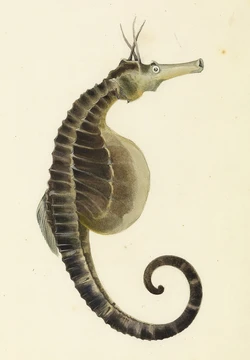
Big-belly seahorse (Hippocampus abdominalis)
Source-cited species reference: taxonomy from WoRMS, biology from FishBase, occurrence map from GBIF, conservation from IUCN Red List, description from Wikipedia.

The big-belly seahorse (Hippocampus abdominalis) or pot-bellied seahorse is one of the largest seahorse species in the world, with a length of up to 35 cm, and is the largest in Australia. Seahorses are members of the family Syngnathidae, and are teleost fishes. They are found in south-eastern Australia and New Zealand, and are listed on Appendix II of CITES. They are the only species of seahorse found in New Zealand, with a habitat range spanning from the Three Kings Island in the north all the way to the Snares Islands in the south.
- Scientific name
- Hippocampus abdominalis
- Authority
- Lesson, 1827
- Family
- Syngnathidae
- Order
- Syngnathiformes
- Maximum length
- 35 cm
- Depth range
- 0–104 m
- Habitat zone
- demersal
- Iucn red list
- Least Concern
- Gbif occurrence records
- 3,421
Classification (WoRMS)
Full classification as recorded by WoRMS: Kingdom: Animalia · Phylum: Chordata · Class: Teleostei · Order: Syngnathiformes · Family: Syngnathidae · Genus: Hippocampus.
Accepted name: Hippocampus abdominalis · Authority: Lesson, 1827 · Taxonomic status: accepted · AphiaID: 275182.
Synonyms and superseded combinations recorded for this taxon: Hippocampus agnesae Fowler, 1907; Hippocampus bleekeri Fowler, 1907; Hippocampus graciliformis McCulloch, 1911.
Source: World Register of Marine Species (WoRMS) — https://www.marinespecies.org/aphia.php?p=taxdetails&id=275182 (CC BY 4.0). Accessed 2026-09-23.
Biology and life history (FishBase)
Measured values published by FishBase for Hippocampus abdominalis. Only fields the database actually holds for this species are shown; these are database values, not aquarium guidance.
Maximum length: 35 cm · Common length: 18 cm · Depth range: 0–104 m · Habitat zone: demersal · Body shape: other · Vulnerability index: 10 of 100 · Fishery importance: of no interest · Aquarium trade: commercial.
FishBase notes: Found in large rock pools at low tide. They remain motionless amidst seaweed. Juveniles are pelagic (Ref. 30915) or attached to drifting seaweeds (Ref. 31838). Feed on minute crustaceans (e.g. copepods and amphipods). Nocturnal (Ref. 9003). Ovoviviparous (Ref. 205). The male carries the eggs in a brood pouch which is found under the tail (Ref. 205). Seen in groups at night. Also around jetties and other man-made objects; attached to sponges and colonial hydroids in deeper water (Ref. 30915). Length measurements refer to height (= TL - head length). This is the largest seahorse species in southeastern Australia, and has more dorsal fin rays and tail rings than any other seahorse (Ref. 31838). Sold locally and internationally for the aquarium trade (Ref. 31838). Dried and sold to the Oriental medicine trade as a tonic and aphrodisiac (Ref. 5316, 34026).
Source: FishBase species summary (SpecCode 46324) — https://www.fishbase.se/summary/Hippocampus-abdominalis.html (CC BY-NC 3.0 — non-commercial use only). Accessed 2026-09-23.
Distribution and occurrence records (GBIF)
3,421 georeferenced occurrence records for Hippocampus abdominalis are published through GBIF from 3 countries or marine areas. The map above plots 42 distinct locations from a sample of 3,000 records, omitting 52 inland records that carry an institution's coordinates rather than a collection site; it shows where the species has been observed and reported, not a modelled range.
Most records by country or area: Australia (2,947); New Zealand (473); United States of America (1).
The full country table, WoRMS marine regions and the sampling notes are on this species' Distribution page.
Source: GBIF Occurrence Search (taxonKey 5201032) — https://www.gbif.org/occurrence/search?taxon_key=5201032&has_coordinate=true (records CC0 / CC BY); WoRMS distribution records (MarineRegions) — https://www.marinespecies.org/aphia.php?p=taxdetails&id=275182 (CC BY 4.0); Natural Earth 110m basemap — https://www.naturalearthdata.com/ (public domain). Accessed 2026-09-23.
Conservation status (IUCN Red List)
The IUCN Red List assesses Hippocampus abdominalis Lesson, 1827 as Least Concern (code LC). No trend, population estimate or threat analysis is given here, because none is available from this source without the Red List API; follow the source link for the full assessment, including its date.
Source: IUCN Red List of Threatened Species (taxon 10057) — https://www.iucnredlist.org/species/10057/0; GBIF IUCN Red List category endpoint (taxonKey 5201032) — https://api.gbif.org/v1/species/5201032/iucnRedListCategory. Accessed 2026-09-23.
Description and natural history (Wikipedia)
The big-belly seahorse has a forward-tilted, a long-snouted head, a distended but narrow pot belly, and a long, coiled tail. They can be yellow, brown or sometimes white in colouration. It swims using its dorsal fin with a vertical stance; when not swimming, it coils its prehensile tail around any suitable growth, such as seaweed, waiting for planktonic animals to drift by, when they are sucked up by the small mouth set at the tip of the snout much like a vacuum cleaner. Seahorses are voracious feeders, eating mainly crustaceans, such as shrimp, and other small animals living among the seaweed, such as copepods and amphipods. They do not chew, so they can eat to excess because of their small gut tract. Each eye moves separately, making it easier for them to see food and predators.
Distinguishing males from females is simple: The male has a smooth, soft, pouch-like area at the base of its abdomen where the stomach meets the tail on the front side. Males also have a fin there, but it is less obvious. The female has more of a pointed stomach with a very obvious fin at the base of it.
Big-belly Seahorses (Hippocampus abdominalis) are found in both South-East Australian and New Zealand waters, typically inhabiting shallow environments such as large rock pools at low tide. They are able to remain motionless amidst seaweed which can be useful to avoid predation.
Juveniles are pelagic or attached to drifting seaweed, and adults feed on minute crustaceans like copepods and amphipods.
They are nocturnal and ovoviviparous, with the male carrying eggs in a brood pouch located under the tail. These seahorses are often observed in groups at night and can attach to sponges, colonial hydroids, or man-made structures such as jetty piles in deeper water. Typically found in waters less than 50 m (160 ft) deep, they have been observed at depths as great as 104 m (340 ft) Notably, this is the largest seahorse species in southeastern Australia, with more dorsal fin rays and tail rings than any other seahorse.
Juvenile and adult big-belly seahorses, when given a choice, prefer vegetated areas (even with artificial seagrass) over open water. They consistently choose vegetated areas, even when mysid prey is present in adjacent clear water. This preference is linked to their predatory behaviour as they rely on ambush predation.
The density of vegetation also plays a role in the seahorses' foraging success. Increasing vegetation density from low to medium habitat complexity positively impacts the capture success of both juvenile and adult big-belly seahorses who are feeding on mysid swarms. But, juvenile seahorses exhibit a decrease in the number of prey attacks in higher-density vegetation, while adult seahorses show no difference. The number of unsuccessful attacks for juveniles, is possibly due to high vegetation density disrupting prey swarm structures, which can form defensive formations. Large, cohesive prey swarms are more effective against lunging predators, but dense vegetation disrupts their structure, making them more vulnerable to ambush predators like seahorses.
Similarly, substrate preference studies revealed a strong preference for substrates with the largest diameter (0.9 mm) and the lowest density (24 mm bar length). Seahorses, known for their prehensile tails, often attach to natural and artificial substrates such as coral and aquaculture nets.
While early juveniles are pelagic in their first month of life, they display attachment to substrates, suggesting a potential preference for specific characteristics. This aligns with earlier findings that emphasize the need for appropriately sized substrates in seahorse rearing to promote optimal distribution and minimise stress.
The use of space in such a complex way also relates to mating systems, suggesting that genetic monogamy in this species arises from factors beyond just the availability of mates, involving intricate ecological and behavioural considerations too.
A home range refers to the area over which an animal travels, often in search of food or mates.
Big-belly seahorse females exhibit larger home ranges and move greater distances than males. Within the species unpaired individuals do not show increased movement compared to those who are paired. The home ranges of pair-bonded individuals tend to overlap significantly more than those of randomly chosen individuals. Both sexes tend to have home ranges that overlap with 6–10 members of the opposite sex; this suggests that mate availability is not a limiting factor for monogamy Body size does not significantly affect home range size or movement patterns of the big-belly seahorse, this challenges the idea that larger individuals would have larger space requirements due to foraging needs or mate searching. Therefore low mate availability does not necessarily drive monogamous behaviour. Ecological factors and the dynamics of pair bonding may influence spatial use and movement patterns among the species.
Juvenile big-belly seahorses have optimised growth at lower densities. Physical interference, such as tail-grasping during feeding, hinders growth and survival at higher densities, with crowding negatively affecting juvenile development. Gender segregation does not significantly impact the growth of sexually mature seahorses, although same-sex courtship behaviours are observed, suggesting that social dynamics among juveniles are more influenced by density than gender.
Source: Wikipedia: Big-belly seahorse — https://en.wikipedia.org/wiki/Big-belly_seahorse (CC BY-SA 4.0). Accessed 2026-09-23.
Frequently Asked Questions
Who is Big-belly seahorse (Hippocampus abdominalis)?
The big-belly seahorse is a large teleost fish in the Syngnathidae family, reaching up to 35 cm in length, which makes it the biggest seahorse species found in Australian waters. It was first formally described by Lesson in 1827 and belongs to the order Syngnathiformes.
What are Big-belly seahorse (Hippocampus abdominalis)'s powers/role?
As a seahorse, it grips seagrass and coral with a prehensile tail and propels itself using tiny pectoral and dorsal fins rather than a traditional tail fin. It inhabits depths from the surface down to roughly 104 metres, giving it a remarkably wide vertical range for the group.
Why is Big-belly seahorse (Hippocampus abdominalis) important?
It holds the unique distinction of being the sole seahorse species recorded in New Zealand waters, spanning from the Three Kings Islands in the far north to the Snares Islands in the south. Its size and ecological niche in seagrass beds make it a key indicator of coastal habitat health in the region.
Where does Big-belly seahorse (Hippocampus abdominalis) live?
Its range covers the south-eastern Australian coastline and the surrounding waters of New Zealand. Within New Zealand it can be encountered from the subtropical Three Kings Islands all the way down to the sub-Antarctic Snares Islands, typically in shallow seagrass meadows or rocky reef areas.
Related in Big-belly seahorse
Links follow this subject's own source article.
Elsewhere in Big-belly seahorse
Spotted an error? Know more?
Reader corrections go straight into our review queue. Suggest an edit · How this site is sourced