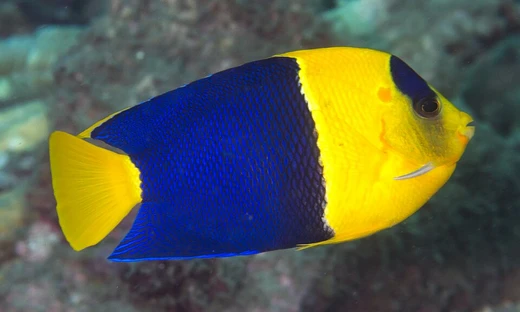
Where Bicolor angelfish has been recorded
GBIF occurrence records for Centropyge bicolor, mapped and tabulated by country.

3,139 georeferenced occurrence records with coordinates are published for Centropyge bicolor through GBIF, from 32 countries or marine areas. This page maps those records and lists where they come from. Occurrence records reflect where people have looked as well as where the species lives, so well-surveyed coastlines are over-represented.
- Georeferenced records
- 3,139
- Countries / areas
- 32
- Mapped locations
- 303
- Records sampled for the map
- 3,000
- Inland records omitted
- 37
- Gbif taxonkey
- 2396484
Physical Form & Coloration
The red-tailed black shark presents a striking silhouette in the water column. Reaching a typical length of about sixteen centimeters, though a few individuals have been measured at eighteen to twenty, the fish carries a moderately compressed, elongated body painted in deep black. Its snout projects slightly beyond a downward-facing mouth, which is flanked by two pairs of sensory barbels. Young specimens appear thin and streamlined, but as they mature their midsection deepens noticeably, a trait most pronounced in females. The most arresting feature is the caudal fin: a forked, vividly red structure whose pointed lobes actually exceed the length of the fish's own head, with the red pigment bleeding into the final scales of the peduncle. Every other fin remains black, though the pectoral fins sometimes flash orange or appear nearly transparent. The large triangular dorsal fin stretches from midbody back toward the peduncle, its longest ray matching the fish's depth. Stress, illness, or degraded water can cause the brilliant tail coloration to dim and fade, a useful visual cue for keepers monitoring their health.
Range & Conservation Status
Native exclusively to Thailand, the red-tailed black shark occupies lowland streams, rivers, and creeks across the lower Mae Khlong, Chao Phraya, and Bangpakong basins. When Hugh McCormick Smith described the species in 1931, he noted it was not uncommon in the Borapet Swamp region of central Siam and its tributary streams, and he recorded it in the Chao Phraya as far south as Bangkok. A 1934 expedition even netted a specimen in the Silom canal. The fish favors fast-flowing water with dense vegetation, large rocks, and rocky or sandy substrates. Yet conservation prospects have darkened dramatically. Between 1996 and 2011 the species was presumed extinct in the wild. By 2011 only a single, tightly localized population persisted somewhere in the Chao Phraya basin, and the fish was considered extirpated from the rest of its former range. A lone specimen surfaced in 2013 in a rocky dam along the mainstream of the Mae Khlong River in Muang District, western Thailand. Today the species carries a critically endangered designation, a stark contrast to its thriving presence in aquariums worldwide.
Behavior & Temperament
In the water column the red-tailed black shark moves with a fluid, oscillatory glide that has earned it its shark-like common name. It is a fast, active benthic swimmer that patrols the bottom around rocks and vegetation, scanning for food. Its diet is broadly omnivorous: insects, small crustaceans, worms, detritus, plant matter, and algae scraped from surfaces all feature on the menu, and it will opportunistically scavenge any recently deceased fish or animal it encounters. Despite its moderate size, the species is notoriously territorial and aggressive. It establishes a personal territory and will chase and harass any tankmate that ventures too close. Its intolerance of conspecifics is particularly acute; two red-tailed black sharks in the same tank will almost certainly fight. The fish is also a capable jumper and can clear the rim of an unlidged aquarium with ease, a behavior that catches many hobbyists off guard. In captivity these fish typically live five to eight years, and their lively, bottom-oriented activity makes them a constant presence in the lower reaches of any community tank.
Captive Breeding & the Aquarium Trade
Every red-tailed black shark available in the aquarium trade today is the product of captive breeding, a necessity given the species' critically endangered status in the wild. Despite their popularity among freshwater hobbyists, prized for the dramatic contrast between their jet-black bodies and blazing red-orange tails, breeding them in a home setup is practically impossible. The fish's extreme aggression and intolerance toward its own kind make pairing and spawning extraordinarily difficult. Even among enthusiasts, almost nothing is documented about natural spawning triggers, mate-selection cues, competitive behaviors, or environmental conditions that might prompt reproduction. Captive breeding became feasible no earlier than 1987, and it relies on injecting a hormone mixture to force ovulation. The procedure carries a devastating cost: post-spawning mortality can reach eighty percent. The physiological stress of hormone-induced spawning leaves both the adults and their fry vulnerable to bacterial infections, particularly Streptococcus iniae, making each successful brood a genuine rarity in the hobby.
Frequently Asked Questions
How many countries or marine areas has the Bicolor angelfish been recorded in?
GBIF data places Centropyge bicolor occurrence records across 32 countries or marine areas. The distribution page visualizes 303 distinct mapped locations drawn from a 3,000-record sample of the 3,139 total georeferenced entries.
How many georeferenced occurrence records exist for Bicolor angelfish?
There are 3,139 georeferenced occurrence records with coordinates published for Centropyge bicolor through GBIF. Of those, 37 inland records were omitted from the map, and 3,000 were sampled for the distribution visualization.
Why do some coastlines show far more Bicolor angelfish records than others?
Occurrence data captures where people have looked as much as where the species actually lives. Well-surveyed coastlines naturally accumulate more sightings, so they are over-represented in the dataset relative to less-studied regions.
What is the GBIF taxonKey for Bicolor angelfish?
The GBIF taxonKey assigned to Centropyge bicolor is 2396484. This identifier lets researchers pull and cross-reference every occurrence record for the species across the GBIF network.
How many mapped locations does the Bicolor angelfish distribution page display?
The page shows 303 mapped locations for Centropyge bicolor. These points come from a 3,000-record sample of the 3,139 total georeferenced entries, with 37 inland records excluded from the map.
Related in Bicolor angelfish
Links follow this subject's own source article.
Elsewhere in Bicolor angelfish
Spotted an error? Know more?
Reader corrections go straight into our review queue. Suggest an edit · How this site is sourced