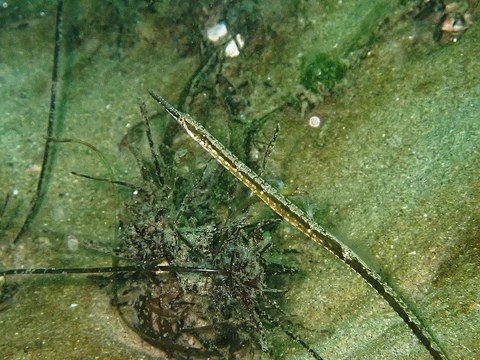
Where Kelp pipefish has been recorded
GBIF occurrence records for Syngnathus californiensis, mapped and tabulated by country.

2,069 georeferenced occurrence records with coordinates are published for Syngnathus californiensis through GBIF, from 5 countries or marine areas. This page maps those records and lists where they come from. Occurrence records reflect where people have looked as well as where the species lives, so well-surveyed coastlines are over-represented.
- Georeferenced records
- 2,069
- Countries / areas
- 5
- Mapped locations
- 87
- Records sampled for the map
- 2,069
- Inland records omitted
- 62
- Gbif taxonkey
- 2332936
Anatomy and Physical Distinctiveness
The snake pipefish presents a strikingly streamlined silhouette among its relatives, boasting an elongated, slender body with smooth skin and a rounded cross-section. What sets it apart from other pipefish sharing the same waters is the near-complete absence of bony rings along its body. Its long head carries a thin dark lateral stripe, a concave snout, and a tiny protractile mouth suited for suction-feeding. The dorsal fin, anchored on a long base, fans out 37 to 47 short rays, while the caudal fin is barely more than a nub; pectoral and anal fins are entirely absent in adults. Colouration runs pale brown to yellowish-green, with 28 to 31 body segments delineated by pale blue rings edged in dark pigment. The gill opening has been reduced to a mere pore above the opercle, and the gill membranes are fused to both the body wall and the isthmus. Sexual dimorphism is notable: females can reach 60 centimetres while males top out around 40, though typical lengths sit closer to 45 and 32 centimetres respectively. Juveniles under 70 millimetres still bear small membranous pectoral fins that vanish as they mature.
Geographic Range and Polar Expansion
As the largest pipefish recorded in European waters, Entelurus aequoreus holds a broad but geographically bounded home in the northeastern Atlantic. Its core range stretches from Iceland and Norway southward to the Azores, and it penetrates into the Baltic Sea, yet it is conspicuously absent from the Mediterranean. The species has long been associated with coastal algal communities, but a remarkable shift occurred in the early 2000s when its distribution pushed well beyond its traditional northern boundary. Individuals were documented as far north as Svalbard and the Barents Sea, marking a clear incursion into Arctic waters. This poleward expansion represented a significant shift beyond the species' previously known northern limits and underscored the fluidity of marine species boundaries in a changing ocean. Despite this northward push, the snake pipefish remains a creature of the open, deeper waters of the northeastern Atlantic rather than a truly circumglobal species. Its range, while impressive for a syngnathid, is still bounded by the geography of the Atlantic basin, and it does not extend into the enclosed waters of the Mediterranean, underscoring the ecological barriers that still shape its distribution.
Habitat, Camouflage, and Reproductive Strategy
Unlike many of its pipefish kin that cling to shallow coastal weed beds, the snake pipefish occupies more open and considerably deeper water, typically between 10 and 100 metres. It threads through kelp forests, deep-water seaweeds, and seagrass meadows of Zostera marina, though both juveniles and large adults have occasionally been captured in fully pelagic open water. Its pale brown or yellowish-green body, ringed with pale blue markings, blends seamlessly into these algal environments, providing effective camouflage against predators. Reproduction follows a distinctive pattern in mid-summer: males and females pair up, and the female deposits over 1,000 fertilised eggs, each roughly 1.2 millimetres across, onto a layer of sticky mucus lining a groove on the male's belly. The eggs remain there until they hatch, making the species ovoviviparous. Newly hatched fry drift as pelagic larvae until they reach about 12 millimetres in length, at which point they presumably settle into vegetated habitats. Adults are active suction-feeders, drawing in small crustaceans and larval fish with their tiny protractile mouths.
Ecological Ripples and Unlikely Predation
The snake pipefish's population dynamics in the early 2000s created an unexpected chain of ecological consequences. On the Waddensee sand flats, the invasion of the Japanese seaweed Sargassum muticum provided new structural habitat, and snake pipefish numbers swelled in response, taking advantage of the additional refuge the foreign kelp offered. This population boom drew the attention of seabirds, particularly auks and terns, whose traditional diet of sand-eels had been declining. Desperate for protein, these birds began capturing pipefish and attempting to feed them to their nestlings. The results were grim: the pipefish's bony, hard-bodied structure made them extremely difficult to digest, and their nutritional profile was far inferior to the oily flesh of sand-eels. Many chicks choked on the indigestible bodies, highlighting a stark mismatch between the predator's needs and the prey's physical composition. The episode illustrated how a single species' habitat shift can ripple through a food web, forcing predators into suboptimal foraging choices with costly consequences for their young.
Frequently Asked Questions
How many georeferenced occurrence records exist for Kelp pipefish?
There are 2,069 georeferenced records with coordinates currently published for Syngnathus californiensis through GBIF. All 2,069 of those records were sampled and included on the distribution map.
In how many countries or marine areas has Kelp pipefish been recorded?
Records span five countries or marine areas in total. The distribution page maps 87 distinct locations drawn from those five regions.
Why do some coastlines show far more Kelp pipefish records than others?
Occurrence data reflects not only where the species actually lives but also where researchers and collectors have done their sampling. Well-surveyed coastlines naturally accumulate more records, so they appear over-represented on the map.
Were all records included on the Kelp pipefish distribution map?
Almost all of them—62 inland records were omitted from the map, leaving the remaining entries to represent the species' marine and coastal range.
What is the GBIF taxonKey for Kelp pipefish?
The GBIF taxonKey assigned to Syngnathus californiensis is 2332936. Fans can use that identifier to pull the full set of georeferenced records directly from the GBIF portal.
Related in Kelp pipefish
Links follow this subject's own source article.
Elsewhere in Kelp pipefish
Spotted an error? Know more?
Reader corrections go straight into our review queue. Suggest an edit · How this site is sourced