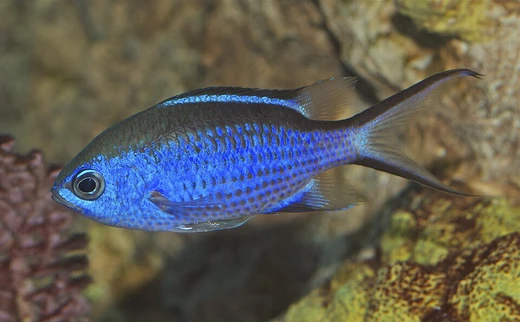
Where Blue chromis has been recorded
GBIF occurrence records for Azurina cyanea, mapped and tabulated by country.

1,614 georeferenced occurrence records with coordinates are published for Azurina cyanea through GBIF, from 35 countries or marine areas. This page maps those records and lists where they come from. Occurrence records reflect where people have looked as well as where the species lives, so well-surveyed coastlines are over-represented.
- Georeferenced records
- 1,614
- Countries / areas
- 35
- Mapped locations
- 137
- Records sampled for the map
- 1,614
- Inland records omitted
- 21
- Gbif taxonkey
- 12157075
Physical Form and Reproductive Strategy
The blue tilapia is a member of the cichlid family, a group of freshwater fish known for diverse reproductive behaviors. In its introduced populations across the United States, adults typically measure between 120 and 200 millimetres in length and can weigh up to five or six pounds. However, the species is capable of growing considerably larger; the single biggest specimen on record exceeded twenty-one inches in length and tipped the scales at more than ten pounds. Reproduction follows the mouthbrooding pattern common to many cichlids: a single female carries her clutch in her oral cavity, with brood sizes ranging from as few as 160 eggs to as many as 1,600. Dietarily, the species is predominantly herbivorous, grazing on plant material, though adults will occasionally supplement their intake with zooplankton. Juveniles, by contrast, incorporate small invertebrates into their feeding repertoire, reflecting the dietary flexibility that likely contributes to the fish's success in varied and often disturbed aquatic environments.
Native Waters and Extraordinary Environmental Tolerance
The blue tilapia's ancestral waters span Northern and Western Africa as well as the Middle East. Within Africa, its native distribution includes the Senegal, Niger, Benue, and lower Nile river systems, while in the Middle East it is indigenous to the Jordan River. The species is fundamentally a freshwater and brackish-water inhabitant, occupying streams, rivers, lakes, and ponds across its range. What makes it particularly remarkable, however, is its extraordinary physiological tolerance. It thrives in water temperatures between 12 and 32 degrees Celsius but can endure extremes from 8 to 40 degrees. Even more striking is its salt tolerance: the fish survives in hypersaline conditions reaching 4.5 percent salinity, which exceeds the roughly 3.5 percent found in open seawater. This combination of thermal and osmotic resilience means the blue tilapia can persist in habitats where many other cichlids would perish, a trait that has undoubtedly aided its establishment in the diverse and often stressed waterways of its introduced ranges.
Ecological Disruption Across the American South and West
Since its first introduction into Florida in 1961, the blue tilapia has steadily expanded its footprint throughout the American South and West, becoming the most widespread non-native fish species in the state of Florida, with confirmed populations reaching as far north as Lake Alice near Gainesville. Its ecological consequences are severe and well documented. In the Taylor Slough region of Everglades National Park, the species has fundamentally altered the structure of the native fish community, making it a persistent management challenge for the National Park Service. In Texas, the tilapia was at one point responsible for suppressing the largemouth bass population in Lake Trinidad, Henderson County, until it was eradicated from that water body. It is also implicated in the decline of native unionid mussels in two separate Texas waterways. Further west, in Nevada, the species is blamed for a dramatic collapse of native fish populations at Warm Springs Natural Area. The original American stock traces back to Israel, and the fish continues to spread, compounding its environmental damage across multiple states.
Cultural Identity and Global Footprint
Beyond its ecological notoriety, the blue tilapia carries a rich cultural identity in its native Middle Eastern waters. In Israel, it is traditionally called the Jordan St. Peter's fish, a name rooted in the long-standing practice of catching it as it migrates downstream from Lake Huleh through the Jordan River into the Sea of Galilee. Locals distinguish it from the smaller, white Common St. Peter's fish (the redbelly tilapia) and from the Galilee St. Peter's fish (the mango tilapia), both of which share the St. Peter's label but differ in color and size. In South Africa, the same species goes by the name blue kurper. Globally, the fish has been introduced to Central and South America, Southeast Asia, and even the Volga River basin in Russia, where a self-sustaining population has been confirmed near heated discharge outflows from a power plant. Many of these introductions were originally intended to provide a food source or to manage excessive aquatic vegetation, and in some regions the species was long misidentified as the closely related Oreochromis niloticus before the two were formally distinguished.
Frequently Asked Questions
How many locations has Blue chromis been recorded in?
Blue chromis has 1,614 georeferenced occurrence records spread across 35 countries or marine areas, with 137 distinct mapped locations on the distribution page. All of these points are drawn from GBIF's published dataset for Azurina cyanea.
Why do some coastlines show way more Blue chromis records than others?
Occurrence data reflects as much where people have looked as where the fish actually lives, so heavily surveyed regions naturally dominate the counts. Well-studied coastlines are over-represented relative to less-explored areas with the same species present.
How many countries or marine areas does the Blue chromis distribution cover?
The distribution spans 35 countries or marine areas. Twenty-one inland records were dropped from the map because they do not represent valid marine observations of this reef-associated species.
Where does the Blue chromis distribution map get its data from?
The map is built from GBIF occurrence records indexed under taxon key 12157075 for Azurina cyanea. All 1,614 sampled records used for plotting are publicly available through that platform.
How many distinct mapped points appear on the Blue chromis distribution page?
The page plots 137 mapped locations drawn from the full set of 1,614 georeferenced records. These points illustrate the geographic spread of observations across the 35 included countries and marine areas.
Elsewhere in Blue chromis
Spotted an error? Know more?
Reader corrections go straight into our review queue. Suggest an edit · How this site is sourced