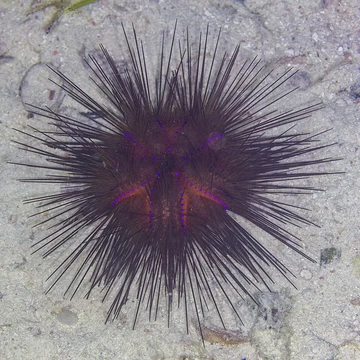
Blue-spotted sea urchin (Astropyga radiata)
Source-cited species reference: taxonomy from WoRMS, biology from SeaLifeBase, occurrence map from GBIF, description from Wikipedia.

Julia Sumangil · CC BY-SA 4.0
Astropyga radiata, the red urchin, fire urchin, false fire urchin or blue-spotted urchin, is a species of sea urchin in the family Diadematidae. It is a large species with long spines and is found in the tropical Indo-Pacific region. It was first described in 1778 by the German naturalist Nathaniel Gottfried Leske.
- Scientific name
- Astropyga radiata
- Authority
- (Leske, 1778)
- Family
- Diadematidae
- Order
- Diadematoida
- Depth range
- 0–70 m
- Habitat zone
- reef-associated
- Gbif occurrence records
- 628
A Star at the Center: Form and Color
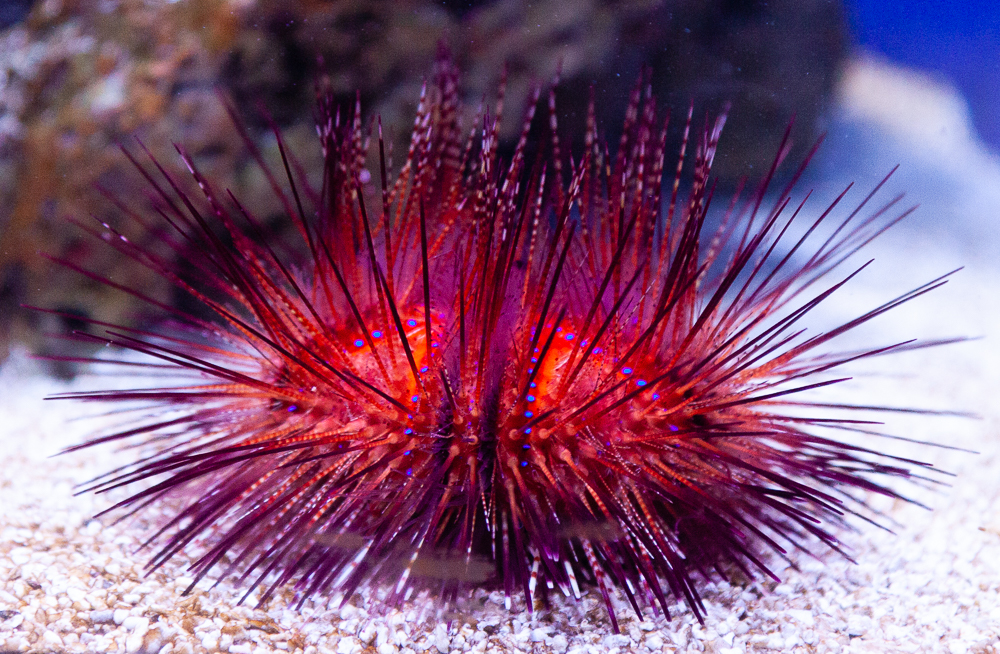
The blue-spotted sea urchin is an imposing creature, its test reaching a diameter of up to twenty centimeters and presenting a flattened or gently concave upper surface. What immediately draws the eye, however, is the pattern of coloration. Five vertical clusters of long, hollow spines—each up to four centimeters in length—radiate across the body, separated by V-shaped bare patches. Those bare interambulacral zones glow red and are studded with lines of iridescent blue dots, giving the animal its popular blue-spotted name. The remaining test and spines shift across a palette of reddish brown, purple, dark brown, or near-black. Two spine types exist; the shorter variety carries venom. A prominent anal sac, brown with a dark tip, sits at the center of the upper surface. The genus name Astropyga references this very feature: the star-shaped pattern surrounding the anus. Radiata, meaning radiant, nods to the overall brilliance of the coloration. Juveniles display transverse banding on their spines, a trait that occasionally lingers into adulthood.
Indo-Pacific Wanderer: Range and Habitat
First catalogued by German naturalist Nathaniel Gottfried Leske in 1778, this species has since been documented across a vast stretch of tropical waters. Its range spans from the western coast of Africa all the way eastward to Hawaiian and Australian waters, encompassing the full breadth of the Indo-Pacific Ocean. While it can be encountered at depths reaching roughly seventy meters, the urchin most commonly inhabits the shallower band between ten and thirty meters. It favors sheltered environments—lagoons and bays—where the seafloor is composed of sand, shingle, or broken coral rubble rather than open reef. One striking behavioral note is its tendency to form dense aggregations; in certain localities, large numbers of individuals cluster together in a single spot, creating what must be a remarkable sight for any diver passing through. The family Diadematidae, to which it belongs, places it among the long-spined sea urchins, and its size and coloration make it a conspicuous resident of these warm, shallow habitats.
Night Grazers and Planktonic Beginnings
By day, the blue-spotted sea urchin tends to keep low, but its active period falls in the nocturnal hours, when it grazes on algae covering the substrate. At the center of its oral surface sits a mouth equipped with five powerful teeth arranged in the classic Aristotle's lantern configuration, a feeding apparatus shared across the urchin lineage. The animal is notably light-sensitive and can deliberately angle its spines toward an approaching object it perceives as a threat, a defensive posture that underscores the danger posed by its venomous shorter spines. Reproduction follows a broadcast pattern: males and females are separate, and both release gametes directly into the surrounding water column. Fertilization occurs externally, and the resulting larvae enter a planktonic phase, drifting through several developmental stages. Only after completing this floating existence do the tiny larvae settle onto the seabed, undergo metamorphosis, and emerge as recognizable juvenile urchins, beginning the cycle anew.
A Living Reef: Symbionts and Human Encounters
The spines of this urchin are far more than a personal defense; they form a microhabitat teeming with other species. Two commensal shrimp species, Periclimenes hirsutus and Stegopontonia commensalis, live among the spines, as does the crab Zebrida adamsii. The crab Dorippe frascone takes the relationship a step further, acting as a symbiont that literally carries the urchin on its back. Juvenile fish also seek shelter in the spiny canopy, including young emperor red snappers, cardinal fish, and the zebra lionfish. For humans, the encounter is a double-edged story. The shorter spines deliver a venom capable of inflicting genuinely painful wounds, earning a rating of twelve out of thirty on the Kings of Pain index. Yet the urchin is not lethal, and its large size combined with vivid coloration makes it hard to miss, so accidental stepping injuries are comparatively uncommon. Its beauty has made it a favorite subject for underwater photographers and a prized specimen among experienced aquarium keepers.
Gallery
Spotted an error? Know more?
Reader corrections go straight into our review queue. Suggest an edit · How this site is sourced