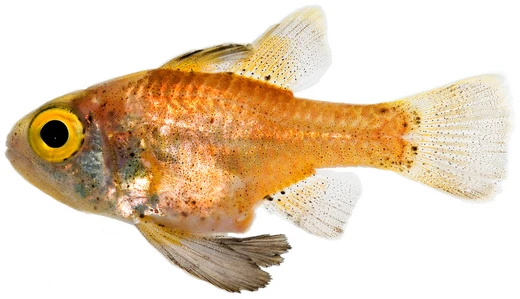
Conchfish (Astrapogon stellatus)
Source-cited species reference: taxonomy from WoRMS, biology from FishBase, occurrence map from GBIF, conservation from IUCN Red List, description from Wikipedia.

Astrapogon stellatus is a species of ray-finned fish in the family Apogonidae, the cardinal fishes. It lives in the tropical western Atlantic Ocean, the Caribbean Sea and the Gulf of Mexico. It is commonly known as the conchfish because it typically conceals itself in the mantle cavity of a living queen conch (Aliger gigas) by day.
- Scientific name
- Astrapogon stellatus
- Authority
- (Cope, 1867)
- Family
- Apogonidae
- Order
- Apogoniformes
- Maximum length
- 8 cm
- Depth range
- 1–40 m
- Habitat zone
- reef-associated
- Iucn red list
- Data Deficient
- Gbif occurrence records
- 16,087
Physical Form and Identification
The conchfish belongs to the cardinal fish family, Apogonidae, a group of ray-finned fishes that share a distinctive body plan: oversized eyes, a broad mouth, two dorsal fins set far apart along the back, an elongated caudal peduncle, and notably large scales. Astrapogon stellatus reaches a maximum standard length of roughly eight centimetres (about three inches), making it a small but visually striking member of its family. In its most common coloration the body is a deep brown or near-black, though a pale phase also occurs, giving individuals a noticeably lighter appearance. It is precisely this combination of pigmentation patterns and meristic counts—the arrangement and number of fin rays and other structural features—that allows ichthyologists to separate A. stellatus from its close relatives within the genus and family. Despite its modest size, the fish's bold coloration and the shared cardinal-fish body template make it a recognizable figure in the shallow tropical waters where it is found.
Geographic Range and Preferred Habitat
Astrapogon stellatus is native to the warm, tropical waters of the western Atlantic Ocean, the Caribbean Sea, and the Gulf of Mexico. Its distribution stretches from the coastlines of Florida, Bermuda, and the Bahamas, across the Greater and Lesser Antilles, and southward along the South American coast all the way to Rio de Janeiro in Brazil. Within this broad range the species favours coral reefs and clear, shallow marine environments, typically occurring at depths of up to about forty metres (roughly one hundred and thirty feet). These habitats provide the structural complexity—rocky outcrops, reef formations, and the presence of large molluscs—that the conchfish relies upon for its daily shelter. The clarity of the water and the abundance of plankton in these open, sunlit zones also support the fish's nocturnal foraging lifestyle. Although the range is extensive, the conchfish's dependence on specific microhabitats, particularly the mantle cavity of the queen conch, means that its actual local abundance can be tightly linked to the health and population density of its host species in any given reef system.
The Conchfish and Its Mollusc Host
The most remarkable aspect of Astrapogon stellatus biology is its commensal association with the queen conch, Aliger gigas. During daylight hours the conchfish tucks itself into the mantle cavity of a living conch, using the mollusc's body as a protective shelter from predators. At night it emerges to forage on plankton in the open water, returning to its host before dawn. This relationship is commensal: the fish gains safety while the conch appears to suffer no significant harm. However, the queen conch has been declining in many parts of its range due to heavy over-fishing for its shell and meat. As suitable conch hosts become scarcer, the conchfish has been observed adapting by taking refuge in other large, rigid bivalves. The pen shell Atrina rigida and the amber pen shell Pinna carnea have both been reported as alternative daytime shelters. Elsewhere in the cardinal fish family, related species seek cover in corals, sponges, and rock crevices, but the conchfish's preference for living molluscs sets it apart as a particularly specialised and ecologically vulnerable member of the group.
Nocturnal Foraging and the Mystery of Reproduction
Astrapogon stellatus is fundamentally a creature of the night. By day it remains hidden and cryptic, concealed within the body of its mollusc host, but once darkness falls it ventures into the open sea to feed on plankton drifting through the water column. Outside of the breeding season the fish is typically solitary, moving independently through its reef habitat. When the time for reproduction arrives, a pair bond forms between a male and female. The male then assumes the role of mouth-brooder: he takes the fertilised eggs into his mouth and carries them there until they hatch, protecting the developing young in this unusual way. Beyond these key reproductive details, very little is known about the broader biology of the conchfish. Its life history, growth rates, longevity, and the full scope of its behavioural repertoire remain largely unexplored. This paucity of information reflects the difficulty of studying a small, nocturnal, cryptic fish that spends most of its waking hours tucked inside another organism, making direct observation in the field a considerable challenge for marine biologists.
Frequently Asked Questions
What is the Conchfish (Astrapogon stellatus)?
It is a small ray-finned fish in the cardinalfish family (Apogonidae), originally described by Cope in 1867. Adults top out at roughly 8 centimeters in length, making it one of the more diminutive members of the order Apogoniformes.
Why is it called the 'conchfish'?
The common name comes from its habit of tucking itself into the mantle cavity of a living queen conch (Aliger gigas) during the daytime for shelter. This close association with the mollusk is the defining behavioral trait that sets it apart from many other cardinalfishes.
Where does the Conchfish live and at what depths?
Its natural range spans the tropical western Atlantic, the Caribbean Sea, and the Gulf of Mexico. It is typically encountered between about 1 and 40 meters depth, favoring shallow coastal and reef-associated waters.
How is the Conchfish classified taxonomically?
It belongs to the family Apogonidae within the order Apogoniformes, and its binomial authority is Cope, 1867. As an Actinopterygian, it is a ray-finned fish rather than a cartilaginous one.
What is the Conchfish's conservation outlook?
The species is catalogued on the IUCN Red List, and given its broad distribution across the western Atlantic and Caribbean it is not currently flagged as threatened. Its reliance on queen conch hosts, however, means that local declines in conch populations could indirectly affect conchfish habitat availability.
Related in Conchfish
Links follow this subject's own source article.
Elsewhere in Conchfish
Spotted an error? Know more?
Reader corrections go straight into our review queue. Suggest an edit · How this site is sourced