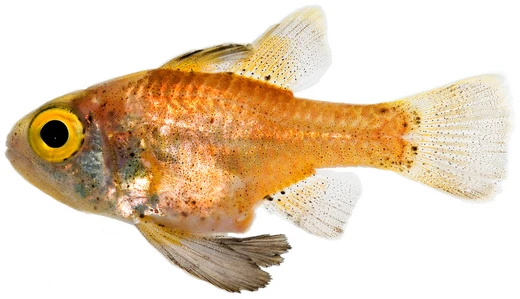
Where Conchfish has been recorded
GBIF occurrence records for Astrapogon stellatus, mapped and tabulated by country.

16,087 georeferenced occurrence records with coordinates are published for Astrapogon stellatus through GBIF, from 21 countries or marine areas. This page maps those records and lists where they come from. Occurrence records reflect where people have looked as well as where the species lives, so well-surveyed coastlines are over-represented.
- Georeferenced records
- 16,087
- Countries / areas
- 21
- Mapped locations
- 26
- Records sampled for the map
- 3,000
- Inland records omitted
- 3
- Gbif taxonkey
- 2396932
A Name in Constant Flux: The Taxonomic Odyssey
The story of the queen conch's scientific name is one of loss, recovery, and repeated reclassification. In 1758, Carl Linnaeus — the Swedish naturalist who created the binomial naming system — described the species as Strombus gigas, drawing on the Greek word for "giant" to reflect its impressive size relative to other gastropods. He offered only "America" as a locality, a vagueness that would haunt later taxonomists. By the early twentieth century, the original type shell was believed lost, prompting Clench and Abbott to designate a neotype in 1941: not a physical specimen but an illustration from Filippo Buonanni's 1684 work Recreatio mentis et occuli, the first book devoted entirely to seashells. In 1953, Swedish malacologist Nils Hjalmar Odhner located the actual Linnaean type shell in the Uppsala University collection, rendering that neotype invalid. The 2000s brought further upheaval as subgenera within Strombidae were elevated to full genus status. Petuch recombined the species as Eustrombus gigas, Landau and colleagues as Lobatus gigas in 2008, and Maxwell and team as Aliger gigas in 2020 — the name now recognized by the World Register of Marine Species.
Architecture of a Giant: Shell, Soft Parts, and Kin
Few marine creatures command as much visual presence as the queen conch, one of the largest molluscs found in the Caribbean Sea and the tropical northwestern Atlantic. Its shell can stretch to 35.2 centimetres in length, a solid and heavy structure marked by knob-like spines along the shoulder and a strikingly flared outer lip. That lip is a biological clock: it is entirely absent in juvenile snails and only appears once the animal reaches reproductive maturity, thickening progressively with age so that the most robust lip signals the oldest individuals. The aperture glows in shades of pink or orange, while the exterior takes on a sandy hue that lets the conch melt into the surrounding substrate. Beneath the shell, the soft anatomy follows the familiar Strombidae blueprint — a long snout, a pair of eyestalks bearing well-developed eyes, additional sensory tentacles, a powerful muscular foot, and a corneous, sickle-shaped operculum. The species sits close to two relatives: the goliath conch, found only in Brazilian waters, and the rooster conch, Aliger gallus.
Life Among the Seagrass: Diet, Commensals, and Predators
The queen conch is a dedicated herbivore, spending its days browsing across seagrass beds for living plant and algal material, and scavenging whatever decaying vegetation washes into the sandy plains where it lives. These habitats — swaying grasses interwoven with nearby coral reef structures — are the conch's preferred domain, though the precise environment it occupies shifts as it moves through different developmental stages. The shell itself becomes a miniature ecosystem: slipper snails, porcelain crabs, and a specialized cardinalfish called Astrapogon stellatus (the conchfish) all make their homes among the soft parts and interior of a living specimen. Coccidian parasites also exploit the host. At the other end of the food web, the conch faces a formidable roster of predators — large predatory sea snails, octopuses, starfish, various crustaceans, fish, sea turtles, and nurse sharks. Sea turtles and nurse sharks in particular rely heavily on the queen conch as a key food source, making this single species a critical link in Caribbean marine food chains.
From Prehistoric Feast to Regulated Trade
Long before modern fisheries management existed, humans were harvesting queen conches. Evidence of capture and consumption stretches back into prehistory, and across the Caribbean and among Native American communities, shell fragments were shaped into practical tools. Today the shell continues to find a market as a souvenir and decorative object, a trade that carries significant ecological weight. International commerce in the species is governed by CITES — the Convention on International Trade in Endangered Species of Wild Fauna and Flora — under the listing name Strombus gigas. While the queen conch is not classified as endangered across the Caribbean as a whole, the picture is far less reassuring at a regional level. In numerous localities the population is commercially threatened, with extreme overfishing identified as the primary driver of decline. The tension between a species that thrives in some areas and one being pushed toward local depletion in others underscores why regulatory frameworks like CITES matter: they attempt to balance the cultural and economic value of the conch with the biological reality that its slow reproductive maturation, marked by the gradual thickening of the flared lip, simply cannot keep pace with unchecked harvest.
Frequently Asked Questions
How many location records exist for Conchfish?
There are 16,087 georeferenced occurrence records with coordinates available for Astrapogon stellatus. These come from 21 different countries or marine areas worldwide.
How many spots are actually shown on the Conchfish distribution map?
The map displays 26 mapped locations, drawn from a sample of 3,000 records to keep the visualization readable. Three inland records were excluded since they don't represent genuine marine sightings.
Why do some coastlines have way more Conchfish records than others?
Occurrence data reflects where researchers and divers have actually looked, not just where the fish lives. Heavily surveyed coastlines naturally accumulate more records, so they appear over-represented on the map.
Where do the Conchfish distribution records come from?
All the georeferenced data is published through GBIF under taxon key 2396932. The fan encyclopedia page simply maps and tabulates those records by country for easier browsing.
Does the Conchfish map show every single record?
No—the map samples 3,000 of the 16,087 total records to avoid visual clutter. The full dataset is still accessible through GBIF if you want to explore every individual coordinate.
Elsewhere in Conchfish
Spotted an error? Know more?
Reader corrections go straight into our review queue. Suggest an edit · How this site is sourced