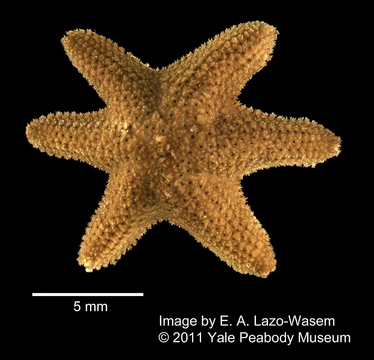
Aquilonastra burtoni
Source-cited species reference: taxonomy from WoRMS, biology from SeaLifeBase, occurrence map from GBIF, description from Wikipedia.

Aquilonastra burtoni is a species of small sea star from the family Asterinidae from the Red Sea which has colonised the eastern Mediterranean by Lessepsian migration through the Suez Canal, although the Mediterranean populations are clonal reproducing through fissiparous asexual reproduction. It was originally described in 1840 by the English zoologist and philatelist John Edward Gray.
- Scientific name
- Aquilonastra burtoni
- Authority
- (Gray, 1840)
- Family
- Asterinidae
- Order
- Valvatida
- Depth range
- 0–10 m
- Habitat zone
- benthic
- Gbif occurrence records
- 174
Classification (WoRMS)
Full classification as recorded by WoRMS: Kingdom: Animalia · Phylum: Echinodermata · Class: Asteroidea · Order: Valvatida · Family: Asterinidae · Genus: Aquilonastra.
Accepted name: Aquilonastra burtoni · Authority: (Gray, 1840) · Taxonomic status: accepted · AphiaID: 459524.
Synonyms and superseded combinations recorded for this taxon: Asterina burtoni Gray, 1840; Asterina burtoni burtoni Gray, 1840; Asterina wega Valenciennes (MS) in Perrier, 1869; Asteriscus wega Valenciennes (MS) in Perrier, 1869.
Source: World Register of Marine Species (WoRMS) — https://www.marinespecies.org/aphia.php?p=taxdetails&id=459524 (CC BY 4.0). Accessed 2026-09-23.
Biology and life history (SeaLifeBase)
Measured values published by SeaLifeBase for Aquilonastra burtoni. Only fields the database actually holds for this species are shown; these are database values, not aquarium guidance.
Depth range: 0–10 m · Habitat zone: benthic · Aquarium trade: never/rarely.
SeaLifeBase notes: Common in the lower eulittoral zone under rock slabs and boulders (Ref. 102838). Members of the family Asterinidae are very opportunistic feeders, feeding indiscriminately on small epifaunal organisms, detritus, decaying animals and plants, and live algae (Ref. 108108). Deposit feeder (Ref. 90951). Found in waters less than 30m. Associated with coral communities. Hides under rocks during the day. Feeds on bacterial film (Ref. 129602).
Source: SeaLifeBase species summary (SpecCode 142270) — https://www.sealifebase.se/summary/Aquilonastra-burtoni.html (CC BY-NC 3.0 — non-commercial use only). Accessed 2026-09-23.
Distribution and occurrence records (GBIF)
174 georeferenced occurrence records for Aquilonastra burtoni are published through GBIF from 29 countries or marine areas. The map above plots 50 distinct locations from a sample of 174 records, omitting 12 inland records that carry an institution's coordinates rather than a collection site; it shows where the species has been observed and reported, not a modelled range.
Most records by country or area: Israel (38); Madagascar (26); Mozambique (15); Oman (15); Philippines (12); Pakistan (12); Egypt (8); Réunion (6); Seychelles (5); Tanzania, United Republic of (5); Australia (4); Mauritius (4); Kenya (3); Saudi Arabia (3); Fiji (2).
Marine regions with a valid WoRMS distribution record: Israeli part of the Mediterranean Sea - Eastern Basin.
Source: GBIF Occurrence Search (taxonKey 2272084) — https://www.gbif.org/occurrence/search?taxon_key=2272084&has_coordinate=true (records CC0 / CC BY); WoRMS distribution records (MarineRegions) — https://www.marinespecies.org/aphia.php?p=taxdetails&id=459524 (CC BY 4.0); Natural Earth 110m basemap — https://www.naturalearthdata.com/ (public domain). Accessed 2026-09-23.
Description and natural history (Wikipedia)
Aquilonastra burtoni is a small species of sea star with up to 8 rays, frequently 7, they frequently demonstrate an asymmetrical form after fissiparous division while the form of larger specimens is often symmetrical with 5 equal rays; there is an inconspicuous madreporite in most interradii. The rays narrow basally, tapering to a narrow rounded distal part which is finger-like.
group of short tubercles. It is a greenish gray colour on the dorsal sid with a large, irregular, purplish brown blotch in the centre which is surrounded by red spots at the bases of the arms. The arms are normally a darker greenish near their distal portions where there is also a pale median line.
The native range of Aquilonastra burtoni is the north western Indian Ocean including the Gulf of Suez, Gulf of Aqaba, the Red Sea, Persian Gulf, Sea of Oman and the coasts of eastern Africa south to Zanzibar. It has been reported from a wider range east to Hawaii and south to Madagascar but these records appear to refer to other similar Aquilonastra species. It was first recorded within the Suez Canal in 1926 and then in the eastern Mediterranean in 1966, and by 2010 it had been recorded from Cyprus.
Aquilonastra burtoni is a benthic species which occurs in shallow waters between 0 and 10m in depth where is common in the lower shore below the low tide line under rock slabs and boulders. It is uncommon in the gravel tails and gravelly hydraulic banks, its preferred food seems to be the rich shade-loving animals that live underneath blacks and slabs, including sponges such as Spirastrella spp and Timea spp. or Ascidiacea, for example Trididemnum or Eudistoma.
In sexual reproduction the eggs and sperm are broadcast and the larvae are planktonic lecithotrophs, i.e. they rely on a yolk for their initial nutrition. In the fissiparous population off the Mediterranean coast of Israel histological examination showed spermatogenesis in all the mature individuals and the peak of sperm production was coincident with the peak of fissiparous reproduction. This has been taken to indicate that the origin of the Mediterranean colonisers was from a fissiparous population in the Red Sea.
Aquilonastra burtoni was originally named Asterina burtoni by John Edward Gray from specimens collected by a Mr John Burton in the Red Sea. A second species was named Asterina wega and this name was used to describe a separate multi armed form which reproduced by fissipary while A. burtoni was used for the five armed sexually reproducing form. Further studies have suggested that this is a complex of species with the three fissiparous Mediterranean populations named as Aquilonastra yairi sp. nov. and the specimens taken in the Gulf of Aqaba as A. burtonii sensu stricto while the non-fissiparous specimens from Eilat were described as Aquilonastra marshae sp. nov., with the caveat that populations elsewhere still have to be properly studied to determine their status.
Source: Wikipedia: Aquilonastra burtoni — https://en.wikipedia.org/wiki/Aquilonastra_burtoni (CC BY-SA 4.0). Accessed 2026-09-23.
Spotted an error? Know more?
Reader corrections go straight into our review queue. Suggest an edit · How this site is sourced