
Warty sea cucumber (Apostichopus parvimensis)
Source-cited species reference: taxonomy from WoRMS, biology from SeaLifeBase, occurrence map from GBIF, conservation from IUCN Red List, description from Wikipedia.
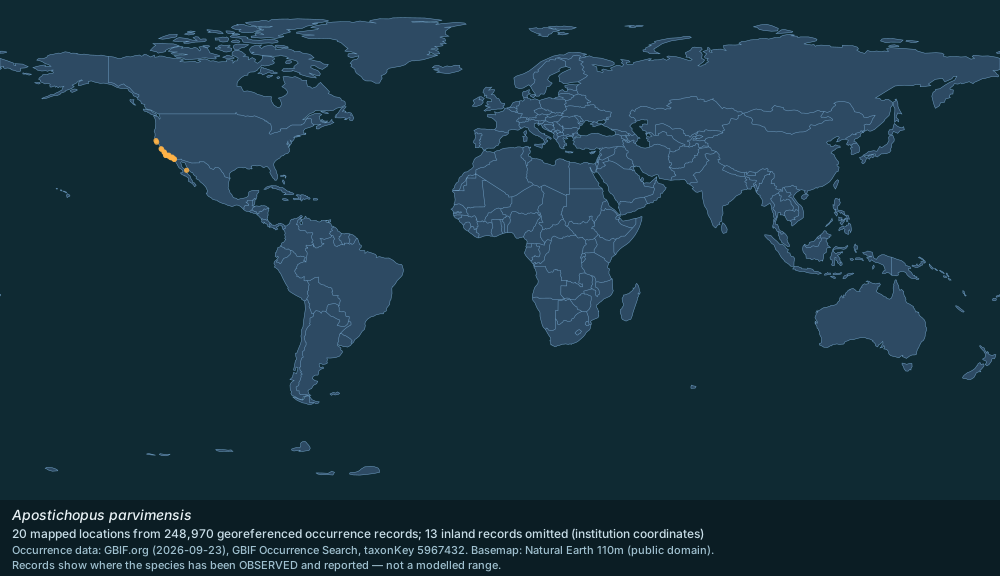
Apostichopus parvimensis, commonly known as the warty sea cucumber, is a Pacific species of sea cucumber that can be found from the Baja California Peninsula, Mexico, to Monterey Bay, California, USA, although only scattered individuals were reported to occur north of Point Conception, California. It is found mainly in low energy environments from the intertidal zone down to 30 m, but can occur as deep as 60 m.
- Scientific name
- Apostichopus parvimensis
- Authority
- (H.L. Clark, 1913)
- Family
- Stichopodidae
- Order
- Synallactida
- Maximum length
- 25 cm
- Depth range
- 0–30 m
- Habitat zone
- benthic
- Iucn red list
- Vulnerable
- Gbif occurrence records
- 248,970
Classification (WoRMS)
Full classification as recorded by WoRMS: Kingdom: Animalia · Phylum: Echinodermata · Class: Holothuroidea · Order: Synallactida · Family: Stichopodidae · Genus: Apostichopus.
Accepted name: Apostichopus parvimensis · Authority: (H.L. Clark, 1913) · Taxonomic status: accepted · AphiaID: 529435.
Synonyms and superseded combinations recorded for this taxon: Parastichopus parvimensis (H.L. Clark, 1913); Stichopus parvimensis H.L. Clark, 1913.
Source: World Register of Marine Species (WoRMS) — https://www.marinespecies.org/aphia.php?p=taxdetails&id=529435 (CC BY 4.0). Accessed 2026-09-23.
Biology and life history (SeaLifeBase)
Measured values published by SeaLifeBase for Apostichopus parvimensis. Only fields the database actually holds for this species are shown; these are database values, not aquarium guidance.
Maximum length: 25 cm · Depth range: 0–30 m · Habitat zone: benthic · Vulnerability index: 15 of 100 · Fishery importance: commercial.
SeaLifeBase notes: It is found on rocky and soft bottoms from the low intertidal to a depth of 30 meters (Ref. 865).
Source: SeaLifeBase species summary (SpecCode 155439) — https://www.sealifebase.se/summary/Apostichopus-parvimensis.html (CC BY-NC 3.0 — non-commercial use only). Accessed 2026-09-23.
Distribution and occurrence records (GBIF)
248,970 georeferenced occurrence records for Apostichopus parvimensis are published through GBIF from 4 countries or marine areas. The map above plots 20 distinct locations from a sample of 3,000 records, omitting 13 inland records that carry an institution's coordinates rather than a collection site; it shows where the species has been observed and reported, not a modelled range.
Most records by country or area: United States of America (248,944); Mexico (24); Indonesia (1); Madagascar (1).
The full country table, WoRMS marine regions and the sampling notes are on this species' Distribution page.
Source: GBIF Occurrence Search (taxonKey 5967432) — https://www.gbif.org/occurrence/search?taxon_key=5967432&has_coordinate=true (records CC0 / CC BY); WoRMS distribution records (MarineRegions) — https://www.marinespecies.org/aphia.php?p=taxdetails&id=529435 (CC BY 4.0); Natural Earth 110m basemap — https://www.naturalearthdata.com/ (public domain). Accessed 2026-09-23.
Conservation status (IUCN Red List)
The IUCN Red List assesses Apostichopus parvimensis (H.L. Clark, 1913) as Vulnerable (code VU). No trend, population estimate or threat analysis is given here, because none is available from this source without the Red List API; follow the source link for the full assessment, including its date.
Source: IUCN Red List of Threatened Species (taxon 180368) — https://www.iucnredlist.org/species/180368/0; GBIF IUCN Red List category endpoint (taxonKey 5967432) — https://api.gbif.org/v1/species/5967432/iucnRedListCategory. Accessed 2026-09-23.
Description and natural history (Wikipedia)
The warty sea cucumber can reach a maximum length of 30 - 40 cm. It has a soft, cylindrical body, with red-brown to yellowish leathery skin. There are numerous grey spots along its body, hence the name "warty." It has an endoskeleton just below the skin. The mouth and anus are on opposite sides of the body. The mouth is surrounded by ten retractable tentacles that are used to bring food in. Five rows of tube feet extend from the mouth to the anus.
Apostichopus parvimensis is a solitary nocturnal animal. When threatened, it can expel its internal organs through its anus and grow new ones.
These sea cucumbers have separate sexes, and eggs are fertilized externally. Spawning usually takes place in November, and each female can produce thousands of eggs. After fertilization, a larva is formed which metamorphoses into a sea cucumber after a few weeks.
Source: Wikipedia: Apostichopus parvimensis — https://en.wikipedia.org/wiki/Apostichopus_parvimensis (CC BY-SA 4.0). Accessed 2026-09-23.
Gallery
Related in Warty sea cucumber
Links follow this subject's own source article.
Elsewhere in Warty sea cucumber
Spotted an error? Know more?
Reader corrections go straight into our review queue. Suggest an edit · How this site is sourced