
Japanese sea cucumber (Apostichopus japonicus)
Source-cited species reference: taxonomy from WoRMS, biology from SeaLifeBase, occurrence map from GBIF, conservation from IUCN Red List, description from Wikipedia.
Apostichopus japonicus is a species of sea cucumber in the family Stichopodidae. It is found in shallow temperate waters along the coasts of south east Asia and is commonly known as the Japanese spiky sea cucumber or the Japanese sea cucumber.
- Scientific name
- Apostichopus japonicus
- Authority
- (Selenka, 1867)
- Family
- Stichopodidae
- Order
- Synallactida
- Maximum length
- 30 cm
- Depth range
- 0–200 m
- Habitat zone
- benthic
- Iucn red list
- Endangered
- Gbif occurrence records
- 742
Classification (WoRMS)
Full classification as recorded by WoRMS: Kingdom: Animalia · Phylum: Echinodermata · Class: Holothuroidea · Order: Synallactida · Family: Stichopodidae · Genus: Apostichopus.
Accepted name: Apostichopus japonicus · Authority: (Selenka, 1867) · Taxonomic status: accepted · AphiaID: 241776.
Synonyms and superseded combinations recorded for this taxon: Stichopus japonicus Selenka, 1867; Stichopus japonicus var. typicus Théel, 1886; Stichopus roseus Augustin, 1908.
Source: World Register of Marine Species (WoRMS) — https://www.marinespecies.org/aphia.php?p=taxdetails&id=241776 (CC BY 4.0). Accessed 2026-09-23.
Biology and life history (SeaLifeBase)
Measured values published by SeaLifeBase for Apostichopus japonicus. Only fields the database actually holds for this species are shown; these are database values, not aquarium guidance.
Maximum length: 30 cm · Depth range: 0–200 m · Habitat zone: benthic · Vulnerability index: 34.7 of 100 · Fishery importance: commercial · Aquarium trade: never/rarely.
SeaLifeBase notes: Common in shallow coastal bottom communities from the intertidal zone to depths more than 100 m. Forms aggregations, usually in the upper sublittoral zone (Ref. 635). May occur in three color variants: red type often found in offshore gravel beds while the green and black types often at inshore sandy-muddy bottoms (Ref. 77132). Juveniles often associated with algal/seagrass and oyster beds (Ref. 621). Most commercially important sea cucumber species (for trade, food and traditional medicine both; fisheries and farming/ranching) in China (Ref. 77133). Aquaculture now widespread in northern coast of China (Ref. 77133) since wild populations became over-exploited in the 1990s. Chinese aquaculture production peaked at 65,283 tons in 2005 (Ref. 77133). A sediment-feeder and bio-scavenger; ingests organic matter in sediment, e.g., bacteria, protozoa, diatoms, plant and animal debris including faeces (Ref. 77143).
Source: SeaLifeBase species summary (SpecCode 50326) — https://www.sealifebase.se/summary/Apostichopus-japonicus.html (CC BY-NC 3.0 — non-commercial use only). Accessed 2026-09-23.
Distribution and occurrence records (GBIF)
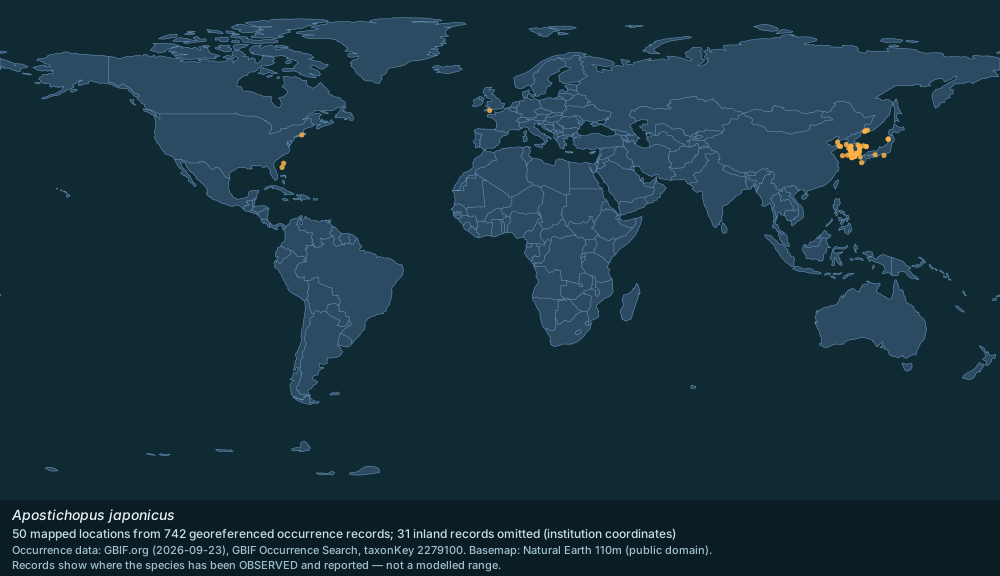
742 georeferenced occurrence records for Apostichopus japonicus are published through GBIF from 10 countries or marine areas. The map above plots 50 distinct locations from a sample of 742 records, omitting 31 inland records that carry an institution's coordinates rather than a collection site; it shows where the species has been observed and reported, not a modelled range.
Most records by country or area: Korea, Republic of (350); Japan (291); Russian Federation (62); China (19); Australia (6); Türkiye (4); France (3); United Kingdom of Great Britain and Northern Ireland (3); United States of America (3); Italy (1).
Source: GBIF Occurrence Search (taxonKey 2279100) — https://www.gbif.org/occurrence/search?taxon_key=2279100&has_coordinate=true (records CC0 / CC BY); WoRMS distribution records (MarineRegions) — https://www.marinespecies.org/aphia.php?p=taxdetails&id=241776 (CC BY 4.0); Natural Earth 110m basemap — https://www.naturalearthdata.com/ (public domain). Accessed 2026-09-23.
Conservation status (IUCN Red List)
The IUCN Red List assesses Apostichopus japonicus (Selenka, 1867) as Endangered (code EN). No trend, population estimate or threat analysis is given here, because none is available from this source without the Red List API; follow the source link for the full assessment, including its date.
Source: IUCN Red List of Threatened Species (taxon 180424) — https://www.iucnredlist.org/species/180424/0; GBIF IUCN Red List category endpoint (taxonKey 2279100) — https://api.gbif.org/v1/species/2279100/iucnRedListCategory. Accessed 2026-09-23.
Description and natural history (Wikipedia)
The Japanese sea cucumber has a cylindrical leathery body with blunt, thorny protuberances. At the anterior or front end there is a mouth surrounded by a ring of short feeding tentacles and at the posterior end is the anus. There are three different colour morphs, red, green and black.
The Japanese sea cucumber is found along the coast of Russia, China, Japan and Korea. The range extends from Alaska and Sakhalin Island to the Amami Islands, Japan. The red morphs are found on gravel beds offshore at depths of 40 m or deeper while the other two colours are found intermingled on muddy and sandy bottoms at shallower depths. Although the red morph may breed red offspring due to its reproductive isolation in a different microhabitat, DNA studies have shown that there is a limited degree of genetic difference between it and the other two colour morphs while there is no significant difference between the black and green forms. In lagoons in southern Sakhalin, Russia, Japanese spiky sea cucumber are found on solid substrates among growth of the red alga Ahnfeltia tobuchiensis and in oyster beds (Crassostrea gigas).
The Japanese sea cucumber sifts through the sediment on the seabed with its tentacles and feeds on detritus and other organic matter including plant and animal remains, bacteria, protozoa, diatoms and faeces.
The sexes are separate in the Japanese sea cucumber. Males and females release a mass of gametes into the sea where fertilization takes place. In the laboratory, spawning from ripe gonads can be induced by varying the temperature at which the adults are kept or by use of the neuropeptide cubifrin. The planktonic larvae develop through several stages before settling on hard surfaces on the seabed, undergoing metamorphosis and becoming juveniles.
The Japanese sea cucumber lives in temperate seas. In locations where the water heats up excessively in summer it undergoes aestivation, going into a state of dormancy. In this state, feeding stops, the gut degenerates, the metabolism slows down and weight is lost. The threshold temperature is about 25 °C, higher for smaller individuals and for those from the southern part of the range where the ambient water temperature is higher. This sea cucumber has been known to continue in aestivation in some areas of China for four years.
The Japanese sea cucumber is used as food. The largest fishery is in Japan where between 2000 and 2005, an average of 8,101 tonnes of this species were harvested annually. The red form is known there as "aka namako" and sells at a different price from "ao namako", the green morph and "kuro namako", the black one. In Russia and North Korea, overfishing has reduced populations considerably. Fishing methods include diving and hand collection at depths of up to 20 m and the use of trawls at greater depths. In the 1920s, a "sea cucumber fork" was developed in China. It is operated from several small vessels working together and allows harvest from depths of up to 60 m.
The Japanese sea cucumber is also cultivated on a commercial scale in shallow ponds and by sea ranching in northern China, where production reached 5,865 tonnes in 2002. Rocks and tiles are placed on the bottom to provide settlement for larvae and protection from predators. Breeding programs are under way to improve growth rates and disease resistance and the genome is being sequenced. Hatchery techniques are being developed in Japan and China as are the preparation of suitable culture feeds and the investigation of the best methods of ranching. Albino forms and a thermally resistant strain that is less prone to aestivate are being developed in China.
Source: Wikipedia: Apostichopus japonicus — https://en.wikipedia.org/wiki/Apostichopus_japonicus (CC BY-SA 4.0). Accessed 2026-09-23.
Gallery
Spotted an error? Know more?
Reader corrections go straight into our review queue. Suggest an edit · How this site is sourced