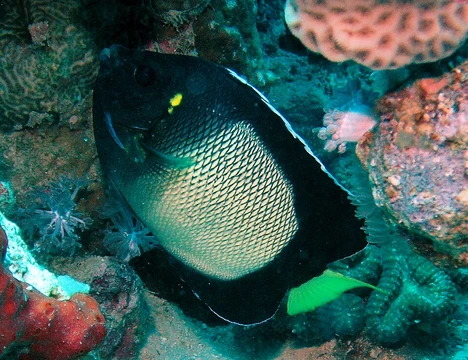
Yellow-ear angelfish (Apolemichthys xanthotis)
Source-cited species reference: taxonomy from WoRMS, biology from FishBase, occurrence map from GBIF, conservation from IUCN Red List, description from Wikipedia.

Rob · CC BY 2.0
Apolemichthys xanthotis, the yellow-ear angelfish or Red Sea angelfish, is a species of marine ray-finned fish, a marine angelfish belonging to the family Pomacanthidae.
- Scientific name
- Apolemichthys xanthotis
- Authority
- (Fraser-Brunner, 1950)
- Family
- Pomacanthidae
- Order
- Acanthuriformes
- Maximum length
- 20 cm
- Depth range
- 10–35 m
- Habitat zone
- reef-associated
- Iucn red list
- Least Concern
- Gbif occurrence records
- 58
A Study in Contrasting Colours
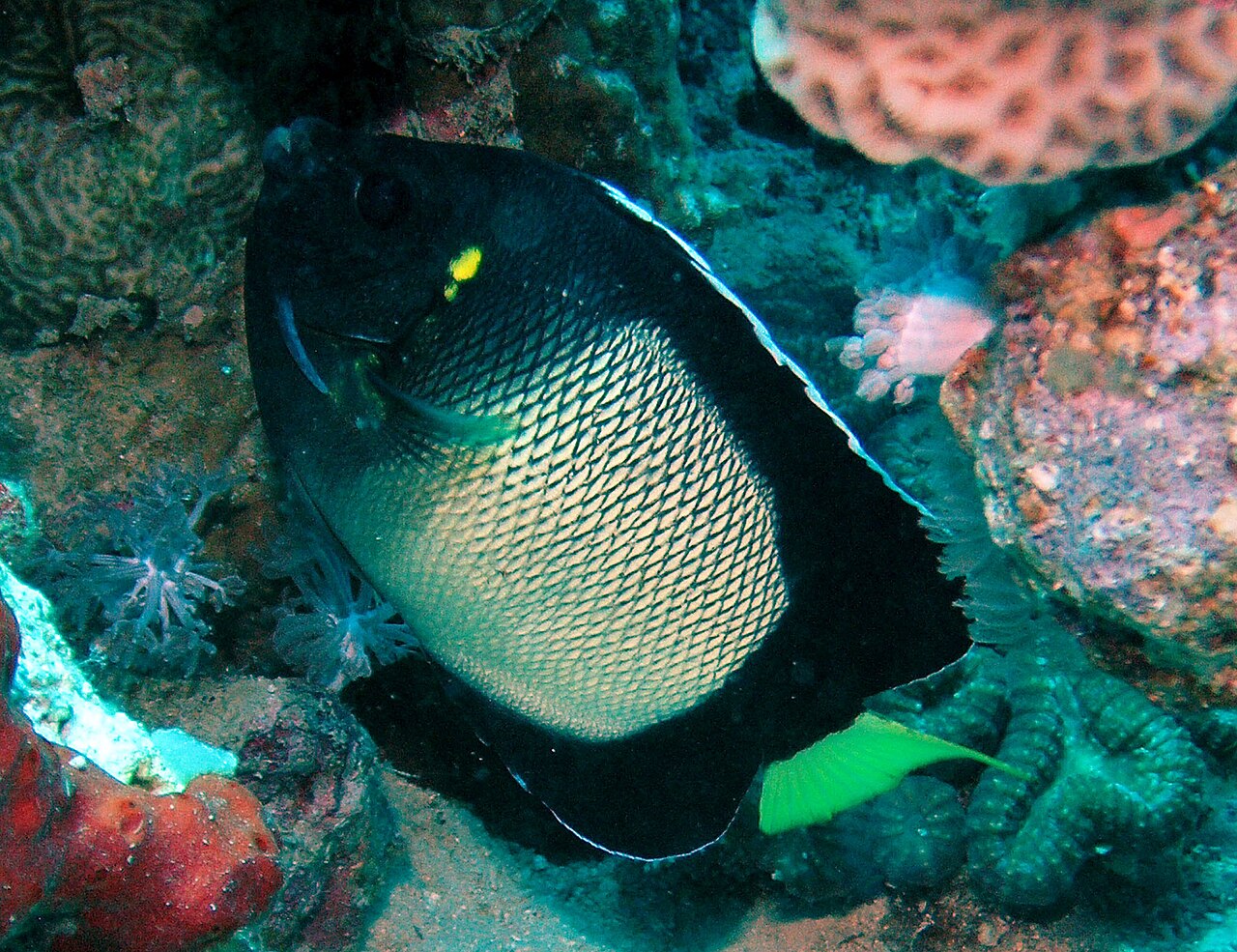
The yellow-ear angelfish presents a striking palette that immediately distinguishes it among marine angelfishes. Its body is predominantly white, anchored by a deep black head and a vivid yellow tail. The dorsal and anal fins carry the same dark pigment, edged with crisp white margins that sharpen the outline of the fish in motion. What sets this species apart from its close relatives is the sheer extent of the black pigmentation on the head: it sweeps across the gill cover and spills over the first few rows of body scales, a broader spread than seen in similar species. Against this dark canvas sits a small but unmistakable yellow spot on the upper preoperculum, the very feature that gives the fish its common name. Young specimens wear an additional wide black band stretching over the eye together with an oblique patch of black on the back, both of which gradually fade as the fish matures. At full growth, an individual reaches a maximum total length of twenty centimetres, roughly eight inches, making it a moderately sized member of the family Pomacanthidae.
A Range Shaped by Ocean Currents
The yellow-ear angelfish occupies a well-defined stretch of the northwestern Indian Ocean. Its core range encompasses the Red Sea, the Gulf of Aden, the Arabian Sea, and the Persian Gulf, with additional populations recorded off the island of Socotra. This distribution places the species squarely within warm, semi-enclosed waters that connect the Indian and Arabian basins. Perhaps the most remarkable aspect of its range is a documented transient population discovered off the coast of Kenya in the wake of the 1998 El Niño event. This brief appearance so far outside the fish's normal boundaries suggests that unusual oceanic conditions can temporarily displace individuals into the eastern Indian Ocean, even if the species does not establish a permanent foothold there. The fact that such a range extension was recorded underscores the dynamic nature of marine distributions and the role that large-scale climate phenomena play in reshaping where a given species can be found, at least for a time.
Life Among the Reefs
In its natural environment, the yellow-ear angelfish inhabits depths ranging from ten to eighty metres, favouring sections of the reef that are rich in living coral as well as more rugged rocky outcrops. It is not a solitary dweller; rather, observers typically encounter it in pairs or in small, loose groups, hinting at a social structure that leans toward cooperative rather than territorial behaviour. Its diet, while not exhaustively documented, appears to centre on algae and benthic invertebrates, with sponges singled out as a particularly important food source. This dietary preference aligns with the species' preference for structurally complex habitats where sponges and other sessile organisms thrive in the crevices and undersides of coral formations. The combination of moderate depth, coral-rich substrate, and a diet anchored in the benthic community paints a picture of a fish well adapted to the mid-reef zone of the northwestern Indian Ocean, where it forages among the living architecture of the reef rather than in open water.
Naming, Lineage, and the Aquarium Question
The species received its formal scientific description in 1950, when the British ichthyologist Alec Fraser-Bruner, working under the genus name Holacanthus, published the original account with the type locality set at Al-Mukalla on the Red Sea coast of Yemen. The specific epithet xanthotis, drawn from Greek roots, translates as "yellow ear" and points directly to the small yellow spot on the upper preoperculum that gives the fish its common name. Within the genus Apolemichthys, phylogenetic evidence suggests this Red Sea species is more closely allied to A. griffisi, a Western Pacific representative, and to the allopatric A. xanthurus of the broader Indian Ocean, hinting at a biogeographic history that spans multiple ocean basins. Despite its attractive colouration and a reputation for being hardy and straightforward to maintain, the yellow-ear angelfish remains uncommon in the aquarium trade. This relative absence from the hobbyist market, set against its aesthetic appeal, makes it a somewhat overlooked gem of the Red Sea reef.
Gallery
Frequently Asked Questions
What is the Yellow-ear angelfish (Apolemichthys xanthotis)?
It is a marine ray-finned angelfish native to the Red Sea, placed in the family Pomacanthidae. The species was first formally described by Fraser-Brunner in 1950.
How large does a Yellow-ear angelfish grow?
Adults top out at roughly 20 cm in total length, making it a modestly sized member of the angelfish family.
At what depths can you find the Yellow-ear angelfish?
This species typically ranges between 10 and 35 meters, favoring the mid-depth band of coastal reef habitats.
What is the full taxonomic placement of Apolemichthys xanthotis?
It belongs to the family Pomacanthidae within the order Acanthuriformes, and its original description is credited to Fraser-Brunner (1950).
What other common names does the Yellow-ear angelfish go by?
Besides 'yellow-ear angelfish,' it is also widely referred to as the Red Sea angelfish, a nod to its geographic range.
Spotted an error? Know more?
Reader corrections go straight into our review queue. Suggest an edit · How this site is sourced