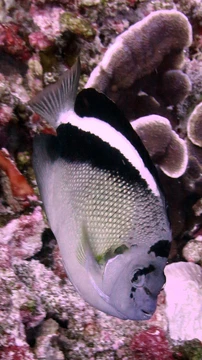
Griffis angelfish (Apolemichthys griffisi)
Source-cited species reference: taxonomy from WoRMS, biology from FishBase, occurrence map from GBIF, conservation from IUCN Red List, description from Wikipedia.

Debra Baker · CC BY 4.0
Apolemichthys griffisi, or Griffis angelfish, is a species of ray-finned fish, a marine angelfish belonging to the family Pomacanthidae. It is found in the Pacific Ocean. It is a rarity for the species to enter the aquarium trade.
- Scientific name
- Apolemichthys griffisi
- Authority
- (Carlson & Taylor, 1981)
- Family
- Pomacanthidae
- Order
- Acanthuriformes
- Maximum length
- 30 cm
- Depth range
- 10–110 m
- Habitat zone
- reef-associated
- Iucn red list
- Least Concern
- Gbif occurrence records
- 150
Physical Appearance and Development
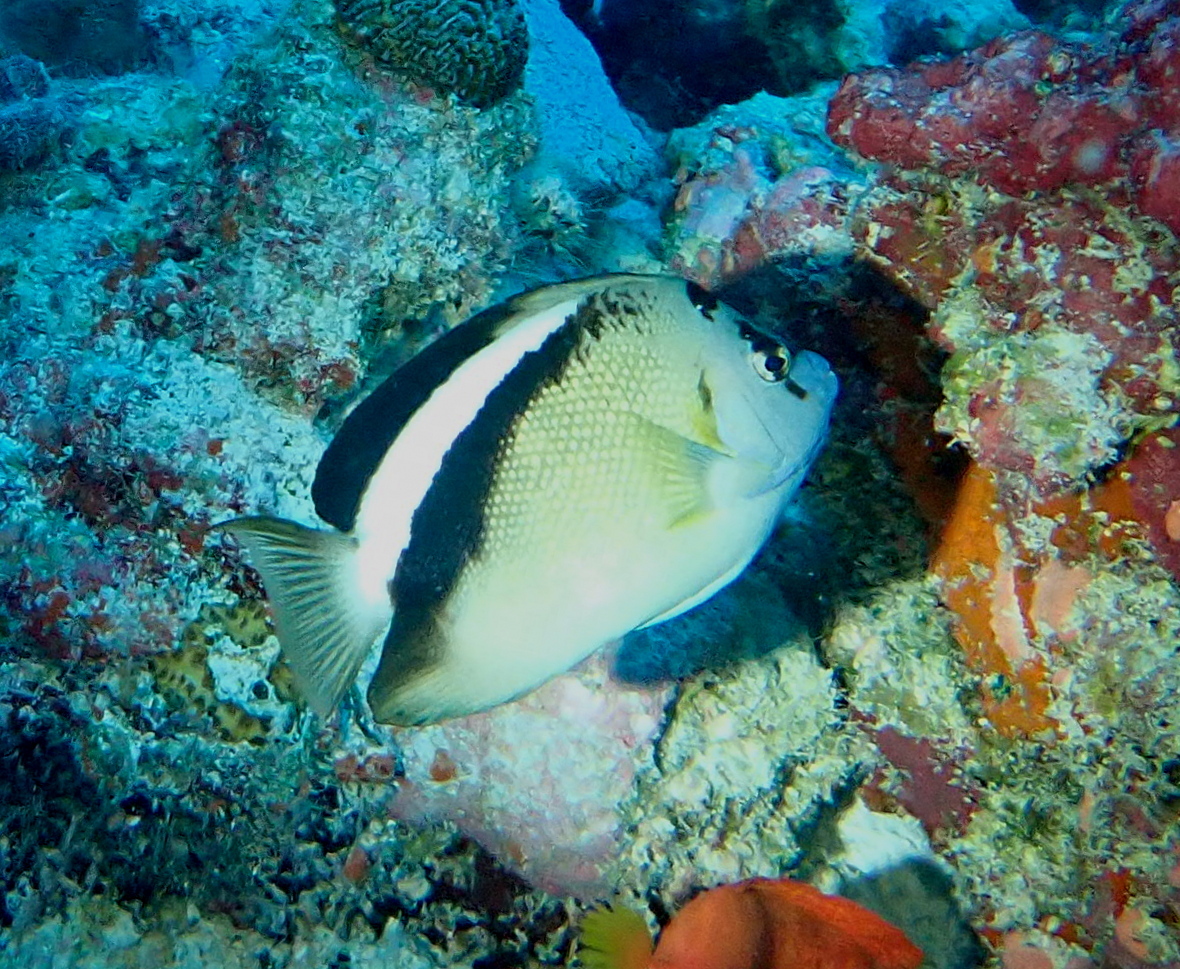
The Griffis angelfish presents a striking yet understated coloration that sets it apart from many of its more flamboyant marine angelfish relatives. Its body is predominantly a muted greyish-white or ash tone, serving as a canvas for a bold, wide black band that stretches from the head all the way to the ventral region of the caudal peduncle. Nestled within that dark stripe runs a contrasting band of white, adding a layer of visual complexity to the fish's profile. A prominent black spot sits above the eye on the head, while the dorsal fin is largely black and the anal and pelvic fins are clean white. The fin architecture is precise: the dorsal fin carries fourteen spines paired with eighteen soft rays, and the anal fin bears three spines alongside eighteen soft rays. One notable developmental detail is that juvenile individuals lack the white stripe that adults display within the black band, suggesting a gradual maturation of the species' signature pattern. The fish reaches a maximum total length of thirty centimetres, roughly twelve inches.
Habitat, Behavior, and Ecology
In the wild, the Griffis angelfish occupies the outer slopes of coral reefs, rocky ledges, and steep drop-offs across a broad swath of the Pacific Ocean. Its known range stretches from Southeast Asia eastward to the Line Islands, with confirmed records from Indonesia, Kiribati, Nauru, the Solomon Islands, and Papua New Guinea, and possible sightings in US territories. The species inhabits depths ranging from ten to one hundred metres, placing it well below the photic zone where many reef fish are commonly observed. Socially, it is typically encountered as a solitary individual, in pairs, or in small aggregations rather than in large schools. Its diet consists of benthic invertebrates, including sponges, tunicates, and crustaceans, reflecting a foraging strategy tied to the reef substrate. Perhaps most intriguingly, the Griffis angelfish is a protogynous hermaphrodite, meaning individuals begin life as females and later transition to males, and there is no visible sexual dimorphism to distinguish the two sexes externally.
Discovery and the Man Behind the Name
The Griffis angelfish was not formally described until 1981, when Bruce Carlson and Leigthon R. Taylor published its scientific account under the name Holacanthus griffisi, with the type locality set at Canton Island in the northern Phoenix Islands of the South Pacific. The species' specific epithet honours Nixon Griffis (1917–1993), a dedicated conservationist who served as a trustee of the New York Zoological Society and as a patron of the New York Aquarium. Griffis played a crucial role in the discovery itself by financially supporting the very collecting expedition to Canton Island on which Carlson and Taylor first encountered the fish. Taxonomically, the species has since been placed within the genus Apolemichthys, where it appears to share a closer evolutionary relationship with the Indian Ocean species A. xanthotis and A. xanthurus than with other Pacific members of the same genus. The story of its naming thus intertwines the work of field ichthyologists with the patronage of a conservation-minded individual whose legacy lives on in the fish's scientific identity.
Rarity and Value in the Aquarium Trade
Despite its striking appearance, the Griffis angelfish remains an uncommon sight in the aquarium trade, a rarity that only amplifies its allure among serious marine aquarists. Specimens that do appear on the market are reported to be sourced predominantly from Kiritimati in Kiribati, making the species' availability heavily dependent on a single geographic location. Because exports are infrequent and the fish is not widely collected, it has earned a reputation as one of the most expensive species available to hobbyists. This scarcity in the trade stands in contrast to its relatively wide natural distribution across the Pacific, suggesting that factors beyond mere abundance—perhaps difficulty in capture, transport sensitivity, or limited collection effort—contribute to its elusiveness in commercial channels. For those who do manage to acquire one, the Griffis angelfish represents a rare glimpse of a deep-water reef specialist that most aquarists will never encounter, a living reminder of the vast, unexplored biodiversity lurking on outer reef slopes far from the shallow waters where most aquarium fish are harvested.
Gallery
Frequently Asked Questions
Who is Griffis angelfish (Apolemichthys griffisi)?
It is a ray-finned marine angelfish in the family Pomacanthidae, formally described by Carlson and Taylor in 1981. Within the broader angelfish community, it remains one of the more obscure Pacific species that most hobbyists have never actually seen outside a database entry.
What is Griffis angelfish (Apolemichthys griffisi)'s role in its ecosystem?
Like other members of Pomacanthidae, it fills the classic angelfish niche of browsing on algae and small invertebrates across reef and upper-slope habitats. Its ability to operate from roughly 10 m down to 110 m gives it access to a vertical band of food resources that many shallower reef specialists simply cannot reach.
Where does Griffis angelfish (Apolemichthys griffisi) live?
The species is restricted to the Pacific Ocean, where records place it anywhere from about 10 metres to 110 metres below the surface. That fairly broad depth window indicates it is at home in both shallow reef zones and the upper continental slope.
How big does Griffis angelfish (Apolemichthys griffisi) get?
Adults top out at roughly 30 centimetres in total length, putting them in the medium-to-large tier for their family. To put that in perspective, a fully grown individual is about the span of a standard dinner plate laid flat.
Why is Griffis angelfish (Apolemichthys griffisi) so rare in home aquariums?
Unlike many of its Pomacanthidae cousins, it almost never appears in the live-fish trade, most likely because its preferred depth range makes collection both difficult and expensive. As a result, the average aquarist will encounter it only in reference books or online species databases rather than on a local shop's rack.
Spotted an error? Know more?
Reader corrections go straight into our review queue. Suggest an edit · How this site is sourced