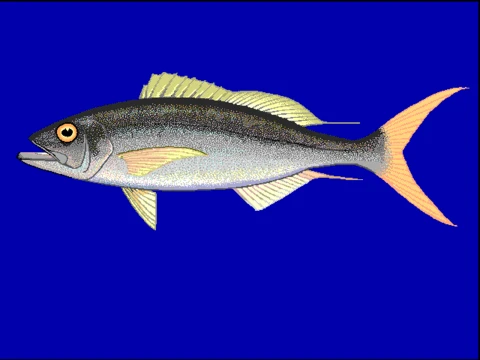
Rusty jobfish (Aphareus rutilans)
Source-cited species reference: taxonomy from WoRMS, biology from FishBase, occurrence map from GBIF, conservation from IUCN Red List, description from Wikipedia.

Aphareus rutilans, the rusty jobfish, ironjaw snapper, red smalltooth job, silvermouth or small tooth jobfish, is a species of marine ray-finned fish, a snapper belonging to the family Lutjanidae. It is found in the Indo-Pacific region.
- Scientific name
- Aphareus rutilans
- Authority
- Cuvier, 1830
- Family
- Lutjanidae
- Order
- Eupercaria incertae sedis
- Maximum length
- 110 cm
- Depth range
- 100–330 m
- Habitat zone
- reef-associated
- Iucn red list
- Least Concern
- Gbif occurrence records
- 1,458
Classification (WoRMS)
Full classification as recorded by WoRMS: Kingdom: Animalia · Phylum: Chordata · Class: Teleostei · Order: Eupercaria incertae sedis · Family: Lutjanidae · Genus: Aphareus.
Accepted name: Aphareus rutilans · Authority: Cuvier, 1830 · Taxonomic status: accepted · AphiaID: 218468.
Synonyms and superseded combinations recorded for this taxon: Aphareus rutlans Cuvier, 1830; Aphareus thompsoni Fowler, 1923.
Source: World Register of Marine Species (WoRMS) — https://www.marinespecies.org/aphia.php?p=taxdetails&id=218468 (CC BY 4.0). Accessed 2026-09-23.
Biology and life history (FishBase)
Measured values published by FishBase for Aphareus rutilans. Only fields the database actually holds for this species are shown; these are database values, not aquarium guidance.
Maximum length: 110 cm · Common length: 79 cm · Depth range: 100–330 m · Habitat zone: reef-associated · Body shape: fusiform / normal · Vulnerability index: 53.5 of 100 · Fishery importance: commercial · Aquarium trade: never/rarely.
FishBase notes: Adults inhabit reefs and rocky bottom areas to depths of at least 100 m (Ref. 4887). Found in pelagic and benthopelagic waters (Ref. 58302). They feed on fishes, squids and crustaceans (Ref. 4887). Marketed fresh (Ref. 37816).
Source: FishBase species summary (SpecCode 83) — https://www.fishbase.se/summary/Aphareus-rutilans.html (CC BY-NC 3.0 — non-commercial use only). Accessed 2026-09-23.
Distribution and occurrence records (GBIF)
1,458 georeferenced occurrence records for Aphareus rutilans are published through GBIF from 29 countries or marine areas. The map above plots 110 distinct locations from a sample of 1,458 records, omitting 17 inland records that carry an institution's coordinates rather than a collection site; it shows where the species has been observed and reported, not a modelled range.
Most records by country or area: Mayotte (1,116); Australia (151); Solomon Islands (35); Mozambique (24); Indonesia (23).
The full country table, WoRMS marine regions and the sampling notes are on this species' Distribution page.
Source: GBIF Occurrence Search (taxonKey 5209907) — https://www.gbif.org/occurrence/search?taxon_key=5209907&has_coordinate=true (records CC0 / CC BY); WoRMS distribution records (MarineRegions) — https://www.marinespecies.org/aphia.php?p=taxdetails&id=218468 (CC BY 4.0); Natural Earth 110m basemap — https://www.naturalearthdata.com/ (public domain). Accessed 2026-09-23.
Conservation status (IUCN Red List)
The IUCN Red List assesses Aphareus rutilans Cuvier, 1830 as Least Concern (code LC). No trend, population estimate or threat analysis is given here, because none is available from this source without the Red List API; follow the source link for the full assessment, including its date.
Source: IUCN Red List of Threatened Species (taxon 194360) — https://www.iucnredlist.org/species/194360/0; GBIF IUCN Red List category endpoint (taxonKey 5209907) — https://api.gbif.org/v1/species/5209907/iucnRedListCategory. Accessed 2026-09-23.
Description and natural history (Wikipedia)
Aphareus rutilans has an elongated, compressed and fusiform body. It has a lower jaw which projects beyond the upper and the mouth extends to the centreline of the eye. It has a flat area between the eyes. The jaws are quilted with thin bands of small teeth and there are no teeth on the roof of the mouth. The dorsal fin has 10 spines and 10, occasionally 11, soft rays while the anal fin has 3 spines and 8 soft rays. These fins lack scales. The rearmost ray in both the dorsal and anal fins are elongated. The caudal fin is deeply forked or lunate in shape. The overall colour is bluish-grey to mauve or reddish with the dorsal, pectoral and caudal fins being yellowish to reddish. The lips of the upper jaw are dark. This species attains a maximum total length of 110 cm, although 79 cm is more typical, and a maximum weight of 11.3 kg.
Aphareus rutilans has a wide Indo-Pacific distribution. It extends from the Gulf of Aqaba in Israel and Jordan south through the Red Sea and along the East African coast as far south as South Africa through the Indian Ocean, including its islands, and east into the Pacific Ocean. In the Pacific its range extends east to Hawaii, north to the Ryukyu and Ogasawara islands of southern Japan and south to Australia. in Australia it is found at the Scott Reef of Western Australia, in the Arafura Sea off the Northern Territory, and the northern Great Barrier Reef as well as reefs in the Coral Sea off Queensland. The larvae have been recorded as far south as Crowdy Head in New South Wales.
Aphareus rutilans is found at depths between 10 and 330 m where it is found in reefs and areas with rocky bottoms, although it is most common at depths of 100 to 250 m. It is a predatory species which feeds on fish, squid and crustaceans. Spawning was recorded as taking place in the spring and summer in Vanuatu, reaching its peak in November and December.
Aphareus rutilans was first formally described in 1830 by the French zoologist Georges Cuvier with the type locality given as the Red Sea but it may also have been Mauritius or Indonesia. The specific name rutilans means "rusty", a reference to the reddish colour of the back and fins.
Aphareus rutilans is frequently encountered in fish markets in its range, it is largely caught using handlines and vertical long lines. It is also caught by spear fishing. It is a locally common species throughout much of its range and so makes up an important component of the catch for many deep water fisheries. In Hawaii it is not targeted and is caught as bycatch, the stock is considered to have been depleted and catch limits have been imposed.
Source: Wikipedia: Aphareus rutilans — https://en.wikipedia.org/wiki/Aphareus_rutilans (CC BY-SA 4.0). Accessed 2026-09-23.
Frequently Asked Questions
What is the Rusty jobfish (Aphareus rutilans)?
It is a deep-water snapper species in the family Lutjanidae, native to the Indo-Pacific region. The fish is also widely known by nicknames like ironjaw snapper, red smalltooth job, and silvermouth.
How big can a Rusty jobfish (Aphareus rutilans) grow?
Individuals can reach a maximum total length of about 110 cm, making it a moderately large member of the snapper family.
At what depths is the Rusty jobfish (Aphareus rutilans) typically found?
It inhabits the mesopelagic to upper bathypelagic zone, generally ranging between 100 and 330 metres below the surface. This places it well below the shallow reef habitats of many other snappers.
Who first described the Rusty jobfish (Aphareus rutilans) and when?
The species was formally named by the French naturalist Cuvier in 1830. It has been recognised under that authority ever since, with its taxonomy tracked through databases such as WoRMS.
What order does the Rusty jobfish (Aphareus rutilans) belong to?
It is classified within the order Eupercaria incertae sedis, a grouping of ray-finned fishes that includes many familiar marine species. Its family-level placement in Lutjanidae links it closely to other well-known snappers.
Related in Rusty jobfish
Links follow this subject's own source article.
Elsewhere in Rusty jobfish
Spotted an error? Know more?
Reader corrections go straight into our review queue. Suggest an edit · How this site is sourced