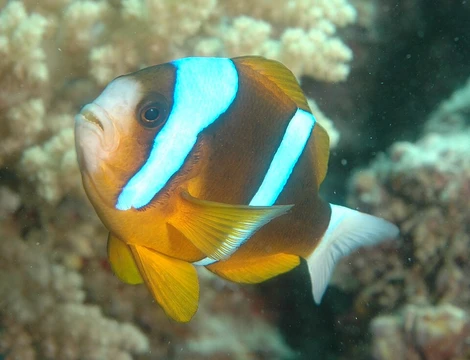
Where Barrier reef anemonefish has been recorded
GBIF occurrence records for Amphiprion akindynos, mapped and tabulated by country.

2,593 georeferenced occurrence records with coordinates are published for Amphiprion akindynos through GBIF, from 10 countries or marine areas. This page maps those records and lists where they come from. Occurrence records reflect where people have looked as well as where the species lives, so well-surveyed coastlines are over-represented.
- Georeferenced records
- 2,593
- Countries / areas
- 10
- Mapped locations
- 116
- Records sampled for the map
- 2,593
- Inland records omitted
- 13
- Gbif taxonkey
- 5212068
Symbiotic Partnership and Social Hierarchy
The clownfish-anemone relationship stands as one of the most celebrated examples of mutualism in marine biology. Anemonefish depend on their host anemones for shelter and protection against predators. In return, the fish act as guardians, defending the anemone from anemone-eating species, cleaning and fanning its tissues, and attracting beneficial microorganisms through their waste. This partnership is so central to their life cycle that juvenile clownfish, after dispersing as larvae across open ocean, must locate a suitable anemone host before settling on the seafloor. Within each group, a strict size-based dominance hierarchy governs social order: the breeding female ranks highest, followed by the breeding male, then non-breeding individuals in descending size. Should the female disappear, the breeding male undergoes a sex change to assume her reproductive role, while the remaining members shift upward in rank. During spawning, the female deposits eggs on a rock near the anemone, and the male fertilizes them.
Taxonomic History and Classification Debates
The genus Amphiprion was formally established in 1801 by Marcus Elieser Bloch and Johann Gottlob Theaenus Schneider, with the red saddleback anemonefish designated as the type species. The name draws from Greek roots meaning 'on both sides' and 'saw,' a reference to the saw-shaped edges along the gill covering. In 1816, Georges Cuvier argued that the maroon clownfish was morphologically distinct enough to warrant placement in a separate genus, Premnas. This taxonomic status has been contested for over two centuries, with Premnas repeatedly oscillating between being treated as a synonym, a subgenus of Amphiprion, or a fully independent genus. In 2021, two expansive phylogenetic analyses of damselfishes confirmed that all Premnas species fall within Amphiprion, settling the matter as a junior synonym. Subfamily placement has also generated debate: ichthyologist Gerald R. Allen proposed the subfamily Amphiprioninae in 1975, while a 2009 genetic study recommended creating the tribe Amphiprionini within Pomacentrinae. Eschmeyer's Catalog of Fishes follows the latter arrangement, though many scientific papers continue to use Amphiprioninae.
Evolutionary Origins and Species Radiation
The clownfish lineage diverged from other living damselfishes approximately 35 million years ago during the late Eocene. The most recent common ancestor of all extant species is dated to roughly 10.5 million years ago in the Early Miocene. A 2014 study traced their geographic origin to waters surrounding the Malay Archipelago. Beginning around 5 million years ago, the group experienced a marked acceleration in species diversification, driven by two major adaptive radiations—one centered on the Malay Archipelago and a later one in the western Indian Ocean. Speciation appears tightly coupled to their sea anemone hosts, as different anemone species occupy distinct habitats, thereby driving ecological separation among clownfish populations. Genetic evidence also reveals substantial interbreeding between species throughout their evolutionary history. As of 2025, 28 living species are recognized, along with two hybrids. That same year, a new species, the Polynesian anemonefish (A. maohiensis), was formally classified after being previously regarded as merely a color morph of the orange-fin anemonefish.
Morphology and Sensory Adaptations
Clownfish display considerable morphological variation across the genus. The maroon clownfish can reach 160 mm in length, while the orange clownfish maxes out at 80 mm, and the smallest group members measure just 6 to 15 mm. Body shapes range from oval to streamlined, with rounded heads that lack scales between the snout and eyes. The dorsal fin carries 10 spines followed by 14 to 20 soft rays, with notable shape differences between species—the ocellaris clownfish shows a large recess between spines and rays, whereas the red saddleback anemonefish presents them as mostly continuous. Their laterally positioned eyes can be seen from the front, suggesting some degree of binocular vision, and they perceive both color and ultraviolet light through small gaps between the iris and lens. A distinctive olfactory feature sets them apart among fish: an arrow-shaped smelling organ bearing fork-like extra flaps. Their hearing is attuned to relatively low frequencies in the 75 to 900 Hz range. Coloration typically features zero to three white vertical bars edged in black over a red, orange, yellow, brown, or black background.
Frequently Asked Questions
How many countries or marine areas have Barrier reef anemonefish been recorded in?
According to GBIF data, Amphiprion akindynos has documented occurrences spanning 10 countries or marine areas.
How many georeferenced occurrence records exist for the Barrier reef anemonefish?
A total of 2,593 records with coordinates are published for this species through GBIF, all of which were sampled for the distribution map.
Why do some coastlines show far more Barrier reef anemonefish records than others?
Occurrence data reflects where researchers and collectors have actually looked, not just where the fish lives, so heavily surveyed coastlines are naturally over-represented in the dataset.
How many distinct mapped locations does the Barrier reef anemonefish distribution page display?
The page plots 116 mapped locations drawn from the full set of 2,593 georeferenced records.
Were any inland records found for the Barrier reef anemonefish, and how were they handled?
Thirteen inland records were identified in the dataset and excluded from the map, since this is a strictly marine species and those points most likely represent data-entry errors.
Related in Barrier reef anemonefish
Links follow this subject's own source article.
Elsewhere in Barrier reef anemonefish
Spotted an error? Know more?
Reader corrections go straight into our review queue. Suggest an edit · How this site is sourced