
Amperima rosea
Source-cited species reference: taxonomy from WoRMS, biology from SeaLifeBase, occurrence map from GBIF, description from Wikipedia.

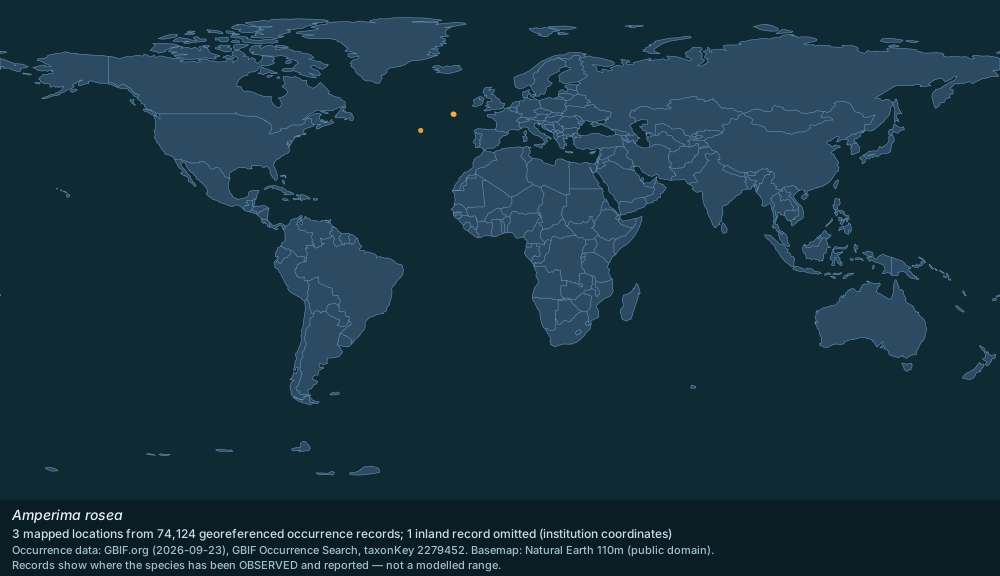
Distribution map plotted from GBIF.org occurrence records; basemap Natural Earth 110m · GBIF records CC0 / CC BY; Natural Earth public domain
Amperima rosea is a species of sea cucumber in the family Elpidiidae. It is found on the seabed at abyssal depths of 4000 m or more. Around 1996, its numbers in the Porcupine Abyssal Plain in the northeastern Atlantic increased dramatically from a few individuals per hectare to over six thousand per hectare, a phenomenon that became known as the "Amperima event".
- Scientific name
- Amperima rosea
- Authority
- (E. Perrier, 1886)
- Family
- Elpidiidae
- Order
- Elasipodida
- Depth range
- 4012–4795 m
- Habitat zone
- benthic
- Gbif occurrence records
- 74,124
Classification (WoRMS)
Full classification as recorded by WoRMS: Kingdom: Animalia · Phylum: Echinodermata · Class: Holothuroidea · Order: Elasipodida · Family: Elpidiidae · Genus: Amperima.
Accepted name: Amperima rosea · Authority: (E. Perrier, 1886) · Taxonomic status: accepted · AphiaID: 124723.
Synonyms and superseded combinations recorded for this taxon: Peniagone rosea E. Perrier, 1886; Periamma roseum R. Perrier, 1896.
Source: World Register of Marine Species (WoRMS) — https://www.marinespecies.org/aphia.php?p=taxdetails&id=124723 (CC BY 4.0). Accessed 2026-09-23.
Biology and life history (SeaLifeBase)
Measured values published by SeaLifeBase for Amperima rosea. Only fields the database actually holds for this species are shown; these are database values, not aquarium guidance.
Depth range: 4012–4795 m · Habitat zone: benthic.
SeaLifeBase notes: Surface deposit feeder (Ref. 111638).
Source: SeaLifeBase species summary (SpecCode 49911) — https://www.sealifebase.se/summary/Amperima-rosea.html (CC BY-NC 3.0 — non-commercial use only). Accessed 2026-09-23.
Distribution and occurrence records (GBIF)
74,124 georeferenced occurrence records for Amperima rosea are published through GBIF from 7 countries or marine areas. The map above plots 3 distinct locations from a sample of 3,000 records, omitting 1 inland record that carry an institution's coordinates rather than a collection site; it shows where the species has been observed and reported, not a modelled range.
Most records by country or area: Ireland (24); Spain (8); France (6); Czechia (1); Morocco (1).
The full country table, WoRMS marine regions and the sampling notes are on this species' Distribution page.
Source: GBIF Occurrence Search (taxonKey 2279452) — https://www.gbif.org/occurrence/search?taxon_key=2279452&has_coordinate=true (records CC0 / CC BY); WoRMS distribution records (MarineRegions) — https://www.marinespecies.org/aphia.php?p=taxdetails&id=124723 (CC BY 4.0); Natural Earth 110m basemap — https://www.naturalearthdata.com/ (public domain). Accessed 2026-09-23.
Description and natural history (Wikipedia)
Amperima rosea is a small sea cucumber growing to a length of between 20 and 35 mm. It occurs on the sediment-covered seabed of the deeper parts of the Pacific, Indian and Atlantic Oceans, including the Porcupine Abyssal Plain in the northeastern Atlantic.
Amperima rosea is a detritivore and feeds on phytodetritus by sifting through the sediment on the seabed. The phytodetritus is the remains of phytoplankton from shallow water locations which drifts down like snow or under certain conditions sinks rapidly to the sea floor. Amperima rosea breeds at any time of year. The eggs are small (less than 200μm in diameter) and lack much yolk indicating that larval development is likely to be planktonic. The species displays a high level of fecundity and it is likely that mass spawning takes place after some external stimulus such as a sudden increase in food supply.
In the mid-1990s in the Porcupine Abyssal Plain, the density of Amperima rosea on the seabed increased from pre-1995 levels of two or three individuals per hectare to over six thousand per hectare, and this new high population level was maintained in subsequent years. During the same period, other species of sea cucumber in the area also increased in number but decreased in average size and the brittle star Ophiocten hastatum also had an explosive increase in population density. The rate at which 100% of the surface layer of the seabed was completely turned over was reduced from two and a half years to six weeks. The increase in density of the sea cucumbers has been linked to a greater abundance of phytodetritus and this in turn may be due to higher surface water temperatures caused by climate change. The rapid increase in sea cucumber populations as a response to increased food supply may have reduced the build-up of organic materials in the sediment which would otherwise have occurred.
Source: Wikipedia: Amperima rosea — https://en.wikipedia.org/wiki/Amperima_rosea (CC BY-SA 4.0). Accessed 2026-09-23.
Gallery
Related in Amperima rosea
Links follow this subject's own source article.
Elsewhere in Amperima rosea
Spotted an error? Know more?
Reader corrections go straight into our review queue. Suggest an edit · How this site is sourced