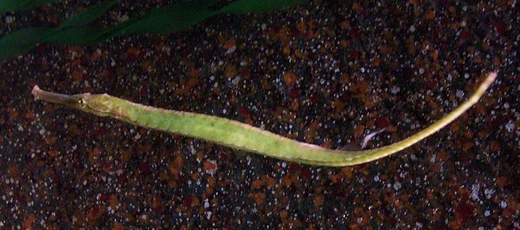
Alligator pipefish (Syngnathoides biaculeatus)
Source-cited species reference: taxonomy from WoRMS, biology from FishBase, occurrence map from GBIF, conservation from IUCN Red List, description from Wikipedia.

The alligator pipefish or double-ended pipefish (Syngnathoides biaculeatus) is a species of fish in the family Syngnathidae and is the only species in the monotypic genus Syngnathoides. It is found in shallow water in the tropical and subtropical Indo-Pacific, its range extending from East Africa to northern Australia. This fish lives in habitats of seagrass and seaweed, and hides by positioning itself vertically with its head down amidst the similar-coloured fronds of vegetation. The elongated, well-camouflaged body can reach 29 cm in length. It feeds by sucking up its prey.
- Scientific name
- Syngnathoides biaculeatus
- Authority
- (Bloch, 1785)
- Family
- Syngnathidae
- Order
- Syngnathiformes
- Maximum length
- 29 cm
- Depth range
- 0–10 m
- Habitat zone
- reef-associated
- Iucn red list
- Least Concern
- Gbif occurrence records
- 608
Classification (WoRMS)
Full classification as recorded by WoRMS: Kingdom: Animalia · Phylum: Chordata · Class: Teleostei · Order: Syngnathiformes · Family: Syngnathidae · Genus: Syngnathoides.
Accepted name: Syngnathoides biaculeatus · Authority: (Bloch, 1785) · Taxonomic status: accepted · AphiaID: 218035.
Synonyms and superseded combinations recorded for this taxon: Stigmatophora unicolor Castelnau, 1875; Syngnathoides bicauleatus (Bloch, 1785); Syngnathoides biculeatus (Bloch, 1785); Syngnathoides blochii Bleeker, 1851; Syngnathus biaculeatus Bloch, 1785; Syngnathus tetragonus Thunberg, 1776.
Source: World Register of Marine Species (WoRMS) — https://www.marinespecies.org/aphia.php?p=taxdetails&id=218035 (CC BY 4.0). Accessed 2026-09-23.
Biology and life history (FishBase)
Measured values published by FishBase for Syngnathoides biaculeatus. Only fields the database actually holds for this species are shown; these are database values, not aquarium guidance.
Maximum length: 29 cm · Depth range: 0–10 m · Habitat zone: reef-associated · Body shape: eel-like · Vulnerability index: 16.1 of 100 · Fishery importance: commercial · Aquarium trade: public aquariums.
FishBase notes: Occur in protected coastal shallows over or among algae, seagrasses (Ref. 41878), or floating weeds (Ref. 1602). Juveniles occasionally found near the surface (Ref. 4281). Ovoviviparous (Ref. 205). The males carry the eggs in a brood pouch which is found under the tail (Ref. 205). Used in Chinese medicine to extract Hailong, one of the important drugs (Ref. 12206). Has been reared in captivity (Ref. 35416).
Source: FishBase species summary (SpecCode 5980) — https://www.fishbase.se/summary/Syngnathoides-biaculeatus.html (CC BY-NC 3.0 — non-commercial use only). Accessed 2026-09-23.
Distribution and occurrence records (GBIF)
608 georeferenced occurrence records for Syngnathoides biaculeatus are published through GBIF from 33 countries or marine areas. The map above plots 138 distinct locations from a sample of 608 records, omitting 60 inland records that carry an institution's coordinates rather than a collection site; it shows where the species has been observed and reported, not a modelled range.
Most records by country or area: Kenya (109); Philippines (96); Australia (87); China (76); Indonesia (67); Japan (38); Papua New Guinea (17); Mozambique (16); Tanzania, United Republic of (13); Singapore (11); Madagascar (10); New Caledonia (10); Malaysia (9); Chinese Taipei (7); India (6).
Marine regions with a valid WoRMS distribution record: Mozambican Exclusive Economic Zone; Seychellois Exclusive Economic Zone; Kenyan Exclusive Economic Zone; South Africa (country); Madagascar; Mauritian Exclusive Economic Zone; Mtwapa.
Source: GBIF Occurrence Search (taxonKey 2333300) — https://www.gbif.org/occurrence/search?taxon_key=2333300&has_coordinate=true (records CC0 / CC BY); WoRMS distribution records (MarineRegions) — https://www.marinespecies.org/aphia.php?p=taxdetails&id=218035 (CC BY 4.0); Natural Earth 110m basemap — https://www.naturalearthdata.com/ (public domain). Accessed 2026-09-23.
Conservation status (IUCN Red List)
The IUCN Red List assesses Syngnathoides biaculeatus (Bloch, 1785) as Least Concern (code LC). No trend, population estimate or threat analysis is given here, because none is available from this source without the Red List API; follow the source link for the full assessment, including its date.
Source: IUCN Red List of Threatened Species (taxon 40715) — https://www.iucnredlist.org/species/40715/0; GBIF IUCN Red List category endpoint (taxonKey 2333300) — https://api.gbif.org/v1/species/2333300/iucnRedListCategory. Accessed 2026-09-23.
Description and natural history (Wikipedia)
The alligator pipefish can grow to a length of about 29 cm though a more typical length is 20 cm. The narrow head has the snout tipped by a pair of short tentacles and the body is elongated and tetrahedral. The dorsal fin has 38 to 48 soft rays and the anal fins have 4 soft rays. The tail is long and tapering. It is prehensile and lacks a tail fin, being used to anchor the fish to vegetation. The colour of this fish tends to match its surroundings and is usually some shade of green, brown, or grey. Females are often blotched and may have a white zigzag line running along the abdomen.
The alligator pipefish occurs in tropical and subtropical parts of the Indian Ocean and Pacific Ocean. Its range extends from South Africa, the East Coast of Africa, and the Red Sea to India, Japan, Indonesia, the Philippines, New Guinea, Australia, and various Pacific Islands. In Australia its range extends from Geraldton in Western Australia around the coast of the Northern Territory and Queensland to Batemans Bay in New South Wales. It occurs in lagoons and on reef flats, in bays and estuaries, in seagrass meadows, and in floating masses of algae, usually at depths of less than 5 m.
The alligator pipefish is an inefficient swimmer, moving by an undulating motion of its pectoral and dorsal fins. It feeds on zooplankton and small creatures which it sucks into its mouth. The diet includes amphipods, mysids, shrimps, other benthic invertebrates, and small fish.
The alligator pipefish is sexually dimorphic with males being larger than females. Males become mature at a length of about 180 mm. Breeding takes place during the summer in Moreton Bay, Queensland but occurs at any time of year in Papua New Guinea. A female produces a batch of 60 to 200 eggs which are retained by the male in a brood pouch on his abdomen. Here they remain until they hatch. The male and female seem to have a monogamous relationship with all the developing eggs being at the same stage of development and presumably the product of a single female.
The alligator pipefish is dried and used in traditional Chinese medicine when it is known as "hailong". This fish appears in the pet trade for sale to home aquarium owners and is also kept and reared in public aquariums. No studies on the population trend for this species have been done and the International Union for Conservation of Nature does not know where the traded fish are acquired; it is unclear whether these are wild-caught fish, whether there are dedicated fisheries for this species, whether the fish are caught as bycatch or whether they are captive-reared. For these reasons, the IUCN considers it has insufficient information to assess the conservation status of this fish and has therefore listed it as being "data deficient". It is a listed marine species under the Australian Environment Protection and Biodiversity Conservation Act 1999.
Source: Wikipedia: Alligator pipefish — https://en.wikipedia.org/wiki/Alligator_pipefish (CC BY-SA 4.0). Accessed 2026-09-23.
Frequently Asked Questions
Who is Alligator pipefish (Syngnathoides biaculeatus)?
It is a slender, elongated member of the pipefish family (Syngnathidae) and the sole species in the genus Syngnathoides, a lineage first named by Bloch back in 1785. Also called the double-ended pipefish, it can grow to roughly 29 cm and is recognizable for its well-camouflaged, needle-like body.
What are Alligator pipefish (Syngnathoides biaculeatus)'s powers/role?
Its signature 'superpower' is near-perfect camouflage: it suspends itself head-down among seagrass and seaweed fronds, matching the color and shape of the surrounding vegetation so closely that it becomes virtually invisible. When it's time to eat, it doesn't chase prey but instead uses a rapid suction action to pull small organisms into its mouth.
Why is Alligator pipefish (Syngnathoides biaculeatus) important?
Taxonomically it occupies a unique position as the monotypic representative of Syngnathoides, making it a distinct branch within Syngnathidae that cannot be replaced by any other species. Ecologically, it fills a foraging niche in tropical and subtropical Indo-Pacific coastal waters, contributing to the small-predator food web in seagrass meadows.
Where can you find Alligator pipefish (Syngnathoides biaculeatus)?
It ranges across shallow tropical and subtropical waters of the Indo-Pacific, from the coast of East Africa to northern Australia, typically between 0 and 10 meters depth. You'll most often spot it tucked vertically among dense seagrass beds or seaweed thickets where its elongated body blends seamlessly with the fronds.
Spotted an error? Know more?
Reader corrections go straight into our review queue. Suggest an edit · How this site is sourced