
Salt-and-pepper doris (Aegires albopunctatus)
Source-cited species reference: taxonomy from WoRMS, biology from SeaLifeBase, occurrence map from GBIF, description from Wikipedia.
Aegires albopunctatus, commonly known as the salt-and-pepper doris, is a species of sea slug or nudibranch, a marine gastropod mollusk in the family Aegiridae.
- Scientific name
- Aegires albopunctatus
- Authority
- MacFarland, 1905
- Family
- Aegiridae
- Order
- Nudibranchia
- Maximum length
- 2.3 cm
- Habitat zone
- benthic
- Gbif occurrence records
- 3,816
Classification (WoRMS)
Full classification as recorded by WoRMS: Kingdom: Animalia · Phylum: Mollusca · Class: Gastropoda · Order: Nudibranchia · Family: Aegiridae · Genus: Aegires.
Accepted name: Aegires albopunctatus · Authority: MacFarland, 1905 · Taxonomic status: accepted · AphiaID: 531071.
Source: World Register of Marine Species (WoRMS) — https://www.marinespecies.org/aphia.php?p=taxdetails&id=531071 (CC BY 4.0). Accessed 2026-09-23.
Biology and life history (SeaLifeBase)
Measured values published by SeaLifeBase for Aegires albopunctatus. Only fields the database actually holds for this species are shown; these are database values, not aquarium guidance.
Maximum length: 2.3 cm · Habitat zone: benthic · Vulnerability index: 10 of 100.
SeaLifeBase notes: Assumed maximum length from Ref. 822. Feeds on calcareous sponges (Ref. 822).
Source: SeaLifeBase species summary (SpecCode 6811) — https://www.sealifebase.se/summary/Aegires-albopunctatus.html (CC BY-NC 3.0 — non-commercial use only). Accessed 2026-09-23.
Distribution and occurrence records (GBIF)
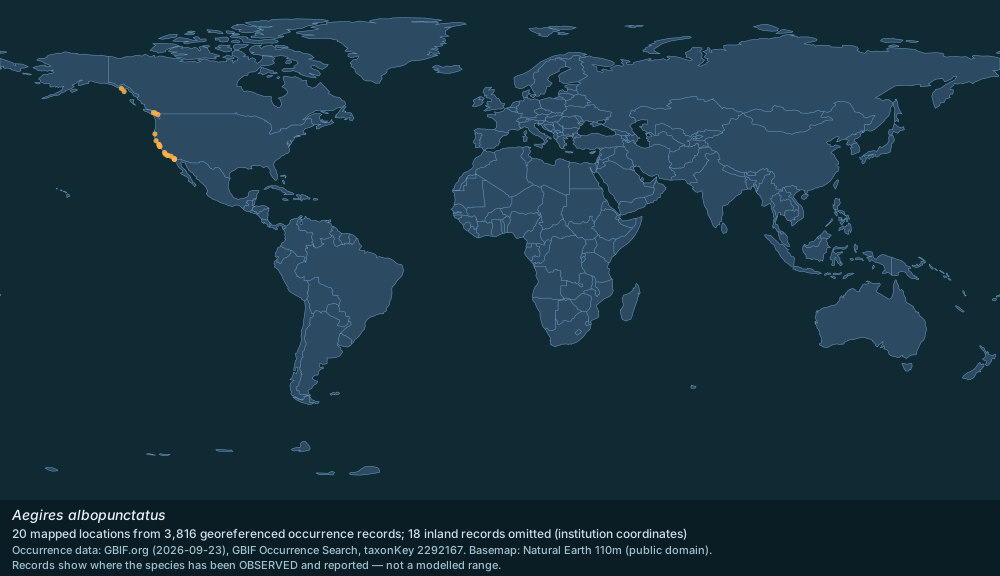
3,816 georeferenced occurrence records for Aegires albopunctatus are published through GBIF from 3 countries or marine areas. The map above plots 20 distinct locations from a sample of 3,000 records, omitting 18 inland records that carry an institution's coordinates rather than a collection site; it shows where the species has been observed and reported, not a modelled range.
Most records by country or area: United States of America (3,763); Canada (43); Mexico (10).
The full country table, WoRMS marine regions and the sampling notes are on this species' Distribution page.
Source: GBIF Occurrence Search (taxonKey 2292167) — https://www.gbif.org/occurrence/search?taxon_key=2292167&has_coordinate=true (records CC0 / CC BY); WoRMS distribution records (MarineRegions) — https://www.marinespecies.org/aphia.php?p=taxdetails&id=531071 (CC BY 4.0); Natural Earth 110m basemap — https://www.naturalearthdata.com/ (public domain). Accessed 2026-09-23.
Description and natural history (Wikipedia)
Other common names include the salt-and-pepper nudibranch, small white nudibranch, white knight nudibranch, and white-spotted doris.
The salt-and-pepper doris occurs in the Eastern Pacific Ocean, along the coast stretching from British Columbia, Canada to Baja California, Mexico. It inhabits the low intertidal zone and the shallow subtidal zone, down to depths of 100 ft (30 m). The salt-and-pepper doris can be found in sheltered, rocky tide pools and on wharf pilings.
The salt-and-pepper doris grows up to 0.9 in (23 mm) in length. Its body is somewhat shaped like a squarish torpedo, and ranges in color from bright white to duller, yellowish-gray shades of white. As its common name references, the salt-and-pepper doris is noted for the small dark and white spots all around its body, which resemble ground table salt and black pepper. The larger, dark "pepper" spots appear black or dark brown in color, while the white "salt" flecks may not be very distinct on brighter white individuals; they are more apparent on grayer individuals. Some individuals may have very little "pepper" spots, or none at all.
Like other members of its genus, the body wall of the salt-and-pepper doris is firm to the touch, as it is filled with spicules from the sponges it consumes. Its body is lined with irregular rows of short, cylindrical tubercles. Its rhinophores are yellowish in color and, like the tubercles along its body, are truncated and simple in shape. It has 3 gills or branchial plumes which are small, tripinnate, and each sheltered by a large, irregularly shaped tubercle.
Near its mouth, the salt-and-pepper doris has small, lobe-like oral tentacles. Its mouth is roofed by a thick, quadrangular mandibular plate and its radula is broad and deeply grooved, with 16-22 rows of 17 teeth.
The salt-and-pepper doris is specialized to feed exclusively on the calcareous sponges of the genera Leucetta, Leucilla, and possibly Leucosolenia.
Like all nudibranchs, the salt-and-pepper doris is a simultaneous hermaphrodite. While mating, individuals wrestle for dominance, attempting to penetrate and impregnate the other with their penis, which is lined with small, hooked spines.
Source: Wikipedia: Aegires albopunctatus — https://en.wikipedia.org/wiki/Aegires_albopunctatus (CC BY-SA 4.0). Accessed 2026-09-23.
Gallery
Related in Salt-and-pepper doris
Links follow this subject's own source article.
Elsewhere in Salt-and-pepper doris
Spotted an error? Know more?
Reader corrections go straight into our review queue. Suggest an edit · How this site is sourced