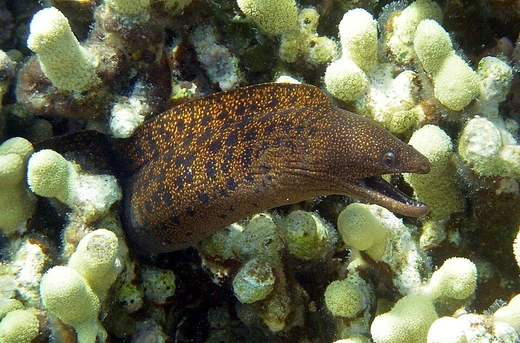
Abbott's moray eel (Gymnothorax eurostus)
Source-cited species reference: taxonomy from WoRMS, biology from FishBase, occurrence map from GBIF, conservation from IUCN Red List, description from Wikipedia.

Abbott's moray eel (Gymnothorax eurostus), also known as the stout moray and the salt and pepper moray, is a moray eel of the family Muraenidae. G. eurostus is found in the Indo-Pacific, and its range exhibits an antitropical distribution. It is the most common moray eel in the Hawaiian Islands. Abbott's moray is found in the eastern Pacific Ocean from Costa Rica to Easter Island, at depths down to 74 m. With a body that is variable in color, the length of this species is up to 60 cm.
- Scientific name
- Gymnothorax eurostus
- Authority
- (Abbott, 1860)
- Family
- Muraenidae
- Order
- Anguilliformes
- Maximum length
- 60 cm
- Depth range
- 0–74 m
- Habitat zone
- reef-associated
- Iucn red list
- Least Concern
- Gbif occurrence records
- 1,927
Classification (WoRMS)
Full classification as recorded by WoRMS: Kingdom: Animalia · Phylum: Chordata · Class: Teleostei · Order: Anguilliformes · Family: Muraenidae · Genus: Gymnothorax.
Accepted name: Gymnothorax eurostus · Authority: (Abbott, 1860) · Taxonomic status: accepted · AphiaID: 217496.
Synonyms and superseded combinations recorded for this taxon: Gymnothorax laysanus (Steindachner, 1900); Lycodontis eurostus (Abbott, 1860); Lycodontis laysanus (Steindachner, 1900); Muraena laysana Steindachner, 1900; Thyrsoidea eurosta Abbott, 1860.
Source: World Register of Marine Species (WoRMS) — https://www.marinespecies.org/aphia.php?p=taxdetails&id=217496 (CC BY 4.0). Accessed 2026-09-23.
Biology and life history (FishBase)
Measured values published by FishBase for Gymnothorax eurostus. Only fields the database actually holds for this species are shown; these are database values, not aquarium guidance.
Maximum length: 60 cm · Depth range: 0–74 m · Habitat zone: reef-associated · Body shape: eel-like · Vulnerability index: 44 of 100 · Fishery importance: commercial · Aquarium trade: commercial.
FishBase notes: Benthic in crevices (Ref. 58302). Feeds on crustaceans and small fishes (Ref. 89972). Minimum depth reported taken from Ref. 86942.
Source: FishBase species summary (SpecCode 6662) — https://www.fishbase.se/summary/Gymnothorax-eurostus.html (CC BY-NC 3.0 — non-commercial use only). Accessed 2026-09-23.
Distribution and occurrence records (GBIF)
1,927 georeferenced occurrence records for Gymnothorax eurostus are published through GBIF from 31 countries or marine areas. The map above plots 137 distinct locations from a sample of 1,927 records, omitting 29 inland records that carry an institution's coordinates rather than a collection site; it shows where the species has been observed and reported, not a modelled range.
Most records by country or area: United States of America (780); Australia (604); Chinese Taipei (126); South Africa (107); Norfolk Island (91).
The full country table, WoRMS marine regions and the sampling notes are on this species' Distribution page.
Source: GBIF Occurrence Search (taxonKey 2404046) — https://www.gbif.org/occurrence/search?taxon_key=2404046&has_coordinate=true (records CC0 / CC BY); WoRMS distribution records (MarineRegions) — https://www.marinespecies.org/aphia.php?p=taxdetails&id=217496 (CC BY 4.0); Natural Earth 110m basemap — https://www.naturalearthdata.com/ (public domain). Accessed 2026-09-23.
Conservation status (IUCN Red List)
The IUCN Red List assesses Gymnothorax eurostus (Abbott, 1860) as Least Concern (code LC). No trend, population estimate or threat analysis is given here, because none is available from this source without the Red List API; follow the source link for the full assessment, including its date.
Source: IUCN Red List of Threatened Species (taxon 195723) — https://www.iucnredlist.org/species/195723/0; GBIF IUCN Red List category endpoint (taxonKey 2404046) — https://api.gbif.org/v1/species/2404046/iucnRedListCategory. Accessed 2026-09-23.
Description and natural history (Wikipedia)
Abbott's moray eel reaches up to 60 cm while containing around 120 to 123 vertebrae. Lacking pectoral fins, Abbott's moray eel has skin protected by a mucus layer that is released by the goblet cells in the epidermis. The color is variable, ranging from reddish brown with yellow spots throughout the body, to tan or brown coloring with pale spots that may have darker spots over them.
The distribution of Abbott's moray eel is temperature related, as it is found in the Indo-Pacific between latitudes 16 and 32 degrees north and south. It is found throughout the Hawaiian Islands, Johnston Island, Easter Island, Austral Islands, Lord Howe Island, Heron Island, Marcus Island, Taiwan, Ryukyu Islands, Japan, Bazaruto Island, and Mozambique. Abbott's moray eel lives in coastal reef habitats in spaces like crevices, caves, and under rocky ledges. It can be found in shallow waters down to a depth of 74 m, but is most frequently found at depths of 3 to 5 m.
Abbott's moray eel is a voracious nocturnal carnivore, feeding mostly on reef fishes. Lironeca puhi is a common parasite of the Abbott's moray eel, with around 15 to 70% of the eel population being infected by the parasite. An Abbott's moray eel that is infected will typically have both a female and male Lironeca in a single, left or right gill chamber.
Source: Wikipedia: Abbott's moray eel — https://en.wikipedia.org/wiki/Abbott%27s_moray_eel (CC BY-SA 4.0). Accessed 2026-09-23.
Frequently Asked Questions
Who is Abbott's moray eel (Gymnothorax eurostus)?
Abbott's moray eel is a species of moray eel in the family Muraenidae, commonly called the stout moray or salt and pepper moray. It was first formally described by Abbott in 1860 and belongs to the order Anguilliformes.
What is Abbott's moray eel (Gymnothorax eurostus)'s role in its ecosystem?
As a predatory eel, it occupies a mid-level trophic position in reef and rocky-substrate communities across its range. In the Hawaiian Islands it is the most frequently encountered moray species, making it a key predator in that local food web.
How big does Abbott's moray eel (Gymnothorax eurostus) get and what does it look like?
Individuals reach a maximum total length of roughly 60 cm and show highly variable coloration from one specimen to the next. The species is found at depths ranging from the surface down to about 74 meters.
Where can you find Abbott's moray eel (Gymnothorax eurostus)?
Its distribution spans the Indo-Pacific with an antitropical pattern, and it also occurs in the eastern Pacific from Costa Rica to Easter Island. Hawaiian waters host it as the region's most common moray eel.
Why is Abbott's moray eel (Gymnothorax eurostus) important?
Being the most abundant moray in the Hawaiian Islands, it is a significant predator in local marine food webs and a species divers and researchers encounter regularly. Its broad Indo-Pacific to eastern Pacific range also makes it a useful reference point for assessing reef and rocky-habitat health across multiple ocean basins.
Related in Abbott's moray eel
Links follow this subject's own source article.
Elsewhere in Abbott's moray eel
Spotted an error? Know more?
Reader corrections go straight into our review queue. Suggest an edit · How this site is sourced