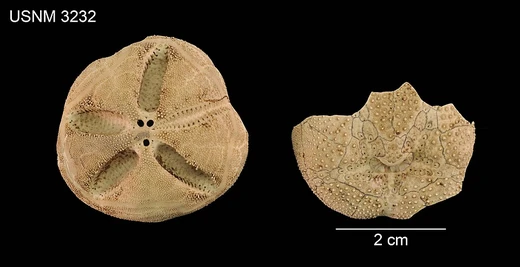
Abatus cordatus
Source-cited species reference: taxonomy from WoRMS, biology from SeaLifeBase, occurrence map from GBIF, description from Wikipedia.

Lillie, Frank Rattray, Moore, Carl Richard, Redfield, Alfred Clarence. · Public domain
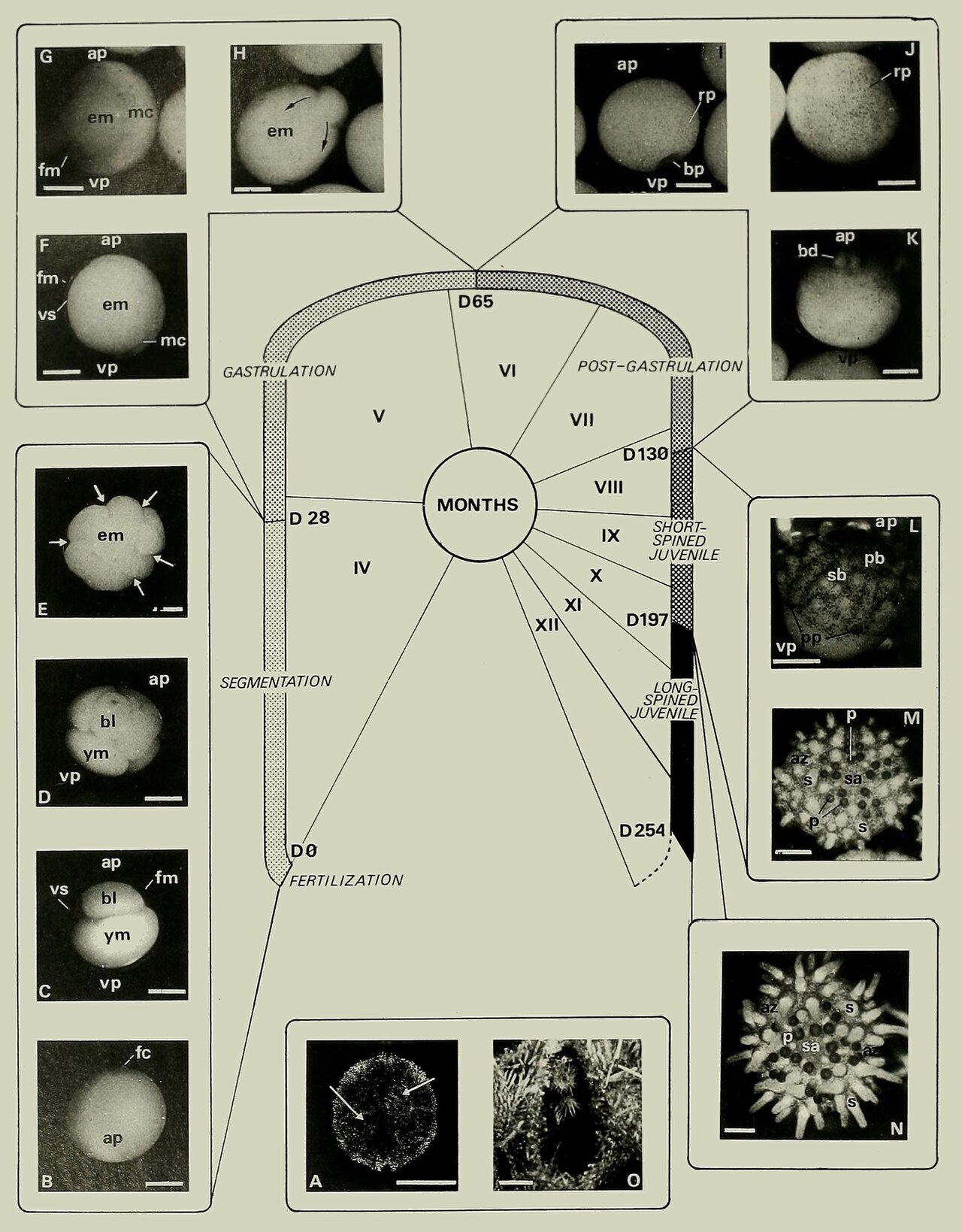
Abatus cordatus is a species of sea urchin in the family Schizasteridae. It is native to shallow seas surrounding certain island groups in the southern Indian Ocean. The body is protected by a hard test or shell which is covered with spines. The female broods its young in deep pockets on the upper surface, retaining the young in place with specialised spines. American zoologist Addison Emery Verrill first scientifically described A. cordatus in 1876.
- Scientific name
- Abatus cordatus
- Authority
- (Verrill, 1876)
- Family
- Schizasteridae
- Order
- Spatangoida
- Habitat zone
- benthic
- Gbif occurrence records
- 523
Taxonomic Identity & Classification
Abatus cordatus belongs to the genus Abatus, a group of sea urchins classified within the family Schizasteridae. This places it among a relatively specialized lineage of echinoderms, distinct from the more commonly encountered sea urchin families. The species epithet cordatus was assigned when Verrill formally described the organism in 1876, anchoring it in the scientific record for nearly two centuries. As a member of Schizasteridae, Abatus cordatus shares broader morphological and developmental traits with its close relatives in the genus, though the specific diagnostic features that separate it from the ten other recognized Abatus species are detailed in the taxonomic literature. The genus itself is not a sprawling or globally distributed group; rather, it represents a compact assemblage of species tied to a particular biogeographic zone. Understanding where Abatus cordatus sits within Schizasteridae helps researchers appreciate both its evolutionary relationships and the ecological niche it occupies in cold, southern waters.
A Southern Ocean Home
The entire genus Abatus is restricted to an extraordinary and remote biogeographic zone: Antarctica and the southernmost reaches of South America. This means Abatus cordatus, like every other species in the genus, is a creature of the cold, high-latitude seas that fringe the continent of ice and the sub-Antarctic islands. No Abatus species has been recorded in temperate or tropical waters, underscoring how tightly the genus is bound to polar and sub-polar marine environments. The distribution spanning both the Antarctic region and the tip of South America suggests a faunal continuity across the waters separating the two landmasses, linking them through shared marine biota. For a sea urchin, this confinement to the planet's southernmost waters implies adaptations to low temperatures, seasonal light extremes, and the unique food webs of polar seas. The fact that all eleven recognized species share this narrow latitudinal band makes Abatus a compelling case study in polar marine biodiversity.
Eleven Species, One Genus
The genus Abatus comprises eleven formally described species, each named by a different taxonomist or group of taxonomists over more than a century of polar marine research. The roster includes Abatus agassizii (Pfeffer, 1889), Abatus beatriceae (Larrain, 1986), Abatus cavernosus (Philippi, 1845), Abatus cordatus (Verrill, 1876), Abatus curvidens (Mortensen, 1936), Abatus ingens (Koehler, 1926), Abatus kieri (McKinney, McNamara & Wiedman, 1988), Abatus koehleri (Thiéry, 1909), Abatus nimrodi (Koehler, 1911), Abatus philippii (Lovén, 1871), and Abatus shackletoni (Koehler, 1911). Several names honor the scientists who first collected or studied Antarctic marine life, while others commemorate explorers and early polar researchers. The spread of description dates, from Philippi's 1845 entry to the McKinney team's 1988 contribution, reflects the slow, expedition-driven pace at which Antarctic biodiversity was catalogued over more than a century of fieldwork.
A Century of Polar Discovery
The taxonomic history of Abatus reads like a chronicle of Antarctic exploration itself. The earliest species in the genus, Abatus cavernosus, was described by Philippi in 1845, barely two decades after the first major scientific voyages to the southern seas. Verrill followed with Abatus cordatus in 1876, and Lovén added Abatus philippii the same year, signaling that multiple European naturalists were examining southern marine collections almost simultaneously. The early twentieth century brought a burst of activity: Koehler described both Abatus ingens in 1926 and Abatus nimrodi in 1911, while Thiéry contributed Abatus koehleri in 1909. Mortensen entered the record in 1936 with Abatus curvidens. The most recent addition, Abatus kieri, was described by McKinney, McNamara, and Wiedman in 1988, closing nearly a 145-year span of discovery. Each new species represents another expedition, another specimen collection, another scientist peering into the frozen margins of the world.
Gallery
Spotted an error? Know more?
Reader corrections go straight into our review queue. Suggest an edit · How this site is sourced