CCOR-2
Space coronagraph at L1 for solar corona imaging.
Last updated
CCOR-2 (Compact CORonograph 2) is the second space coronagraph in the Compact Coronograph series, mounted on the SOLAR-1 spacecraft at the Lagrange 1 point, roughly 1.5 million kilometers from Earth toward the Sun. It orbits the Sun between 0.974 and 1.006 AU. Launched in September 2025 from Florida, it provides low-latency visible-light images of the solar corona for space weather forecasting.
Quick Facts
- Launched
- 24 September 2025
- Launch site
- Kennedy Space Flight Center, eastern Florida
- Launch vehicle
- SpaceX Falcon 9
- First light
- 23 January 2026
- Developer
- US Naval Research Laboratory, Washington D.C.
- Length
- 72 centimeters (28.3 in)
Facts from the source article.
Mission
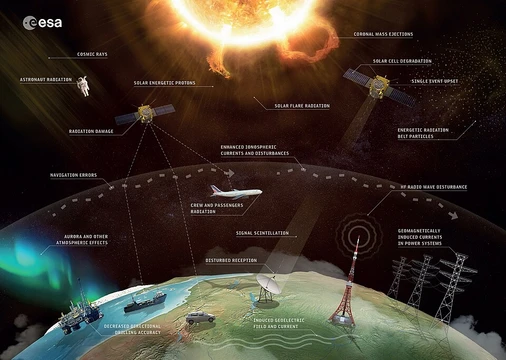
CCOR-2 delivers low-latency, high-cadence visible-light images of the solar corona and its surroundings, focusing on coronal mass ejections (CMEs) that threaten electronic infrastructure. Its data supports space weather forecasting for the National Oceanic and Atmospheric Administration and the Space Weather Prediction Center. The coronagraph is a descendant of the aging SOHO/LASCO and STEREO/COR instruments. Data from CCOR-2 feeds the PyCAT open-source software and the WSA-Enlil model to calculate CME mass, velocity, and direction.
Parameters and technical data
The instrument uses a 2048×1920 pixel Active Pixel Sensor detector sensitive to wavelengths from about 450 nm to 750 nm. It must achieve a spatial resolution of ≤70 arcseconds, an inner field-of-view cutoff at 3.0 solar radii, and an outer field of view at 20 solar radii or better. Signal-to-noise ratio must be 10 in the region between 4.4 and 22.7 solar radii (1.17° to 6.05°). Maximum image latency is 30 minutes, and full-resolution images are taken every 15 minutes (or every 5 minutes for 2×2 binned images).
CME mass estimates must have an error ≤50% for masses between specified limits, and CME velocity estimates must have a maximum error of 5% in the range 200 km/s to 3400 km/s. The instrument includes a closable outer door and must meet all requirements during an X50 solar flare or S4 class solar storm. Data processing begins with L0 CCSDS raw readout, which is rotated to create L0B, then converted to Level 1A in Mean Solar Brightness units with corrections for vignetting and detector linearity.
Level 2 images are produced by subtracting a median background, applying distortion correction, and flat-field rectification. Public data access began on 17 June 2026, 15 days after the Provisional-maturity Product Validation Review.
More in Space Weather
Sources
Compiled from Wikipedia and the sources listed below. Text from Wikipedia is available under CC BY-SA 4.0; this entry is adapted from it.
- Wikipedia: CCOR-2 (CC BY-SA 4.0).
Spotted an error? Know more?
Reader corrections go straight into our review queue. Suggest an edit · How this site is sourced