Geomagnetically induced current
Electrical currents induced by geomagnetic disturbances affecting infrastructure.
Last updated
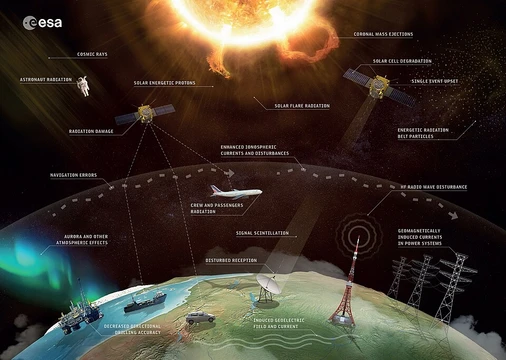
Geomagnetically induced currents happen when quick shifts in Earth's magnetic field, driven by space weather, create electrical flows at the surface. These currents can disrupt long conductors like power lines and pipelines, with the biggest problems hitting high-latitude regions.
Quick Facts
- First observed
- 1847–1848 during Solar cycle 9
- Typical gic magnitude
- tens to hundreds of amperes
- Example of major impact
- 13 March 1989 collapse of Hydro-Québec power grid
- Typical variation periods
- seconds to about an hour
Facts from the source article.
Background
The Earth's magnetic field varies on timescales from seconds to millennia. Long-term changes arise from core dynamo action, while shorter variations stem from processes in the ionosphere, magnetosphere, and heliosphere tied to the solar activity cycle. These geomagnetic responses to solar conditions are useful in magnetotellurics but also create a hazard to technology beneath the atmosphere.
Risk to infrastructure
A time-varying external magnetic field induces telluric currents in the ground, which produce a secondary internal field. By Faraday's law, this creates a surface electric field (measured in V/km) that acts as a voltage source across grounded conducting networks such as power grids, pipelines, undersea cables, telephone and telegraph lines, and railways. GIC are quasi-DC, with frequency governed by the electric field's time variation. For GIC to be hazardous, the current must be large and frequent enough to cause immediate or cumulative damage.
The largest GIC occur during geomagnetic storms, when magnetospheric-ionospheric current variations are greatest. Significant variation periods range from seconds to about an hour, involving the upper mantle and lithosphere. The largest magnetic field variations are at high geomagnetic latitudes, where GIC of tens to hundreds of amperes have been recorded since the 1970s in Canada, Finland, and Scandinavia. GIC have also been observed at mid-latitudes during major storms, and low-latitude areas may be at risk during sudden storm commencements due to high short-period field changes on the day side.
GIC were first noted on the electric telegraph network in 1847–1848. Fewer problems have been reported for undersea cables, telephone networks, and railways due to resiliency efforts.
In power grids
Modern power transmission systems operate at fixed voltages (200–700 kV) between substations, with a trend toward higher voltages and lower line resistances to reduce losses over longer distances. Low resistances favor GIC flow. GIC disrupt transformer magnetic circuits, causing half-cycle saturation that produces harmonics, localized heating, increased reactive power demand, inefficient transmission, and possible mis-operation of protective relays.
The magnitude causing problems varies by transformer type; modern industry specifies GIC tolerance levels for new transformers. On 13 March 1989, a severe geomagnetic storm caused the Hydro-Québec grid to collapse in seconds as protective relays tripped in cascade, leaving six million people without power for nine hours. Since then, power companies in North America, the UK, Northern Europe, and elsewhere have assessed GIC risk and developed mitigation strategies.
Risk reduction options include capacitor blocking systems, maintenance schedule changes, additional on-demand generating capacity, and load shedding, though these are expensive or impractical. Growing high-voltage networks increase risk due to greater interconnectedness, connections to auroral zone grids, and operation near capacity.
GIC hazard in pipelines
Major pipeline networks exist at all latitudes, often continental in scale. Steel pipelines have corrosion-resistant coatings; damage exposing steel to soil or water can cause localized corrosion. Buried pipelines use cathodic protection to maintain a negative potential relative to ground, minimizing corrosion.
GIC cause swings in pipe-to-soil potential, increasing corrosion rates during major geomagnetic storms, leading to reduced service life rather than catastrophic failure. Pipeline networks are modeled similarly to power grids using distributed source transmission line models that calculate pipe-to-soil potential at any point, accounting for bends, branches, and electrical insulators. This modeling helps engineers understand cathodic protection system behavior during storms when surveying and maintenance may be suspended.
More in Space Weather
Sources
Compiled from Wikipedia and the sources listed below. Text from Wikipedia is available under CC BY-SA 4.0; this entry is adapted from it.
- Wikipedia: Geomagnetically induced current (CC BY-SA 4.0).
Spotted an error? Know more?
Reader corrections go straight into our review queue. Suggest an edit · How this site is sourced