Pioneer 10
First spacecraft to traverse the asteroid belt and reach Jupiter.
Last updated
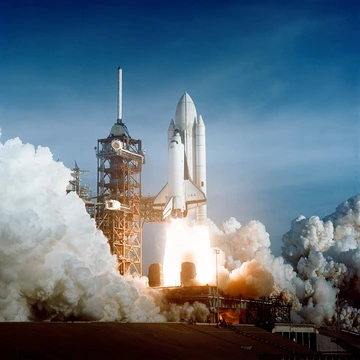
Pioneer 10 was the first spacecraft to fly beyond Mars, through the asteroid belt, and to Jupiter, making the first in-situ measurements of that planet's environment.[1] It became the first human-made object to leave the solar system after its Jupiter flyby.[1] At 01:49:00 UTC on March 3, 1972 (8:49 p.m. Eastern Standard Time on March 2), an Atlas-Centaur launch vehicle lifted off from Cape Canaveral Launch Complex 36A carrying Pioneer 10.[2]
Key facts and history
NASA approved the mission in February 1969, and the spacecraft was originally designated Pioneer F before launch.[3] The main body of Pioneer 10 measured 36 cm in depth and had a hexagonal shape with six sides each 76 cm long; this bus contained eight of the eleven scientific instruments on board.[4] A 2.74 m parabolic dish, built from aluminum honeycomb sandwich material, served as the spacecraft's high-gain antenna.[5] After crossing the asteroid belt without encountering any large particles, Pioneer 10 exited the belt on approximately February 15, 1973.[6]
Pioneer 10 became the first spacecraft to execute a gravity-assist maneuver, using Jupiter's gravitational pull to propel it out of the Solar System.[7] The formal conclusion of the Pioneer 10 mission occurred on March 31, 1997, at which point the spacecraft was located 67 AU from the Sun.[5]
What the cited sources add
The NASA technical report "Pioneer Odyssey: Encounter with a Giant" states that Pioneer 10 provided the first close-up pictures of Jupiter and was the first man-made object to leave the solar system.[1] The Weebau Spaceflight Encyclopedia notes that as of January 1, 1997, Pioneer 10 was at about 67 AU from the Sun near the ecliptic plane, heading outward at 2.6 AU/year.[8] The same source records that on February 5, 2002, Pioneer 10 was 79.66 AU from the Sun and traveling at 12.24 km/sec relative to the Sun.[8] The Weebau Spaceflight Encyclopedia also states that until Pioneer 10 reaches about 1.5 parsec from the Sun—roughly 126,000 years from now—its path will be dominated by the Sun's gravitational field.[8]
References
- "Pioneer Odyssey: Encounter with a Giant", NASA, August 1974. facts only, no text reused. ntrs.nasa.gov
- Wikipedia, "Pioneer 10" (CC BY-SA 4.0), which cites: "NASA Glenn: Pioneer Launch History", NASA, 7 March 2003 (original not read by us) en.wikipedia.org
- Wikipedia, "Pioneer 10" (CC BY-SA 4.0), which cites: Burrows 1999, p. 476 (original not read by us) en.wikipedia.org
- Wikipedia, "Pioneer 10" (CC BY-SA 4.0), which cites: "Study of the anomalous acceleration of Pioneer 10 and 11", Physical Review D, April 2002; "Pioneer Odyssey: Encounter with a Giant", NASA, August 1974 (we also read that source) en.wikipedia.org
- Wikipedia, "Pioneer 10" (CC BY-SA 4.0), which cites: "Study of the anomalous acceleration of Pioneer 10 and 11", Physical Review D, April 2002 (original not read by us) en.wikipedia.org
- Wikipedia, "Pioneer 10" (CC BY-SA 4.0), which cites: "Pioneer 10 beats the asteroid belt", New Scientist, 1 March 1973, p. 470; Burgess 1982, p. 16 (original not read by us) en.wikipedia.org
- Wikipedia, "Pioneer 10" (CC BY-SA 4.0), which cites: "NASA says 'bye bye Birdie' to Pioneer 10 Spacecraft", The Salina Journal, 13 June 1983 (original not read by us) en.wikipedia.org
- "Weebau Spaceflight Encyclopedia", November 9, 2010. facts only, no text reused. weebau.com
Each numbered sentence above was checked against the source it cites before publication. Sentences citing Wikipedia adapt text from the English Wikipedia article Pioneer 10 (contributors), used under CC BY-SA 4.0; this entry is available under the same licence. Other sources were used for facts only; no text or images are copied from them.
More in Space Missions
Sources
Compiled from Wikipedia and the sources listed below. Text from Wikipedia is available under CC BY-SA 4.0; this entry is adapted from it.
- Wikipedia: Pioneer 10 (CC BY-SA 4.0).
Spotted an error? Know more?
Reader corrections go straight into our review queue. Suggest an edit · How this site is sourced