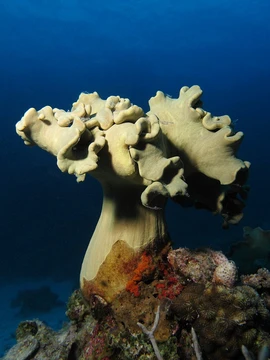
Pseudoplexaura porosa
A large, flexible Caribbean octocoral with bioactive secondary metabolites.
Last updated
The colony has a trunk up to 5 cm thick and branches dichotomously into long, slightly tapered end branches averaging 4 mm thick.[1] Its polyps have eight tentacles and are retracted into round pores arranged spirally up the smooth, slimy branches.[1] This soft coral forms upright, tree-like colonies that can reach approximately 2.25 m in height.[1]
Scientific classification
- KingdomAnimalia
- PhylumCnidaria
- SubphylumAnthozoa
- ClassOctocorallia
- OrderMalacalcyonacea
- FamilyPlexauridae
- GenusPseudoplexaura
- SpeciesPseudoplexaura porosa
Named by (Houttuyn, 1772)
Sources: Wikipedia taxobox: Pseudoplexaura porosa (CC BY-SA 4.0) · order, family and genus agree with WoRMS AphiaID 290881 (CC BY 4.0)
Where the pseudoplexaura porosa has been recorded
Each dot is a place where the species has been observed and reported (500 records, half-degree grid) — not a modelled range. 7 inland records left out (institution coordinates).
Map: drawn by Codexery. Data: GBIF occurrence search (records CC0 / CC BY) · Natural Earth basemap (public domain)
Quick Facts
- Species
- porosa
Facts from the source article.
Biology and range
The Parr account notes that P. porosa prefers shallow waters with high light levels and good water flow.[2] The tissues contain symbiotic zooxanthellae that provide nutrients through photosynthesis.[3][2] Colonies are either male or female and release gametes on nights about five days after a full moon in summer.[3][2] Planula larvae settle after five days, acquire zooxanthellae, and grow by budding.[3]
The geographic distribution of this octocoral includes the Caribbean Sea, the Gulf of Mexico, and waters from Bermuda and Florida down to Colombia.[4] Reef habitats between 3 and 6 m depth are its typical home, though observations have placed it as deep as 280 m.[4] Nematocysts arm the polyps, which can be pulled back into the branches as a defensive action.[5] Fragments that break off can establish new colonies, and the main threat to survival is being torn loose during tropical storms.[3]
What the specialist sources record
The Parr account states that P. porosa is a sedentary benthic animal with very little defense and reduced nematocyst density.[2] A 1998 gut-content study found that one colony’s diet was dominated by zooplankton remnants such as gastropod larvae.[2] The Sprung article notes that Pseudoplexaura species are distinguished from Plexaurella by having purple sclerites and round pores, and that they grow very rapidly.[6] The same source says the circular pores of Pseudoplexaura are distinct from the slit-shaped pores of Plexaurella.[6]
The Parr account reports that P. porosa is protected by the Coral Reef Preserve Act in Bermuda and is a popular aquarium species.[2]
References
- Wikipedia, "Pseudoplexaura porosa" (CC BY-SA 4.0), which cites: "Porous false Plexaura (Pseudoplexaura porosa)", Interactive Guide to Caribbean Diving (original not read by us) en.wikipedia.org
- Parr, Melissa, "Porous Sea Rod: Pseudoplexaura porosa", Marine Invertebrates of Bermuda. facts only, no text reused. thecephalopodpage.org
- Wikipedia, "Pseudoplexaura porosa" (CC BY-SA 4.0), which cites: Parr, Melissa, "Porous Sea Rod: Pseudoplexaura porosa", Marine Invertebrates of Bermuda (we also read that source) en.wikipedia.org
- Wikipedia, "Pseudoplexaura porosa" (CC BY-SA 4.0), which cites: "Porous false Plexaura (Pseudoplexaura porosa)", Interactive Guide to Caribbean Diving; Sprung, Julian, "Aquarium Invertebrates: Caribbean Gorgonians: Beauty in Motion", Advanced Aquarist, 2004-03-01 (we also read that source) en.wikipedia.org
- Wikipedia, "Pseudoplexaura porosa" (CC BY-SA 4.0), which cites: Sprung, Julian, "Aquarium Invertebrates: Caribbean Gorgonians: Beauty in Motion", Advanced Aquarist, 2004-03-01 (we also read that source) en.wikipedia.org
- Sprung, Julian, "Aquarium Invertebrates: Caribbean Gorgonians: Beauty in Motion", Advanced Aquarist, 2004-03-01. facts only, no text reused. advancedaquarist.com
Each numbered sentence above was checked against the source it cites before publication. Sentences citing Wikipedia adapt text from the English Wikipedia article Pseudoplexaura porosa (contributors), used under CC BY-SA 4.0; this entry is available under the same licence. Other sources were used for facts only; no text or images are copied from them.
More in Soft Corals and Leathers
Sources
Compiled from Wikipedia and the sources listed below. Text from Wikipedia is available under CC BY-SA 4.0; this entry is adapted from it.
- Wikipedia: Pseudoplexaura porosa (CC BY-SA 4.0).
- Classification: the source article's taxobox; order, family and genus checked against WoRMS, the World Register of Marine Species (CC BY 4.0).
- Occurrence records: GBIF (CC0 / CC BY). Basemap: Natural Earth (public domain).
- Word definitions: the , each quoted from its Wikipedia article.
Spotted an error? Know more?
Reader corrections go straight into our review queue. Suggest an edit · How this site is sourced