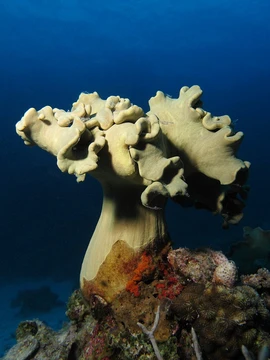
Plexaura homomalla
A Caribbean gorgonian coral rich in prostaglandin used as a drug source.
Last updated

Paul Asman and Jill Lenoble · via Wikipedia: Plexaura homomalla · CC BY 2.0
Plexaura homomalla is a marine species in the family Plexauridae, class Octocorallia.[1][2] Upright branches of this species form colonies that resemble bushy candelabras, reaching roughly 35 cm in height.[3]
Scientific classification
- KingdomAnimalia
- PhylumCnidaria
- SubphylumAnthozoa
- ClassOctocorallia
- OrderMalacalcyonacea
- FamilyPlexauridae
- GenusPlexaura
- SpeciesPlexaura homomalla
Named by (Esper, 1792)
Sources: Wikipedia taxobox: Plexaura homomalla (CC BY-SA 4.0) · order, family and genus agree with WoRMS AphiaID 290797 (CC BY 4.0)
Where the plexaura homomalla has been recorded
Each dot is a place where the species has been observed and reported (1,847 records, half-degree grid) — not a modelled range. 17 inland records left out (institution coordinates).
Map: drawn by Codexery. Data: GBIF occurrence search (records CC0 / CC BY) · Natural Earth basemap (public domain)
Quick Facts
- Common names
- black sea rod, Caribbean sea whip
- Family
- Plexauridae
- Height
- about 35 cm (14 in)
- Depth range
- down to about 55 m (180 ft)
- Prostaglandin content
- 2 to 3% by weight
- Forms
- P. h. forma kuekenthali (taller, slimmer) and P. h. forma homomalla (shorter, more robust)
Facts from the source article.
Biology and range
It grows at depths down to about 55 m.[4] Lateral branches are numerous, and the colony's branching pattern is mostly planar, with only a few dichotomous forks.[3] Two morphs exist: the taller, more slender form is P. h. forma kuekenthali, while the shorter form with stouter terminal branches is P. h. forma homomalla.[3] Polyps display cream, yellow, or pale brown hues, and the central stalk and branches are black or dark brown.[3]
Polyps emerge from calyces that are usually not projecting, though they can be slightly raised.[3] The coral's tissues contain prostaglandin A at levels roughly a million times higher than those seen in most other animals.[5] It remains unclear what purpose the coral's high prostaglandin concentration serves.[5]
What the specialist sources record
Gerhart's 1984 feeding experiments demonstrated that fish rapidly learned to reject gelatin pellets that contained prostaglandin A2, while they continued to accept control pellets.[6] A 2001 PNAS article reported that P. homomalla's prostaglandin content is 2–3% of its weight, and that the coral was harvested as a drug source until synthetic production became feasible in the 1970s.[5] In mammals, prostaglandin serves as a muscle relaxant and is employed to induce labor, but it also triggers nausea and vomiting.[5]
References
- World Register of Marine Species, Plexaura homomalla (AphiaID 290797). CC BY 4.0. marinespecies.org
- GBIF Backbone Taxonomy and occurrence index, Plexaura homomalla (taxon key 2261367). CC BY 4.0 (backbone); counts are facts. gbif.org
- Wikipedia, "Plexaura homomalla" (CC BY-SA 4.0), which cites: Bayer, 1961. Shallow water Octocorallia of the West Indian Region. Studies on the fauna of Curacao and other Caribbean Islands. 55.; Black Sea Rod (Plexaura homomalla) Marine Species Identification Portal. Retrieved 2012-04-10.; Sheppard, Charles. Plexaura homomalla (Esper 1792) Coralpedia. Coventry, England: University of Warwick. Retrieved 2012-04-10. (original not read by us) en.wikipedia.org
- Wikipedia, "Plexaura homomalla" (CC BY-SA 4.0), which cites: van Ofwegen, Leen, "Plexaura homomalla (Esper, 1792)", 2010; Black Sea Rod (Plexaura homomalla) Marine Species Identification Portal. Retrieved 2012-04-10. (original not read by us) en.wikipedia.org
- Wikipedia, "Plexaura homomalla" (CC BY-SA 4.0), which cites: "The origin of 15R-prostaglandins in the Caribbean coral Plexaura homomalla: Molecular cloning and expression of a novel cyclooxygenase", PNAS, 2001, p. 7700–7705 (original not read by us) en.wikipedia.org
- Wikipedia, "Plexaura homomalla" (CC BY-SA 4.0), which cites: Gerhart, Donald J., "Prostaglandin A2, an agent of chemical defense in the Caribbean gorgonian Plexaura homomalla", Marine Ecology Progress Series, 1984, p. 181–187 (original not read by us) en.wikipedia.org
Each numbered sentence above was checked against the source it cites before publication. Sentences citing Wikipedia adapt text from the English Wikipedia article Plexaura homomalla (contributors), used under CC BY-SA 4.0; this entry is available under the same licence. Other sources were used for facts only; no text or images are copied from them.
More in Soft Corals and Leathers
Sources
Compiled from Wikipedia and the sources listed below. Text from Wikipedia is available under CC BY-SA 4.0; this entry is adapted from it.
- Wikipedia: Plexaura homomalla (CC BY-SA 4.0).
- Classification: the source article's taxobox; order, family and genus checked against WoRMS, the World Register of Marine Species (CC BY 4.0).
- Occurrence records: GBIF (CC0 / CC BY). Basemap: Natural Earth (public domain).
- Word definitions: the Codexery glossary, each quoted from its Wikipedia article.
Spotted an error? Know more?
Reader corrections go straight into our review queue. Suggest an edit · How this site is sourced