
Agar.io
Browser game where cells grow by eating others.

GamerCoD986 · Public domain
Agar.io is a massively multiplayer online browser and mobile game created by Brazilian developer Matheus Valadares and published by Miniclip. Players control one or more circular cells in a Petri dish map, aiming to grow by consuming smaller cells and agar while avoiding larger cells. The game became one of the most popular browser and mobile games in its first year, largely through word of mouth on social networks and content creators on YouTube and Twitch.
- Creator
- Matheus Valadares
- Publisher
- Miniclip
- Release date browser
- 28 April 2015
- Release date android
- 7 July 2015
- Release date ios
- 8 July 2015
- Genre
- Massively multiplayer online game
- Platforms
- Browser, Android, iOS
Lore & Background
Agar.io was created by nineteen-year-old Brazilian developer Matheus Valadares, written in JavaScript and C++. Valadares shared an IP address for playtesting on the 4chan video game board /v/ and game development forums before releasing it on the domain agar.io on 28 April 2015. The name comes from agar, a substance used to culture bacteria. Valadares considered adding more complex biological features like photosynthesis and mitochondria but decided to keep the game simple. In-game advertisements covered server costs.
Reader's Guide
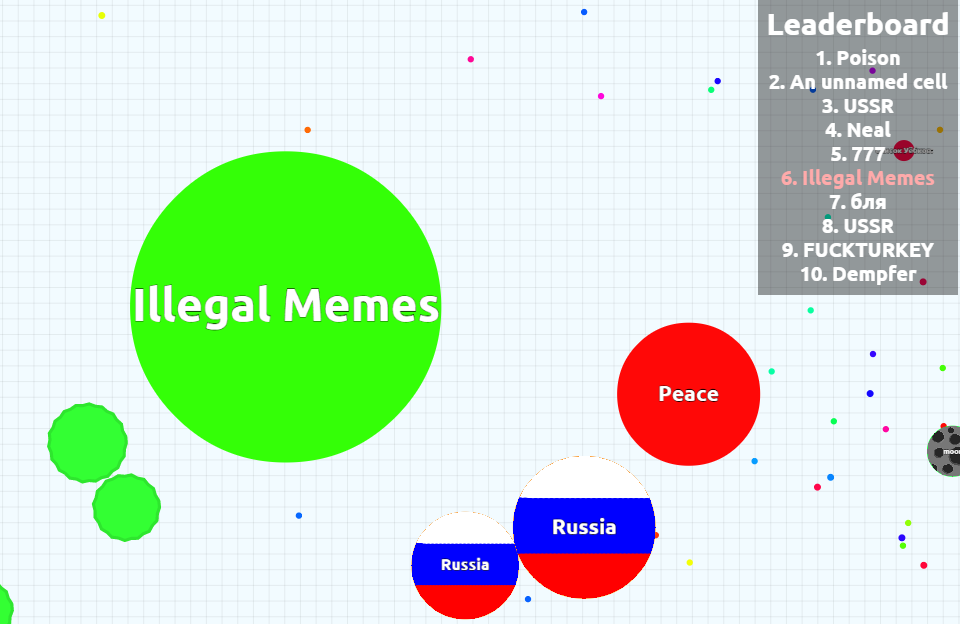
Agar.io's significance lies in its rapid, largely organic rise to popularity and its influence on the genre of '.io games'. Valadares never marketed the game outside a single post on 4chan; its success is attributed to online content creators such as YouTubers and Twitch streamers. By March 2016, Agar.io videos reached two billion views on YouTube. The game inspired similar web games called '.io games', including those with different characters or elements from other genres like shooters. Critics praised its simplicity, competition, and mechanics, while criticism targeted its repetitive gameplay and mobile controls. The ability to choose usernames and skins allowed players to declare support for geopolitical causes, which some commentators argued was a key reason for its success. Miniclip later improved moderation and removed certain offensive skins.
Did You Know?
- PewDiePie, who then had over 42 million subscribers, called Agar.io his 'new favourite game' in May 2015.
- In the weeks leading up to the June 2015 Turkish general election, players using names related to Turkish politics were prevalent and often cooperated against other political parties.
Origins & Development
Agar.io was born from the work of Matheus Valadares, a nineteen-year-old Brazilian programmer who built the game using JavaScript and C++. Rather than launching through traditional channels, Valadares shared an IP address on the 4chan /v/ board and game development forums for playtesting before officially releasing the title on the agar.io domain on April 28, 2015. The name itself is a nod to agar, the gel-like substance scientists use to culture bacteria in petri dishes—a fitting reference for a game where players grow circular cells on a dish-shaped map. During development, Valadares considered layering in more complex biological systems such as photosynthesis and mitochondria, but ultimately chose to strip the experience down to its bare, intuitive mechanics. To keep the servers running, the browser version relied on in-game advertisements to cover hosting costs. He also created an experimental mode specifically as a sandbox for testing new features before they might reach the main game.
Viral Explosion & the Creator Economy
What makes Agar.io's rise to fame remarkable is that it received virtually no formal marketing. Valadares's only promotional effort was his single post on 4chan, where early players even organized into cartels to dominate the in-game leaderboard. The true engine behind the game's explosion was organic word-of-mouth spreading across social networks, amplified enormously by online content creators. Just one week after launch, the YouTube channel Vinesauce posted a gameplay video. Then on May 30, PewDiePie—who already commanded over 42 million subscribers—uploaded the first of nine Agar.io videos, calling it his new favourite game. Notably, he acknowledged that his audience had been begging for the video for some time, meaning the game had already achieved a grassroots buzz before his endorsement. Dedicated Agar.io YouTubers saw their subscriber counts surge rapidly. By March 2016, Agar.io-related videos had accumulated two billion views on YouTube. Critics and commentators attributed the phenomenon to the game's free, browser-based accessibility and the deeply addictive loop of its simple, intuitive mechanics.
Gameplay Mechanics & Strategy
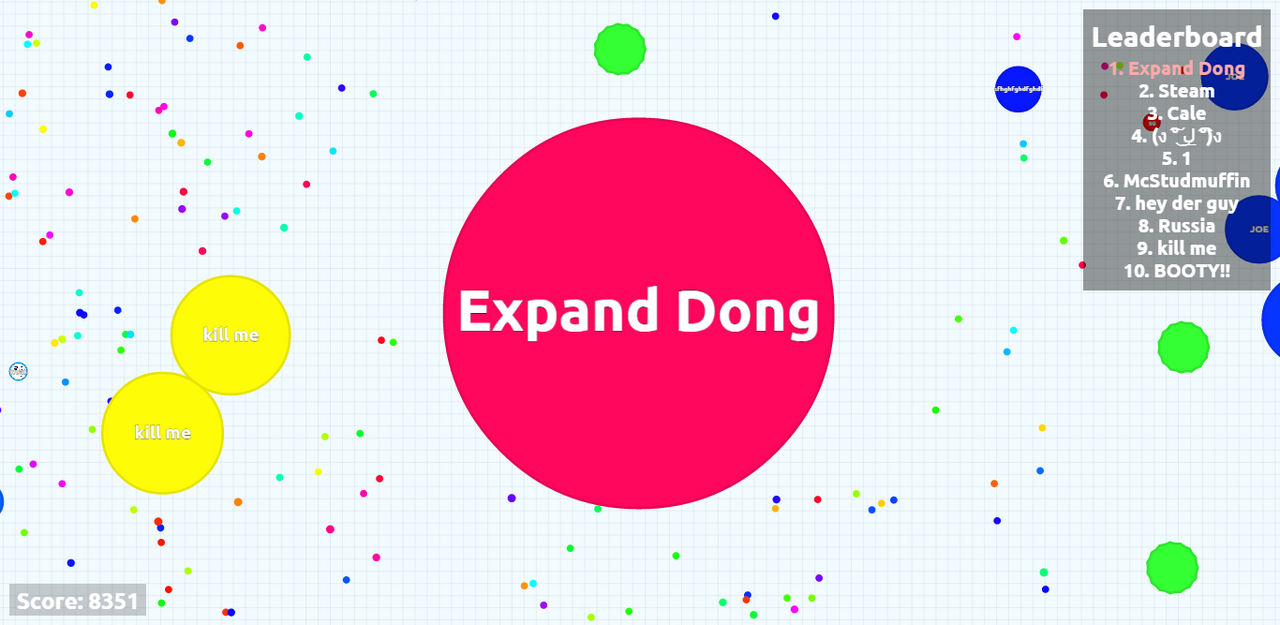
At its core, Agar.io asks players to grow a circular cell by consuming randomly generated food pellets and any player cells smaller than their own, while dodging anything larger. A key strategic layer is splitting: once a cell reaches sufficient mass, a player can divide it in two, shooting one half toward the cursor with the space bar. This can serve as a ranged attack to swallow smaller cells or as a quick escape. Players can maintain up to 16 cells simultaneously, and split cells merge back together if a larger same-owner cell consumes them. Green spiky viruses add chaos—eating one splits your cell into many vulnerable fragments—but players can hide beneath them if small enough, or feed them mass to push them toward an enemy. Red viruses, exclusive to Experimental and Battle Royale modes, spit out food equivalent to the mass of any cell under 200 that they consume, and reward the eater with 200 mass instead of the standard 100. Cells also slowly lose mass over time, and heavier cells move more slowly, creating a constant tension between growth and mobility. Releasing a small fraction of mass to feed another player is widely read as a signal of friendly intent.
Mobile Launch & Lasting Legacy
The mobile expansion of Agar.io was a direct result of its staggering browser success. Mobile publisher Miniclip met with Valadares in Lisbon at the end of April 2015, drawn by a game that already boasted five million daily players. Miniclip executive producer Jamie Cason noted that his entire staff had become hooked within a single week. The Android port launched on July 7, 2015, with the iOS version following on July 8. The mobile release hit number one on the App Store in the United States, the United Kingdom, and thirty-two additional countries. Beyond its own commercial triumph, Agar.io left a structural mark on the gaming landscape: it essentially spawned the entire .io web-game genre, inspiring titles that kept the core eat-and-grow objective while swapping in different characters, as well as games that blended the formula with shooters and other genres. Critics praised the game's simplicity, competitive tension, and elegant mechanics, though some noted the gameplay could feel repetitive over long sessions. As late as 2021, Digital Trends observed that Agar.io still maintained an active core fanbase, a testament to how a free browser game built by a teenager could outlive the typical flash-in-the-pan online trend.
Gallery


Frequently Asked Questions
Who created Agar.io and who publishes it?
Brazilian developer Matheus Valadares designed the game, and Miniclip handles its publication across web and mobile platforms.
What is the core gameplay loop in Agar.io?
You pilot a circular cell around a Petri-dish arena, eating smaller cells and scattered agar to grow while dodging anything bigger than you. The goal is simply to become the largest cell on the map.
When did Agar.io first launch?
The browser version went live on April 28, 2015, followed by an Android port on July 7 and an iOS version on July 8 of the same year.
How did Agar.io become so popular so quickly?
It spread almost entirely through word of mouth on social media and streams on YouTube and Twitch, making it one of the most-played browser and mobile games within its first year.
What genre is Agar.io classified as?
It is a massively multiplayer online game in which thousands of players share the same arena simultaneously, competing to outgrow one another.
More in Social casual games 1-24
Spotted an error? Know more?
Reader corrections go straight into our review queue. Suggest an edit · How this site is sourced