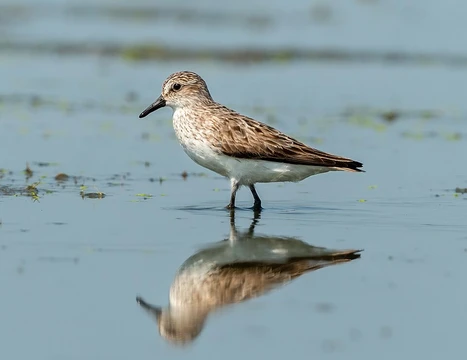
Snowy plover
A small, pale plover of American shores and inland waters.
Last updated
The snowy plover (Anarhynchus nivosus) is a small shorebird of the Americas, belonging to the family Charadriidae. It is one of the best-studied endemic shorebirds of the region and also one of the rarest. Recognized as a distinct species since 2011, it was formerly classified as a subspecies of the Kentish plover.
Scientific classification
- KingdomAnimalia
- PhylumChordata
- ClassAves
- OrderCharadriiformes
- FamilyCharadriidae
- GenusAnarhynchus
- SpeciesAnarhynchus nivosus
Named by (Cassin, 1858)
Close relatives
Other species of Anarhynchus with a Codexery entry.
- Kentish plover Anarhynchus alexandrinus
- Wilson's plover Anarhynchus wilsonia
- Western snowy plover Anarhynchus nivosus nivosus
Sources: Wikipedia taxobox: Snowy plover (CC BY-SA 4.0)
Conservation status
Near Threatened (NT)
- LC
- NT▲ this species
- VU
- EN
- CR
- EW
- EX
Source: IUCN Red List assessment
How big is it?
Largest length in the source, 0.43 m, next to a 1.8 m person.
Diagram: drawn by Codexery, schematic shapes to scale (not a likeness). Length: Wikipedia: Snowy plover
Where the snowy plover has been recorded
Map: drawn by Codexery. Data: Natural Earth basemap (public domain) · place coordinates: Wikipedia (CC BY-SA 4.0)
Taxonomy and systematics
John Cassin first described the snowy plover in 1858 as Aegialitis nivosa, based on a skin collected two years earlier by William P. Trowbridge at Presidio, later part of San Francisco. That holotype was subsequently lost; after being given to Henry E. Dresser in 1872, it apparently never reached the Victoria University of Manchester when his collection was transferred there in 1898. Joseph Grinnell, searching for it in 1931, thought Dresser might have given it away unaware of its importance.
Plovers form the subfamily Charadriinae within Charadriidae, alongside lapwings. The snowy plover was long placed in the genus Charadrius, but a 2013 genetic analysis showed that genus to be polyphyletic, with lapwings nested inside it. Later studies recommended splitting Charadrius into five genera, and in 2023 the International Ornithologists' Union moved the snowy plover to Anarhynchus, a genus that previously held only the wrybill. The name Anarhynchus comes from Ancient Greek elements meaning “ana-” and “rhunkhos”; nivosus is Latin for “snowy”.
A 2015 cladogram indicates its closest relatives include the Kentish, white-fronted, Malaysian, chestnut-banded, and red-capped plovers.
Description
The snowy plover is a plump shorebird with a large head, short neck and tail, and a slender black bill. Adults measure 15–17 cm in length, with a wingspan of 34–43.2 cm and a weight of 40–43 g.
Its body is usually held horizontally; its legs are relatively long for a plover and are gray to black. The plumage is pale brown above and white below, with a white band on the hind neck. Breeding males develop black patches behind the eye, on the sides of the neck, and on the forehead; the neck patches are separated and do not form a continuous breast band.
Females are slightly duller, with some patches partly brown. Outside the breeding season, the patches fade and sexes become indistinguishable. Chicks have pale upper sides with brown to black spots and white underparts. The snowy plover can be told from similar species such as the piping, collared, semipalmated, and Wilson's plovers by its entirely black slender bill, gray to black legs, and broken breast band.
Behavior and ecology
Snowy plovers feed on invertebrates including crustaceans, worms, beetles, and flies. In a California coastal population, beetles occurred in 72% of fecal samples, flies in 44%, and insect larvae in 25%. Prey is taken from the sand surface, below it, from plants, and from carcasses. Foraging is visual: the bird stands briefly, scans, then runs to capture prey.
It also probes the substrate, charges into fly swarms, and uses foot-trembling on wet substrates or shallow water to stir up prey. Brine fly larvae are often shaken before being eaten, and captured flies are bitten two or three times. Foraging occurs both day and night; one individual was observed feeding in near-total darkness. Fresh water is drunk when available, but the plover can survive on the water content of its prey.
At the start of the breeding season, an unpaired male establishes and defends a territory, advertising it to females by calling and excavating scrapes. After chicks hatch, the family moves and defends a surrounding radius rather than a fixed territory. Males use an Upright Display with erected breast feathers to intimidate intruders, and may fight by jumping breast-to-breast, pecking, shoving, and pulling feathers. Fights can last up to 1.5 hours.
Territories are also defended against other bird species such as semipalmated plovers and whimbrels. Territory size ranges from 0.1 to 1 ha.
Status and conservation
The snowy plover is listed as Near Threatened by the IUCN since 2014, due to a moderately rapid population decline from habitat degradation and human disturbance. The global population was estimated at 24,000–31,000 mature individuals as of 2020. The North American population (including juveniles) is about 25,869; the Gulf of Mexico population about 2,500; and the South American population 8,000–10,000.
Coastal habitat loss results from recreational beach use, raking that removes debris and invertebrates, and invasion by European and American beachgrasses that replace native foredune vegetation. Housing and urbanization near beaches also destroy habitat. In Mexico, around Ceuta, the species is affected by mangrove removal, illegal beach development, and mangrove spread into abandoned evaporation ponds that had been used as habitat.
Did You Know?
- Some females desert their brood soon after hatching to re-mate with another male, while the first mate rears the chicks.
- In California, there are 1.4 times as many males as females.
More in Shorebirds
Test yourself
Three questions drawn from this entry’s sources. Pick an answer to check it.
Answers checked against the source article
Sources
Compiled from Wikipedia and the sources listed below. Text from Wikipedia is available under CC BY-SA 4.0; this entry is adapted from it.
- Wikipedia: Snowy plover (CC BY-SA 4.0).
- Conservation status: IUCN Red List assessment.
- Word definitions: the , each quoted from its Wikipedia article.
Spotted an error? Know more?
Reader corrections go straight into our review queue. Suggest an edit · How this site is sourced